Question
A parallel-plate capacitor having plate area $20cm^2$ and separation between the plates 1.00mm is connected to a battery of 12.0V. The plates are pulled apart to increase the separation to 2.0mm.
  1. Calculate the charge flown through the circuit during the process.
  2. How much energy is absorbed by the battery during the process?
  3. Calculate the stored energy in the electric field before and after the process.
  4. Using the expression for the force between the plates, find the work done by the person pulling the plates apart.
  5. Show and justify that no heat is produced during this transfer of charge as the separation is increased.
Answer

Area = $a = 20cm^2 = 2 \times 10^{-2}m^2$ d = Separation = $1mm = 10^{-3}m$
$\text{C}_{\text{i}}=\frac{\in_0\times2\times10^{-3}}{10^{-3}}=2\in_0$
$\text{C}_{\text{f}}=\frac{\in_0\times2\times10^{-3}}{2\times10^{-3}}=\in_0$
$\text{q}_{\text{i}}=24\in_0$
$\text{q}_{\text{f}}=12\in_0$
  1. So, q flown out $12\in_0.$ i.e., $q_i - q_f$​​​​​​​
So, $q = 12 \times 8.85 \times 10^{-12} = 106.2 \times 10^{-12}C = 1.06 \times 10^{-10}C$​​​​​​​
  1. Energy absorbed by battery during the process
$= q \times v = 1.06 \times 10^{-10}C \times 12$
$= 12.7 \times 10^{-10}J$​​​​​​​
  1. Before the process
$\text{E}_{\text{i}}=\Big(\frac{1}{2}\Big)\times\text{C}_{\text{i}}\times\text{V}^2$
$=\Big(\frac{1}{2}\Big)\times2\times8.85\times10^{-12}\times144$
$=12.7\times10^{-10}\text{J}$
After the force
$\text{E}_{\text{f}}=\Big(\frac{1}{2}\Big)\times\text{C}_{\text{f}}\times\text{V}^2$
$=\Big(\frac{1}{2}\Big)\times8.85\times10^{-12}\times144$
$=6.35\times10^{-10}\text{J}$
  1. Workdone = Force × Distance
$=\frac{1}{2}\frac{\text{q}^2}{\in_0\text{A}}=1\times10^{3}$
$=\frac{1}{2}\times\frac{12\times12\times\in_0\times\in_0\times10^{-3}}{\in_0\times2\times10^{-3}}$
  1. From (c) and (d) we have calculated, the energy loss by the separation of plates is equal to the work done by the man on plate. Hence no heat is produced in transformer.

Need a full question paper?

Generate a complete, print-ready paper with questions like this in minutes — across 16+ boards, with answer keys.

Start Generating Free

Similar questions

What are progressive waves? Explain their construction write their main characteristics.
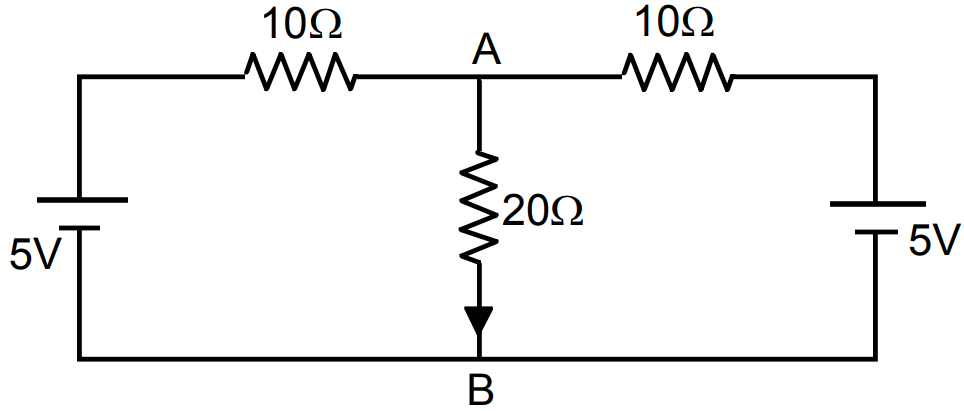
(a) Find the current in the $20\Omega$ resistor shown in the figure. (b) If a capacitor of capacitance $4\mu\text{F}$ is joined between the points A and B, what would be the electrostatic energy stored in it in steady state?
A steel rod $100cm$ long is clamped at its middle. The fundamental frequency of longitudinal vibrations of the rod are given to be $2.53 kHz$. What is the speed of sound in steel?
Two charged particles placed at a separation of 20cm exert 20N of Coulomb force on each other. What will be the force if the separation is increased to 25cm?
$4\times10^{23}$ tritium atoms are contained in a vessel. The half-life of decay tritium nuclei is 12.3y. Find:
  1. The activity of the sample.
  2. The number of decay in the next 10 hours.
  3. The number of decays in the next 6.15y.
A tunnel is dug through the centre of the Earth. Show that a body of mass ‘m’ when dropped from rest from one end of the tunnel will execute simple harmonic motion.
A parallel-plate capacitor of plate area $40cm^2$ and separation between the plates 0.10mm, is connected to a battery of emf 2.0V through a $16\Omega$ resistor. Find the electric field in the capacitor 10ns after the connections are made.
A small block of superdense material has a mass of $3 \times 10^{24}kg$. It is situated at a height h (much smaller than the earth's radius) from where it falls on the earth's surface. Find its speed when its height from the earth's surface has reduced to $\frac{\text{h}}{2}.$ The mass of the earth is $6 \times 10^{24}kg$.
i. What is projectile motion?
ii. The maximum range of projectile is $\frac{2}{\sqrt{3}}$ times actual range. What is the angle of projection for the actual range?
iii. Two balls are thrown with the same initial velocity at angles $\alpha$ and $\left(90^{\circ}-\alpha\right)$ with the horizontal. What will be the ratio of the maximum heights attained by them? When will this ratio be equal to 1 ?
A pipe, $30.0 cm$ long, is open at both ends. Which harmonic mode of the pipe resonates a $1.1 kHz$ source? Will resonance with the same source be observed if one end of the pipe is closed? Take the speed of sound in air as $330 m s ^{-1}$.