Question
What are progressive waves? Explain their construction write their main characteristics.
Answer

SELF

Need a full question paper?

Generate a complete, print-ready paper with questions like this in minutes — across 16+ boards, with answer keys.

Start Generating Free

Similar questions

India has had a long and unbroken tradition of great scholarship-in mathematics, astronomy, linguistics, logic and ethics. Yet, in parallel with this, several superstitious and obscurantistic attitudes and practices flourished in our society and unfortunately continue even today-among many educated people too. How will you use your knowledge of science to develop strategies to counter these attitudes?
Calculate the velocity of transverse waves in a copper wire $1mm^2$ in cross section, under the tension produced by $1kg$ wt. The relative density of copper = $8.93$.
A block of mass 2.0kg kept at rest on an inclined plane of inclination $37^\circ $ is pulled up the plane by applying a constant force of 20N parallel to the incline. The force acts for one second.
  1. Show that the work done by the applied force does not exceed 40J.
  2. Find the work done by the force of gravity in that one second if the work done by the applied force is 40J.
  3. Find the kinetic energy of the block at the instant the force ceases to act. Take $g = 10m/s^2.$
A block of weight $100N$ is slowly slid up on a smooth incline of inclination $37^\circ$ by a person. Calculate the work done by the person in moving the block through a distance of $2.0m$, if the driving force is:
  1. Parallel to the incline.
  2. In the horizontal direction.
To simulate car accidents, auto manufacturers study the collisions of moving cars with mounted springs of different spring constants. Consider a typical simulation with a car of mass $1000 \ kg$ moving with a speed $18.0 \ km / h$ on a smooth road and colliding with a horizontally mounted spring of spring constant $5.25 \times 10^3 N m ^{-1}$. What is the maximum compression of the spring?
Consider the above Example taking the coefficient of friction, $\mu,$ to be $0.5$ and calculate the maximum compression of the spring.
A particle A having a charge of $2.0 \times 10^{-6}C$ is held fixed on a horizontal table. A second charged particle of mass $80g$ stays in equilibrium on the table at a distance of $10cm$ from the first charge. The coefficient of friction between the table and this second particle is $\mu=0.2.$ Find the range within which the charge of this second particle may lie.
A plane is in level flight at constant speed and each of its two wings has an area of $25m^2$. If the speed of the air is $180km/ h$ over the lower wing and $234km/ h$ over the upper wing surface, determine the plane’s mass. (Take air density to be $1kg m^{–3}$).
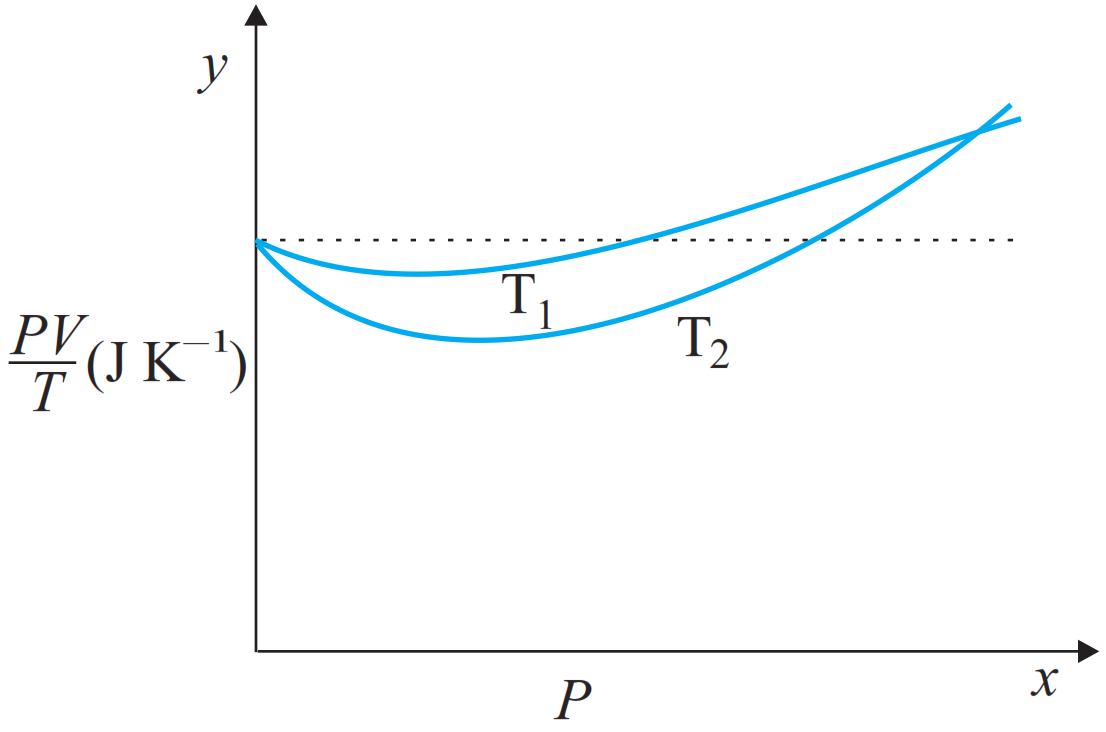
Shows plot of $\frac{\text{PV}}{\text{T}}$ versus P for $1.00 \times 10^{-3}kg$ of oxygen gas at two different temperatures: What is the value of $\frac{\text{PV}}{\text{T}}$ where the curves meet on the y-axis?
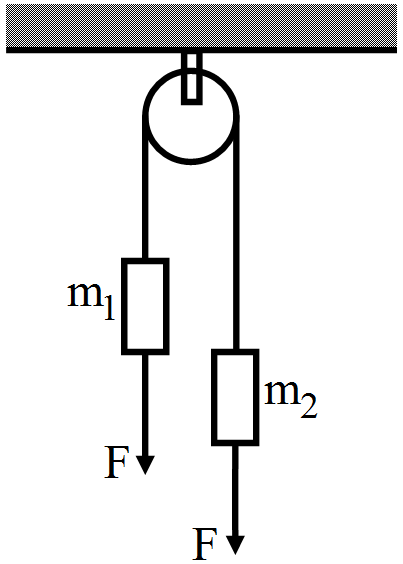
In figure $m_1 = 5kg, m_1 = 2kg$ and $F = 1N$. Find the acceleration of either block. Describe the motion of $m_1$ if the string breaks but F continues to act.
A body is in translational equilibrium under the action of coplanar forces. If the torque of these forces is zero about a point, is it necessary that it will also be zero about any other point?