Question
A parallel-plate capacitor having plate area 20cm2 and separation between the plates 1.00mm is connected to a battery of 12.0V. The plates are pulled apart to increase the separation to 2.0mm.
  1. Calculate the charge flown through the circuit during the process.
  2. How much energy is absorbed by the battery during the process?
  3. Calculate the stored energy in the electric field before and after the process.
  4. Using the expression for the force between the plates, find the work done by the person pulling the plates apart.
  5. Show and justify that no heat is produced during this transfer of charge as the separation is increased.
Answer

Area = a = 20cm2 = 2 × 10⁻²m2

d = Separation = 1mm = 10-3m

$\text{C}_{\text{i}}=\frac{\in_0\times2\times10^{-3}}{10^{-3}}=2\in_0$

$\text{C}_{\text{f}}=\frac{\in_0\times2\times10^{-3}}{2\times10^{-3}}=\in_0$

$\text{q}_{\text{i}}=24\in_0$

$\text{q}_{\text{f}}=12\in_0$

  1. So, q flown out $12\in_0.$ i.e., qi - qf

So, q = 12 × 8.85 × 10-12 = 106.2 × 10⁻¹²C = 1.06 × 10⁻¹⁰C

  1. Energy absorbed by battery during the process

= q × v = 1.06 × 10-10C × 12

= 12.7 × 10⁻¹⁰J

  1. Before the process

$\text{E}_{\text{i}}=\Big(\frac{1}{2}\Big)\times\text{C}_{\text{i}}\times\text{V}^2$

$=\Big(\frac{1}{2}\Big)\times2\times8.85\times10^{-12}\times144$

$=12.7\times10^{-10}\text{J}$

After the force

$\text{E}_{\text{f}}=\Big(\frac{1}{2}\Big)\times\text{C}_{\text{f}}\times\text{V}^2$

$=\Big(\frac{1}{2}\Big)\times8.85\times10^{-12}\times144$

$=6.35\times10^{-10}\text{J}$

  1. Workdone = Force × Distance

$=\frac{1}{2}\frac{\text{q}^2}{\in_0\text{A}}=1\times10^{3}$

$=\frac{1}{2}\times\frac{12\times12\times\in_0\times\in_0\times10^{-3}}{\in_0\times2\times10^{-3}}$

  1. From (c) and (d) we have calculated, the energy loss by the separation of plates is equal to the work done by the man on plate. Hence no heat is produced in transformer.

Need a full question paper?

Generate a complete, print-ready paper with questions like this in minutes — across 16+ boards, with answer keys.

Start Generating Free

Similar questions

Figure shows a situation similar to the previous problem. All parameters are the same except that a battery of emf $\in$ and a variable resistance R are connected between O and C. The connecting wires have zero resistance. No external force is applied on the rod (except gravity, forces by the magnetic field and by the pivot). In what way should the resistance R be changed so that the rod may rotate with uniform angular velocity in the clockwise direction? Express your answer in terms of the given quantities and the angle $\theta$ made by the rod OA with the horizontal.

What is electric dipole? Find and expression for electric potential at any point due to an electric dipole.
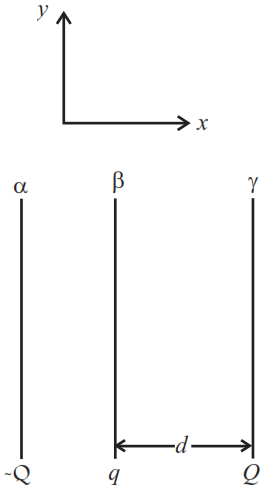
Two fixed, identical conducting plates $(\alpha\ \&\ \beta)$, each of surface area S are charged to -Q and q, respectively, where Q > q > 0. A third identical plate $(\gamma)$, free to move is located on the other side of the plate with charge q at a distance d (Fig.). The third plate is released and collides with the plate $\beta$. Assume the collision is elastic and the time of collision is sufficient to redistribute charge amongst $\beta\ \&\ \gamma$.

Find the electric field acting on the plate $\gamma$ before collision.
The two blocks in an Atwood machine have masses 2.0kg and 3.0kg. Find the work done by gravity during the fourth second after the system is released from rest.
Consider the situation of the previous problem. The man has to reach the other shore at the point directly opposite to his starting point. If he reaches the other shore somewhere else, he has to walk down to this point. Find the minimum distance that he has to walk.
Two samples A and B, of the same gas have equal volumes and pressures. The gas in sample A is expanded isothermally to double its volume and the gas in B is expanded adiabatically to double its volume. If the work done by the gas is the same for the two cases, show that $\gamma$ satisfies the equation $1-2^{1-\gamma}=(\gamma-1)\text{ln}2.$
If light passes near a massive object, the gravitational interaction causes a bending of the ray. This can be thought of as happening due to a change in the effective refrative index of the medium given by
$\text{n}(\text{r})=1+2\frac{\text{GM}}{\text{rc}^2}$
where r is the distance of the point of consideration from the centre of the mass of the massive body, G is the universal gravitational constant, M the mass of the body and c the speed of light in vacuum. Considering a spherical object find the deviation of the ray from the original path as it grazes the object.
Figure. shows a conductor of length l with a circular cross-section. The radius of the cross-section varies linearly from a to b. The resistivity of the material is ρ. Assuming that b - a << l, find the resistance of the conductor.

Suppose the $19\Omega$ resistor of the previous problem is disconnected. Find the current through P2Q2 in the two situations:
  1. Both the wires move towards right.
  2. If P1Q1 moves towards left but P2Q2 moves towards right.
Define magnifying power of a telescope. Write its expression.
A small telescope has an objective lens of focal length 150 cm and an eye piece of focal length 5 cm. If this telescope is used to view a 100m high tower 3 km away, find the height of the final image when it is formed 25 cm away from the eye piece.