Question
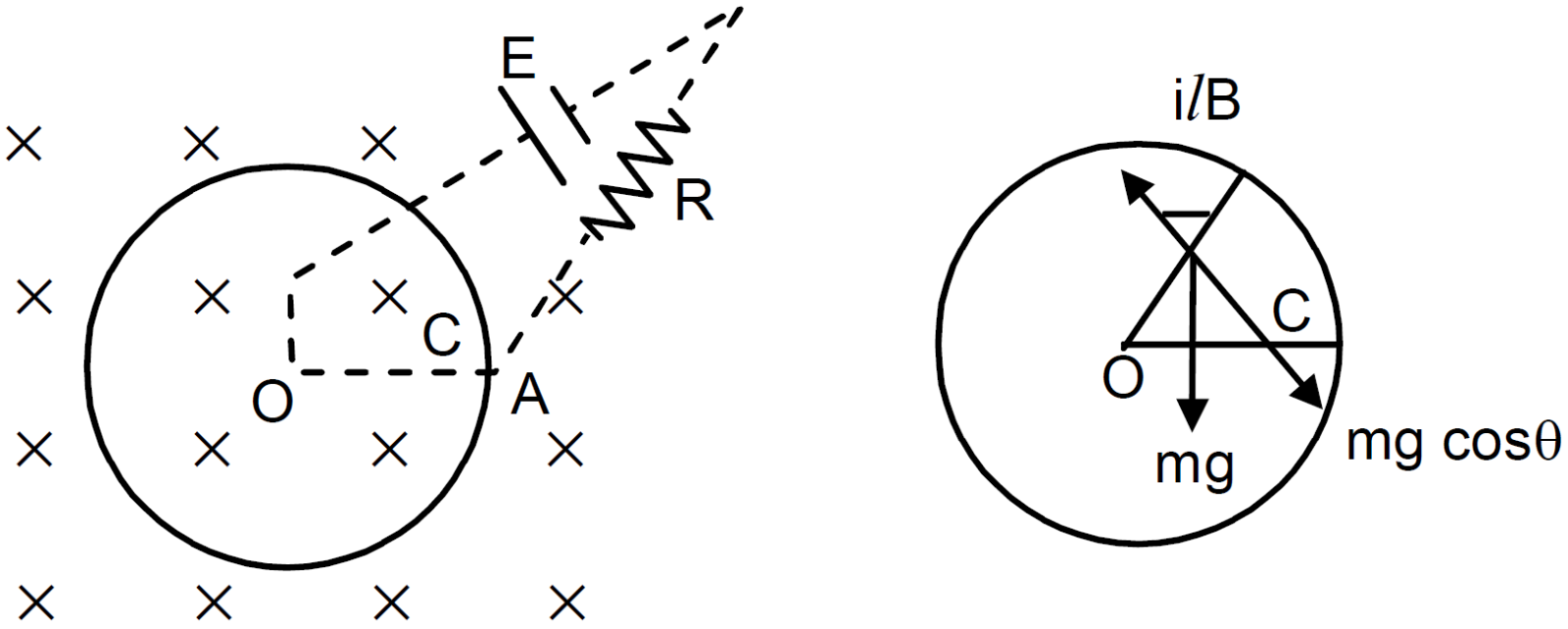
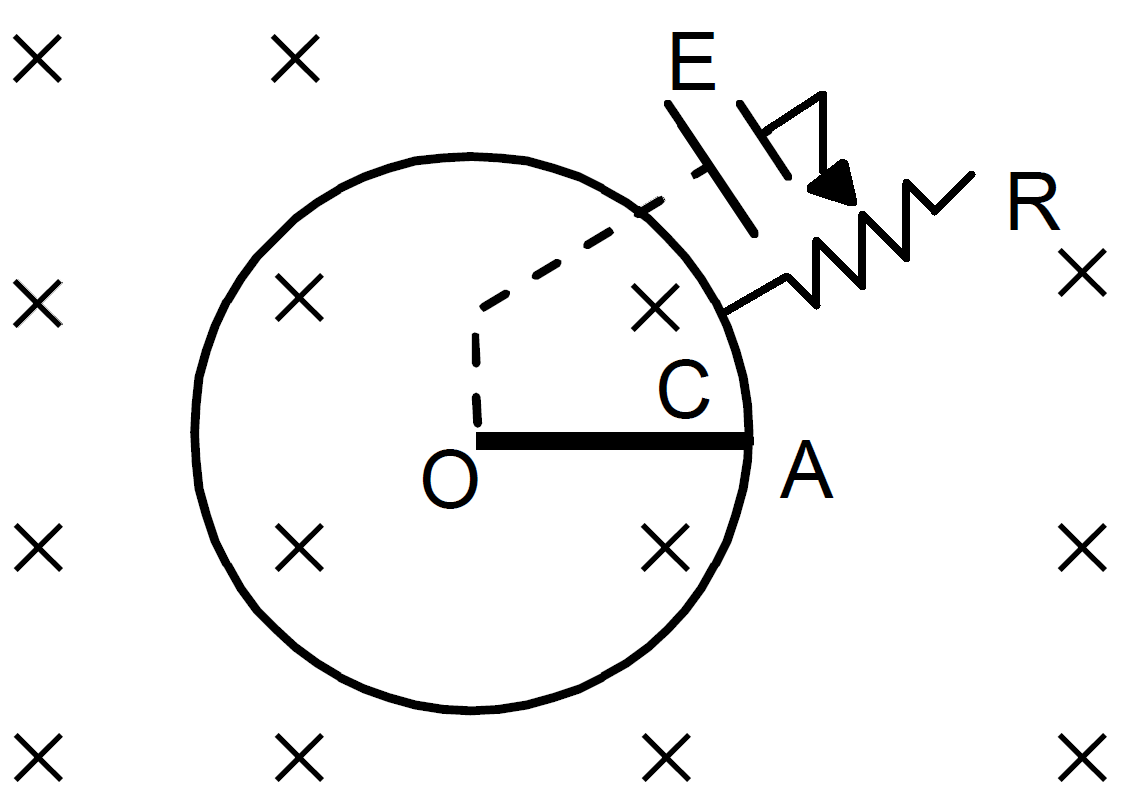
Figure shows a situation similar to the previous problem. All parameters are the same except that a battery of emf $\in$ and a variable resistance R are connected between O and C. The connecting wires have zero resistance. No external force is applied on the rod (except gravity, forces by the magnetic field and by the pivot). In what way should the resistance R be changed so that the rod may rotate with uniform angular velocity in the clockwise direction? Express your answer in terms of the given quantities and the angle $\theta$ made by the rod OA with the horizontal.
Answer


$\text{emf}=\frac{1}{2}\text{B}\omega\text{a}^2$ [from previous problem]

Current $= \frac{\text{e}+\text{E}}{\text{R}}=\frac{\frac{1}{2}\times\text{B}\omega\text{a}^2+\text{E}}{\text{R}}$

$=\frac{\text{B}\omega\text{a}^2 +2\text{E}}{2\text{R}}$

$\Rightarrow \text{mg} \cos \theta =\text{ilB}$ [Net force acting on the rod is O]

$\Rightarrow \text{mg}\cos\theta =\frac{\text{B}\omega\text{a}^2+2\text{E}}{2\text{R}}\text{a}\times\text{B}$

$\Rightarrow \text{R}=\frac{\big(\text{B}\omega\text{a}^2+2\text{E}\big)\text{ab}}{2\text{mg}\cos\theta}$

Need a full question paper?

Generate a complete, print-ready paper with questions like this in minutes — across 16+ boards, with answer keys.

Start Generating Free

Similar questions

Two convex lenses, each of focal length 10cm, are placed at a separation of 15cm with their principal axes coinciding,
  1. Show that a light beam coming parallel to the principal axis diverges as it comes out of the lens system.
  2. Find the location of the virtual image formed by the lens system of an object placed far away.
  3. Find the focal length of the equivalent lens.
(Note that the sign of the focal length is positive although the lens system actually diverges a parallel beam incident on it).
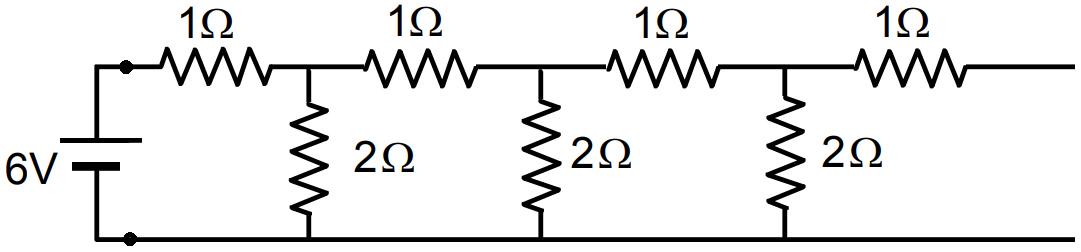
An infinite ladder is constructed with $1\Omega$ and $2\Omega$ resistors, as shown in the figure.

(a) Find the effective resistance between the points A and B. (b) Find the current that passes through the $2\Omega$ resistor nearest to the battery.

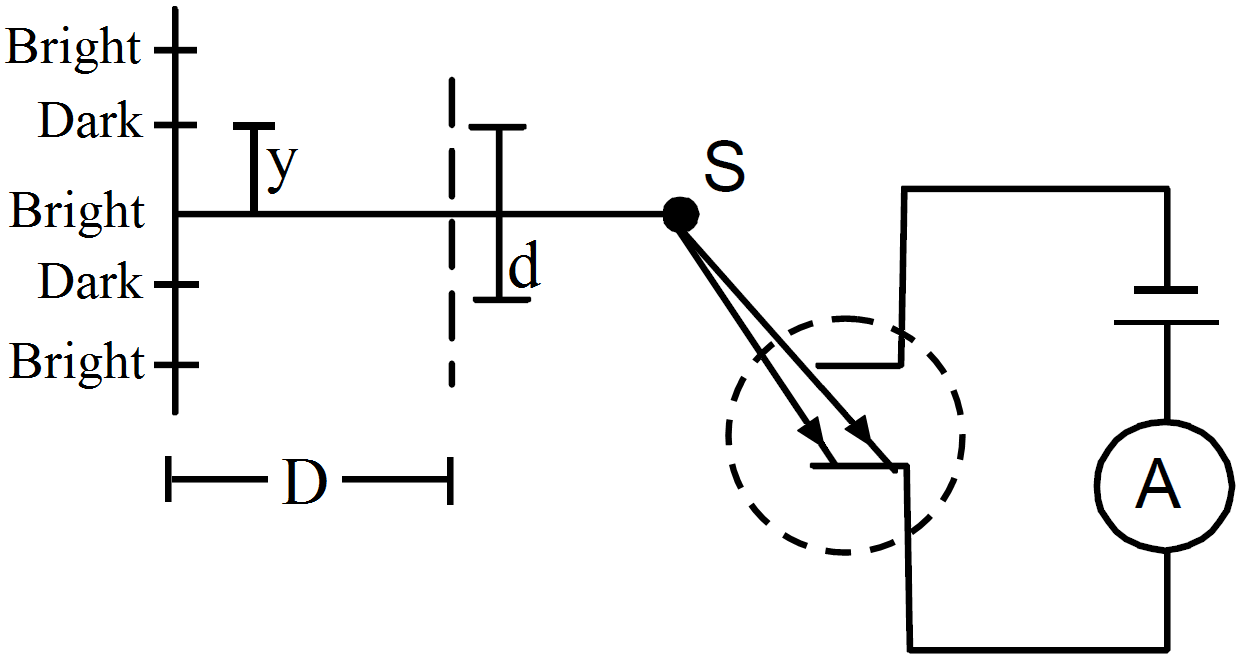
In the arrangement shown in figure y = 1.0mm. d = 0.24mm end D = 1.2m. The work function of the materiel of the emitter is 2.2eV. Find the stopping potential V needed to stop the photocurrent.

What is a transformer? It is of how many types? Explain the principle, construction and working of any transformer.
1MW power is to be delivered from a power station to a town 10km away. One uses a pair of Cu wires of radius 0.5cm for this purpose. Calculate the fraction of ohmic losses to power transmitted if,

  1. Power is transmitted at 220V. Comment on the feasibility of doing this.
  2. A step-up transformer is used to boost the voltage to 11000V, power transmitted, then a step-down transfomer is used to bring voltage to 220V.

$(\rho_\text{Cu}1.7\times10^{-8}\text{SI unit})$.

0.040g of He is kept in a closed container initially at 100.0°C. The container is now heated. Neglecting the expansion of the container, calculate the temperature at which the internal energy is increased by 12J.
If the above capacitor is connected across a 6.0V battery, find:
  1. The charge supplied by the battery.
  2. The induced charge on the dielectric.
  3. The net charge appearing on one of the coated surfaces.
Write the upper and lower limits of interference in terms of path difference.
A copper wire of radius 0.1mm and resistance $1\text{k}\Omega$ is connected across a power supply of 20V.
(a) How many electrons are transferred per second between the supply and the wire at one end? (b) Write down the current density in the wire.
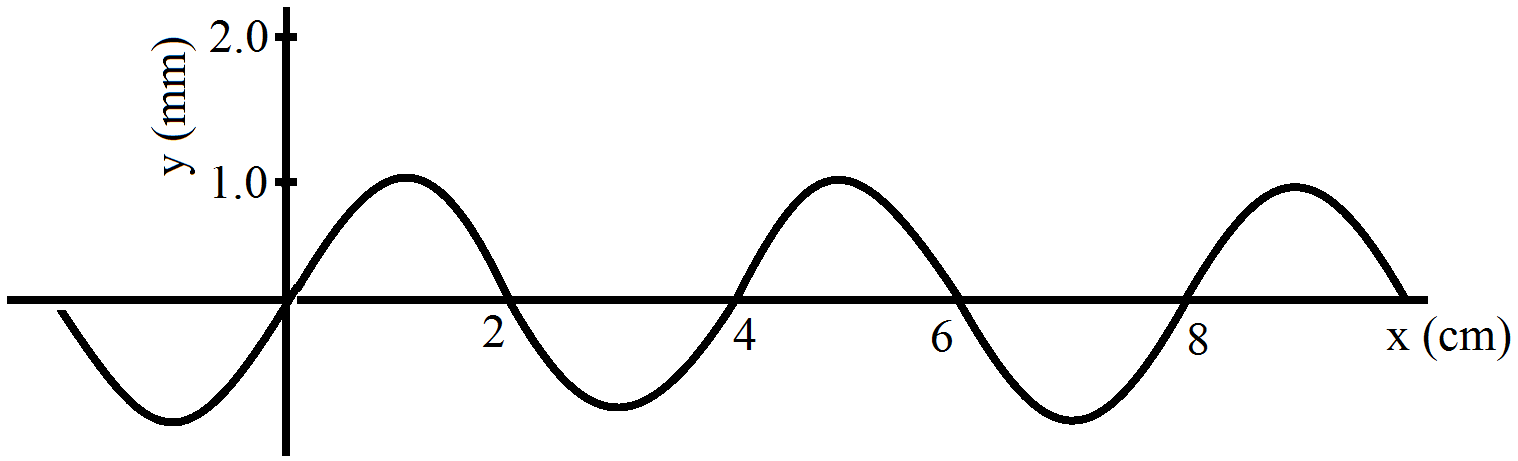
Figure shows a plot of the transverse displacements of the particles of a string at t = 0 through which a travelling wave is passing in the positive x-direction. The wave speed is 20cm/s. Find-

  1. The amplitude
  2. The wavelength
  3. The wave number
  4. The frequency of the wave.