Question
A parallel-plate capacitor having plate area 400cm2 and separation between the plates 1.0mm is connected to a power supply of 100V. A dielectric slab of thickness 1.0mm and dielectric constant 5.0 is inserted into the gap:
  1. Find the increase in electrostatic energy.
  2. If the power supply is now disconnected and the dielectric slab is taken out, find the further increase in energy.
  3. Why does the energy increase in inserting the slab as well as in taking it out?
Answer

A = 400cm2 = 4 × 10⁻²m2
d = 1cm = 1 × 10⁻³m
V = 160V
t = 0.5 = 5 × 10⁻⁴m
k = 5
$\text{C}=\frac{\in_0\text{A}}{\text{d}-\text{t}+\frac{\text{t}}{\text{k}}}$
$=\frac{8.85\times10^{-12}\times4\times10^{-2}}{10^{-3}-5\times10^{-4}+\frac{5\times10^{-4}}{5}}$
$=\frac{35.4\times10^{-4}}{10^{-3}-0.5}$

Need a full question paper?

Generate a complete, print-ready paper with questions like this in minutes — across 16+ boards, with answer keys.

Start Generating Free

Similar questions

If the tension in the cable supporting an elevator is equal to the weight of the elevator, the elevator may be:
  1. Going up with increasing speed.
  2. Going down with increasing speed.
  3. Going up with uniform speed.
  4. Going down with uniform speed.
An electric dipole of dipole moment $\vec{\text{P}}$ is placed in a uniform electric field $\vec{\text{E}}.$ Write the expression for the torque $\vec\tau$ experienced by the dipole. Identify two pairs of perpendicular vectors in the expression. Show diagrammatically the orientation of the dipole in the field for which the torque is (i) Maximum (ii) Half the maximum value (iii) Zero.
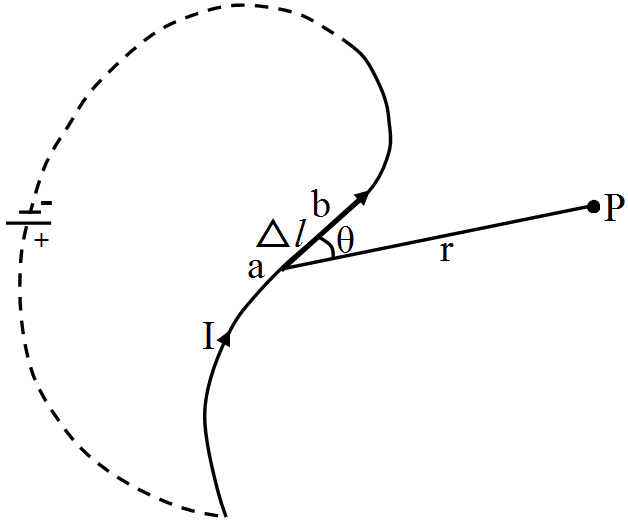
State and explain Biot-Savart law. Use it to derive an expression for the magnetic field produced at a point near a long current carrying wire.

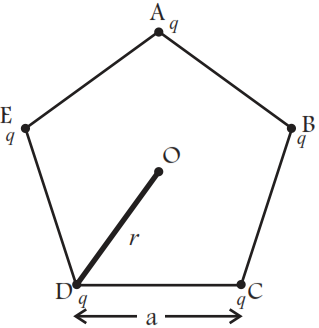
Five charges, q each are placed at the corners of a regular pentagon of side 'a' (Fig.).

  1.  
  1. What will be the electric field at O, the centre of the pentagon?
  2. What will be the electric field at O if the charge from one of the corners (say A) is removed?
  3. What will be the electric field at O if the charge q at A is replaced by -q?
  1. How would your answer to (a) be affected if pentagon is replaced by n-sided regular polygon with charge q at each of its corners?
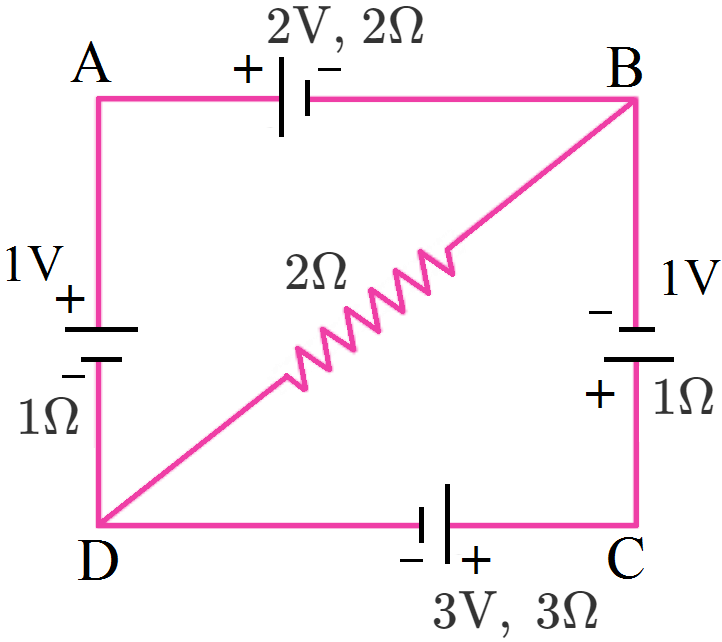
For the circuit shown here, calculate the potential difference between points B and D.

A uniform chain of mass M and length L is held vertically in such a way that its lower end just touches the horizontal floor. The chain is released from rest in this position. Any portion that strikes the floor comes to rest. Assuming that the chain does not form a heap on the floor, calculate the force exerted by it on the floor when a length x has reached the floor.
  1. Write the expression for the force, $\overrightarrow{\text{F}}$, acting on a charged particle of charge 'q', moving with a velocity$\overrightarrow{\text{v}}$ in the presence of both electric field $\overrightarrow{\text{E}}$and magnetic field $\overrightarrow{\text{B}}.$ Obtain the condition under which the particle moves undeflected through the fields.
  2. A rectangular loop of size l x b carrying a steady current I is placed in a uniform magnetic field $\overrightarrow{\text{B}}.$ Prove that the torque$\overrightarrow{\tau}$ acting on the loop is given by $\overrightarrow{\tau} =\overrightarrow{\text{m}}\times\overrightarrow{\text{B},}$were $\overrightarrow{\text{m}}$is the magnetic moment of the loop.
  1. Using Gauss Theorem show mathematically that for any point outside the shell, the field due to a uniformly charged spherical shell is same as the entire charge on the shell, is concentrated at the centre.
  2. Why do you expect the electric field inside the shell to be zero according to this theorem?

OR

A thin conducting spherical shell of radius R has charge Q spread uniformly over its surface. Using Gauss’s theorem, derive an expression for the electric field at a point outside the shell.

Draw a graph of electric field E(r) with distance r from the centre of the shell for $0\leq\text{r}\le\infty.$

OR

Find the electric field intensity due to a uniformly charged spherical shell at a point (i) outside the shell and (ii) inside the shell. Plot the graph of electric field with distance from the centre of the shell.

OR

Using Gauss’s law obtain the expression for the electric field due to a uniformly charged thin spherical shell of radius R at a point outside the shell. Draw a graph showing the variation of electric field with r, for r > R and r < R.

Consider the situation shown in figure. Suppose a small electric field E exists in the space in the vertically upward direction and the upper block carries a positive charge Q on its top surface. The friction coefficient between the two blocks is g but the floor is smooth. What maximum horizontal force F can be applied without disturbing the equilibrium?
[Hint: The force on a charge Q by the electric field E is F = QE in the direction of E.]
A 4µF capacitor is charged by a 200V supply. It is then disconnected from the supply, and is connected to another uncharged 2µF capacitor. How much electrostatic energy of the first capacitor is lost in the form of heat and electromagnetic radiation?