Question
A parallel-plate capacitor having plate area $400cm^2$ and separation between the plates 1.0mm is connected to a power supply of 100V. A dielectric slab of thickness 1.0mm and dielectric constant 5.0 is inserted into the gap:
  1. Find the increase in electrostatic energy.
  2. If the power supply is now disconnected and the dielectric slab is taken out, find the further increase in energy.
  3. Why does the energy increase in inserting the slab as well as in taking it out?
Answer

$A = 400cm^2 = 4 \times 10^{-2}m^2$
$d = 1cm = 1 \times 10^{-3}m$
$V = 160V$
$t = 0.5 = 5 \times 10^{-4}m$
$k = 5$
$\text{C}=\frac{\in_0\text{A}}{\text{d}-\text{t}+\frac{\text{t}}{\text{k}}}$
$=\frac{8.85\times10^{-12}\times4\times10^{-2}}{10^{-3}-5\times10^{-4}+\frac{5\times10^{-4}}{5}}$
$=\frac{35.4\times10^{-4}}{10^{-3}-0.5}$

Need a full question paper?

Generate a complete, print-ready paper with questions like this in minutes — across 16+ boards, with answer keys.

Start Generating Free

Similar questions

If the outer coil of the previous problem is rotated through 90° about a diameter, what would be the magnitude of the magnetic field B at the centre?
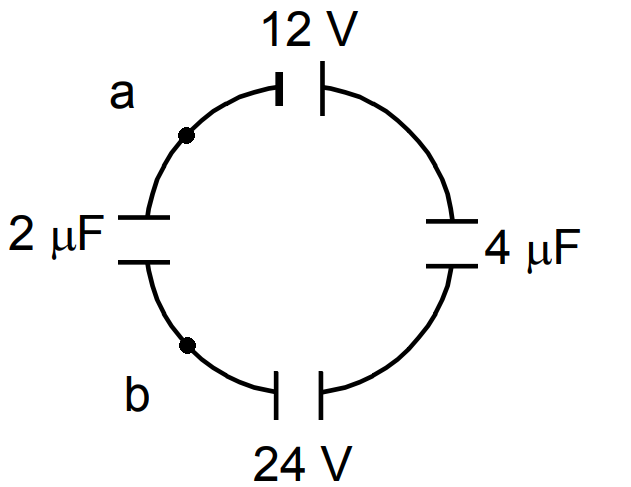
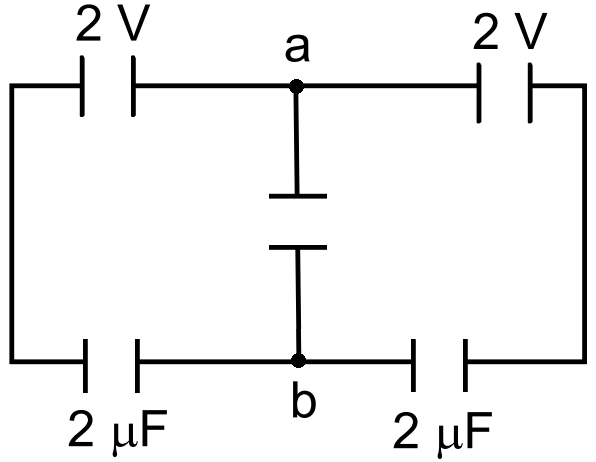
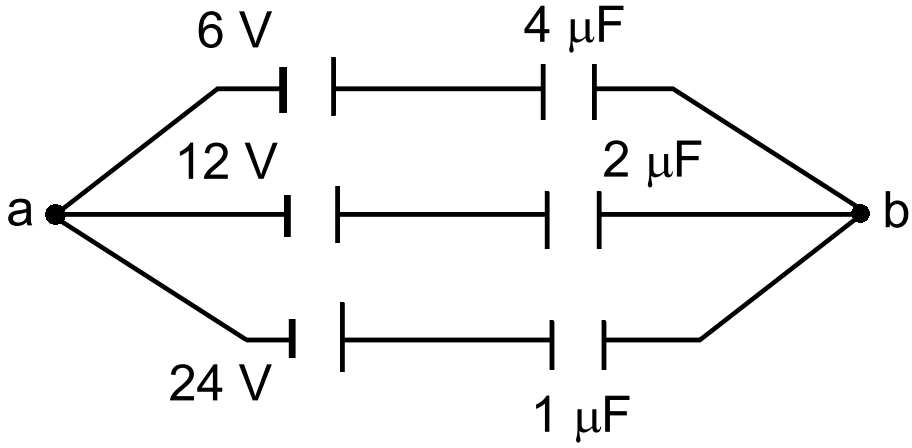
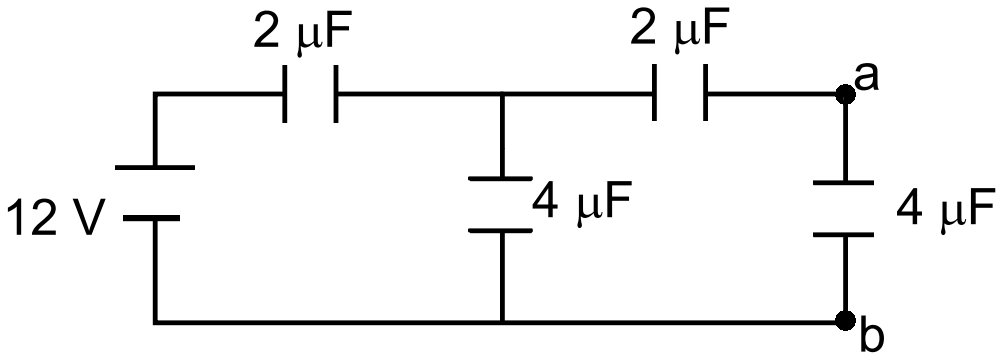
Find the potential difference $V_a - V_b$ between the points a and b shown in each part of the figure.


A gas is initially at a pressure of 100kPa and its volume is $2.0m^3.$ Its pressure is kept constant and the volume is changed from $2.0m^3$ to $2.5m^3$. Its volume is now kept constant and the pressure is increased from 100kPa to 200kPa. The gas is brought back to its initial state, the pressure varying linearly with its volume.
  1. Whether the heat is supplied to or extracted from the gas in the complete cycle?
  2. How much heat was supplied or extracted?
0.040g of He is kept in a closed container initially at 100.0°C. The container is now heated. Neglecting the expansion of the container, calculate the temperature at which the internal energy is increased by 12J.
Two parallel wires seprated by a distance of 10cm carry currents of 10A and 40A along-the same direction. Where should a third current be placed so that it experiences no magnetic force?
The mixture a pure liquid and a solution in a long vertical column (i.e, horizontal dimensions < < vertical dimensions) produces diffusion of solute particles and hence a refractive index gradient along the vertical dimension. A ray of light entering the column at right angles to the vertical is deviated from its original path. Find the deviation in travelling a horizontal distance d < < h, the height of the column.
A thin prism of angle $6.0^\circ,\omega=0.07$ and $\mu_\text{y}=1.50$ is combined with another thin prism having $\omega=0.08$ and $\mu_\text{y}=1.60.$ The combination produces no deviation in the mean ray.
  1. Find the angle of the second prism.
  2. Find the net angular dispersion produced by the combination when a beam of white light passes through it.
  3. If the prisms are similarly directed, what will be the deviation in the mean ray
  4. Find the angular dispersion in the situation described in (c).
A capacitor of capacitance $5.00\mu\text{F}$ is charged to 24.0V and another capacitor of capacitance $6.0\mu\text{F}$ is charged to 12.0V:
  1. Find the energy stored in each capacitor.
  2. The positive plate of the first capacitor is now connected to the negative plate of the second and vice versa. Find the new charges on the capacitors.
  3. Find the loss of electrostatic energy during the process.
  4. Where does this energy go?
Ten positively charged particles are kept fixed on the x-axis at points $x = 10cm, 20cm, 30cm, ..., 100cm$. The first particle has a charge $1.0 \times 10^{-8}C$, the second $8 \times 10^{-8}C$, the third $27 \times 10^{-8}C$ and so on. The tenth particle has a charge $1000 \times 10^{-8}C$. Find the magnitude of the electric force acting on a 1C charge placed at the origin.
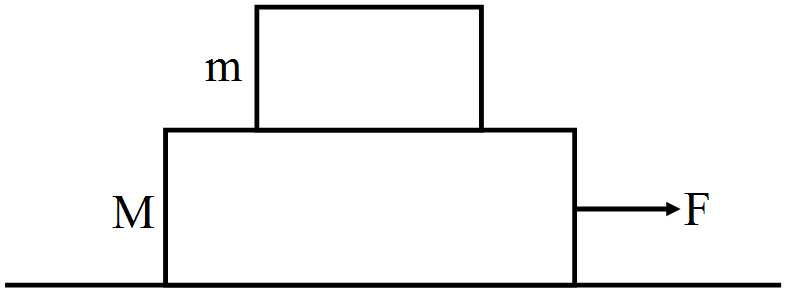
A block of mass m is kept over another block of mass M and the system rests on a horizontal surface figure. A constant horizontal force F acting on the lower block produces an acceleration $\frac{\text{F}}{2(\text{m+M})}$ in the system, the two blocks always move together.
  1. Find the coefficient of kinetic friction between the bigger block and the horizontal surface.
  2. Find the frictional force acting on the smaller block.
  3. Find the work done by the force of friction on the smaller block by the bigger block during a displacement d of the system.