The mixture a pure liquid and a solution in a long vertical column (i.e, horizontal dimensions < < vertical dimensions) produces diffusion of solute particles and hence a refractive index gradient along the vertical dimension. A ray of light entering the column at right angles to the vertical is deviated from its original path. Find the deviation in travelling a horizontal distance d < < h, the height of the column.
Download our app for free and get started
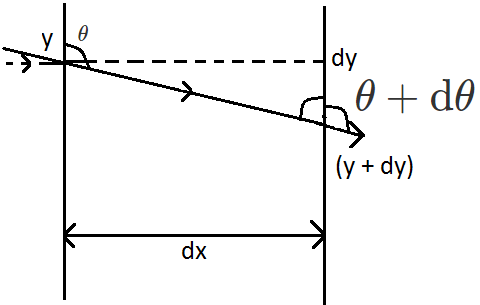
Let us consider a portion of a ray between x and x + dx inside the liquid. Let us suppose the angle of incidence at x be $\theta$ and let it enter the thin column at height y
Because of the bending it shall emerge at x = dx with an angle $\theta+\text{d}\theta$ and at a height y + dy. From Snell's law,
$\mu(\text{y})\sin\theta=\mu(\text{y}+\text{dy})\sin(\theta+\text{d}\theta)$
$\Rightarrow\ \mu(\text{y})\sin\theta=\Big(\mu(\text{y})+\frac{\text{d}\mu}{\text{dy}}\text{dy}\Big)(\sin\theta\cos\text{d}\theta+\cos\theta\sin\text{d}\theta)$
$\big[\because\ \sin(\text{A}+\text{B})=\sin\text{A}\cos\text{B}+\sin\text{B}\cos\text{A}\big]$
Since $\text{d}\theta$ is too small.
Hence, $\cos\text{d}\theta\approx1\text{ and }\text{d}\theta=\text{d}\theta$
$\therefore\ \mu(\text{y})\sin\theta=\Big(\mu(\text{y})+\frac{\text{d}\mu}{\text{dy}}\text{dy}\Big)(\sin\theta+\cos\theta\text{d}\theta)$
$\Rightarrow\ \mu(\text{y})\sin\theta=\mu(\text{y})\sin\theta+\mu(\text{y})\cos\theta\text{d}\theta+\sin\theta\frac{\text{d}\mu}{\text{dy}}\text{dy}+\frac{\text{d}\mu}{\text{dy}}\text{dy}\cos\theta\text{d}\theta$
$\Rightarrow\ \mu(\text{y})\cos\theta\text{d}\theta=-\frac{\text{d}\mu}{\text{dy}}\text{dy}\sin\theta\ \ \bigg[\text{Neglecting}\frac{\text{d}\mu}{\text{dy}}\text{dy}\cos\theta\text{d}\theta\bigg]$
$\Rightarrow\ \text{d}\theta=\frac{-\text{d}\mu}{\mu\text{dy}}\text{dy}\tan\theta$
From the figute, we have $\tan\theta=\frac{\text{dx}}{\text{dy}}$
$\therefore\ \text{d}\theta=\frac{-1\text{d}\mu}{\mu\text{dy}}\text{dx}$
Solving this variable separable from of differential equation, we get
$\therefore\ \theta=\frac{-1\text{d}\mu}{\mu\text{dy}}\int_0^\text{d}\text{dx}=\frac{-1\text{d}\mu}{\mu\text{dy}}\text{d}$
Because of the bending it shall emerge at x = dx with an angle $\theta+\text{d}\theta$ and at a height y + dy. From Snell's law,
$\mu(\text{y})\sin\theta=\mu(\text{y}+\text{dy})\sin(\theta+\text{d}\theta)$
$\Rightarrow\ \mu(\text{y})\sin\theta=\Big(\mu(\text{y})+\frac{\text{d}\mu}{\text{dy}}\text{dy}\Big)(\sin\theta\cos\text{d}\theta+\cos\theta\sin\text{d}\theta)$
$\big[\because\ \sin(\text{A}+\text{B})=\sin\text{A}\cos\text{B}+\sin\text{B}\cos\text{A}\big]$
Since $\text{d}\theta$ is too small.
Hence, $\cos\text{d}\theta\approx1\text{ and }\text{d}\theta=\text{d}\theta$
$\therefore\ \mu(\text{y})\sin\theta=\Big(\mu(\text{y})+\frac{\text{d}\mu}{\text{dy}}\text{dy}\Big)(\sin\theta+\cos\theta\text{d}\theta)$
$\Rightarrow\ \mu(\text{y})\sin\theta=\mu(\text{y})\sin\theta+\mu(\text{y})\cos\theta\text{d}\theta+\sin\theta\frac{\text{d}\mu}{\text{dy}}\text{dy}+\frac{\text{d}\mu}{\text{dy}}\text{dy}\cos\theta\text{d}\theta$
$\Rightarrow\ \mu(\text{y})\cos\theta\text{d}\theta=-\frac{\text{d}\mu}{\text{dy}}\text{dy}\sin\theta\ \ \bigg[\text{Neglecting}\frac{\text{d}\mu}{\text{dy}}\text{dy}\cos\theta\text{d}\theta\bigg]$
$\Rightarrow\ \text{d}\theta=\frac{-\text{d}\mu}{\mu\text{dy}}\text{dy}\tan\theta$
From the figute, we have $\tan\theta=\frac{\text{dx}}{\text{dy}}$
$\therefore\ \text{d}\theta=\frac{-1\text{d}\mu}{\mu\text{dy}}\text{dx}$
Solving this variable separable from of differential equation, we get
$\therefore\ \theta=\frac{-1\text{d}\mu}{\mu\text{dy}}\int_0^\text{d}\text{dx}=\frac{-1\text{d}\mu}{\mu\text{dy}}\text{d}$

Download our appand get started for free
Experience the future of education. Simply download our apps or reach out to us for more information. Let's shape the future of learning together!No signup needed.*
Similar Questions
- 1View SolutionA normal eye has retina 2cm behind the eye-lens. What is the power of the eye-lens when the eye is
- Fully relaxed,
- Most strained?
- 2View SolutionA compound microscope consists of an objective lens of focal length 2.0 cm and an eyepiece of focal length 6.25 cm separated by a distance of 15 cm. How far from the objective should an object be placed in order to obtain the final image at (a) the least distance of distinct vision (25 cm), and (b) at infinity? What is the magnifying power of the microscope in each case?
- 3Two concave mirrors of equal radii of curvature R are fixed on a stand facing opposite directions. The whole system has a mass m and is kept on a frictionless horizontal table.View Solution
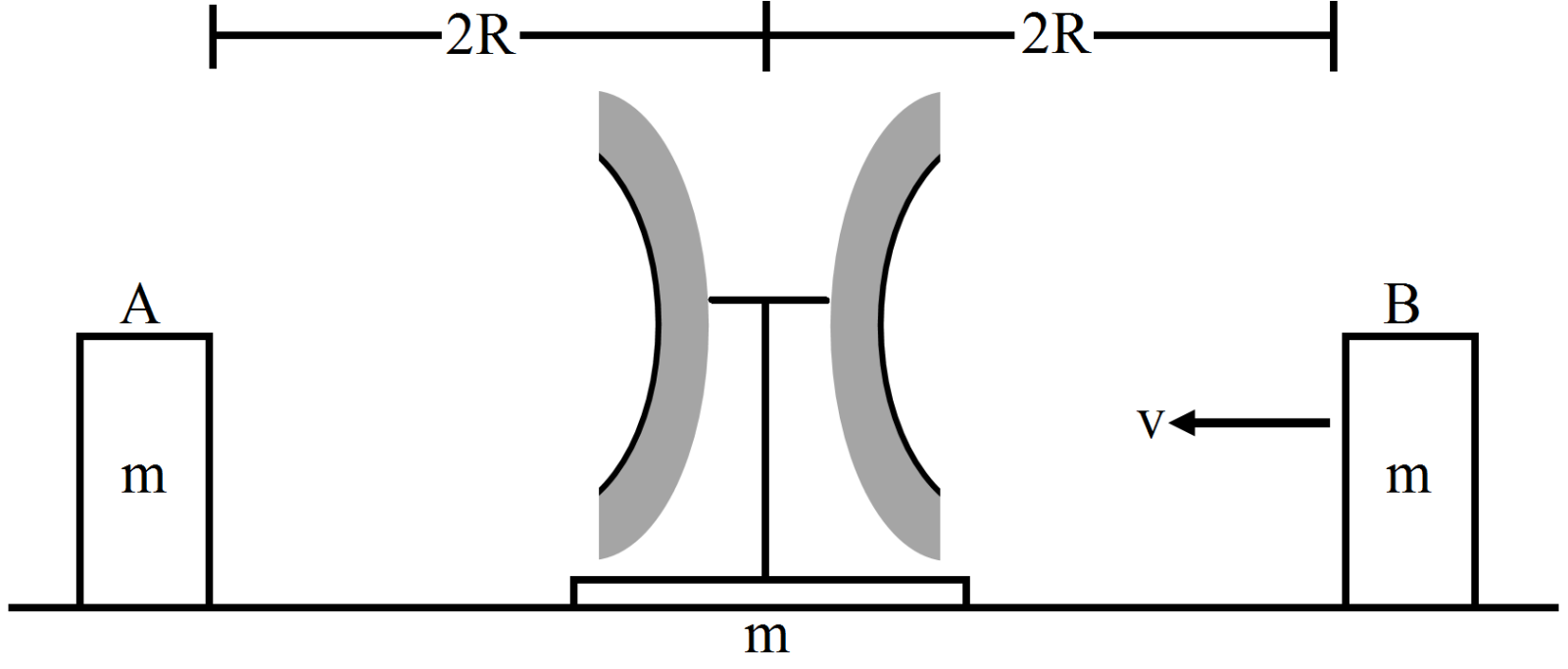
Two blocks A and B, each of mass m, are placed on the two sides of the stand. At t = 0, the separation between A and the mirrors is 2 R and also the separation between B and the mirrors is 2 R. The block B moves towards the mirror at a speed v. All collisions which take place are elastic. Taking the original position of the mirrors-stand system to be x = 0 and X-axis along AB, find the position of the images of A and B at t =- $\frac{\text{R}}{\text{v}}$
- $\frac{3\text{R}}{\text{v}}$
- $\frac{5\text{R}}{\text{v}}$
- 4View Solution
- An object is placed in front of a concave mirror. It is observed that a virtual image is formed. Draw the ray diagram to show the image formation and hence derive the mirror equation $\frac{1}{\text{f}}=\frac{1}{\text{u}}+\frac{1}{\text{v}}.$
- An object is placed 30cm in front of a plano-convex lens with its spherical surface of radius of curvature 20cm. If the refractive index of the material of the lens is 1.5, find the position and nature of the image formed.
- 5View SolutionFigure shows a plane mirror M placed at a distance of 10cm from a concave lens L. A point object is placed at a distance of 60cm from the lens. The image formed due to refraction by the lens and reflection by the mirror is 30cm behind the mirror. What is the focal length of this lens?
- 6A point object 'O' is kept in a medium of refractive index $n_1$ in front of a convex spherical surface of radius of curvature R which separates the second medium of refractive index $n_2$ from the first one, as shown in the figure. Draw the ray diagram showing the image formation and deduce the relationship between the object distance and the image distance in terms of $n_1, n_2$ and R.View Solution
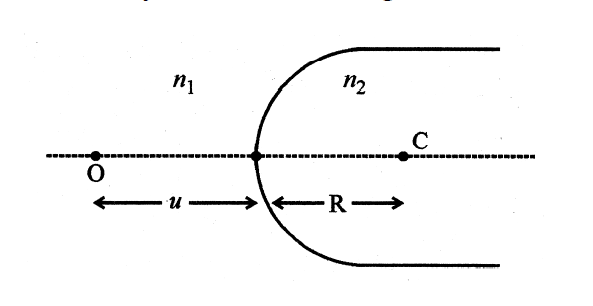
- hen the image formed above acts as a virtual object for concave spherical, surface separating the medium $n_2$ from $n_1 (n_2> n_1),$ draw this ray diagram and write the similar (similar to (a) relation. Hence obtain the expression for the lens maker's formula.
- 7View SolutionA converging lens of focal length 15cm and a converging mirror of focal length 10cm are placed 50cm apart. If a pin of length 2.0cm is placed 30cm from the lens farther away from the mirror, where will the final image form and what will be the size of the final image?
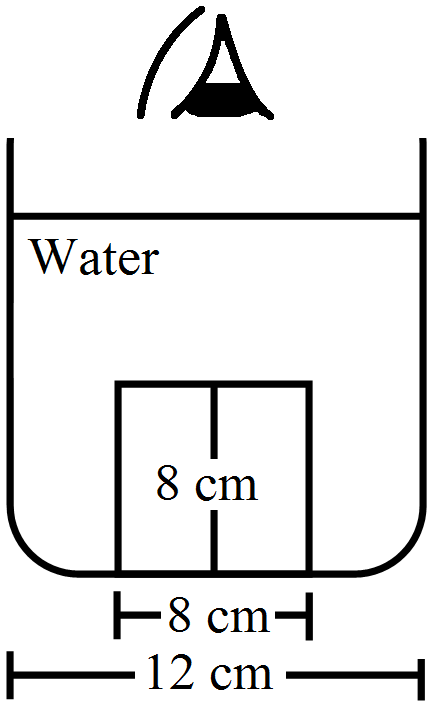
- 8A cylindrical vessel of diameter 12cm contains $800\pi\text{cm}^3$ of water. A cylindrical glass piece of diameter 8.0 cm and height 8.0cm is placed in the vessel. If the bottom of the vessel under the glass piece is seen by the paraxial rays, locate its image. The index of refraction of glass is 1.50 and that of water is 1.33.View Solution
- 9A hemispherical portion of the surface of a solid glass sphere $(\mu=1.5)$ of radius r is silvered to make the inner side reflecting. An object is placed on the axis of the hemisphere at a distance 3r from the centre of the sphere. The light from the object is refracted at the unsilvered part, then reflected from the silvered part and again refracted at the unsilvered part. Locate the final image formed.View Solution
- 10View SolutionA converging lens of focal length 15cm and a converging mirror of focal length 10cm are placed 50cm apart with common principal axis. A point source is placed in between the lens and the mirror at a distance of 40cm from the lens. Find the locations of the two images formed.