MCQ
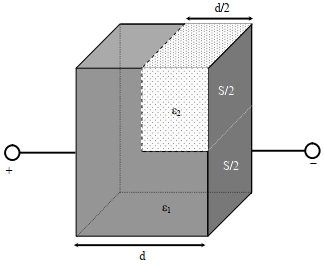
A parallel plate capacitor having plates of area $S$ and plate separation $d$, has capacitance $C _1$ in air. When two dielectrics of different relative permittivities $\left(\varepsilon_1=2\right.$ and $\left.\varepsilon_2=4\right)$ are introduced between the two plates as shown in the figure, the capacitance becomes $C _2$. The ratio $\frac{ C _2}{ C _1}$ is
  • A
    $6 / 5$
  • B
    $5 / 3$
  • C
    $7 / 5$
  • $7 / 3$

Answer

Correct option: D.
$7 / 3$
d
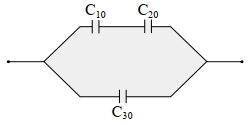
$C _{10}=\frac{4 \varepsilon_0 \frac{ S }{2}}{ d / 2}=\frac{4 \varepsilon_0 S }{ d }$

$C _{20}=\frac{2 \varepsilon_0 S }{ d }, C _{30}=\frac{\varepsilon_0 S }{ d }$

$\frac{1}{ C _{10}^{\prime}}=\frac{1}{ C _{10}}+\frac{1}{ C _{10}}=\frac{ d }{2 \varepsilon_0 S }\left[1+\frac{1}{2}\right]$

$\Rightarrow C _{10}^{\prime}=\frac{4 \varepsilon_0 S }{3 d }$

$C _2= C _{30}+ C _{10}^{\prime}=\frac{7 \varepsilon_0 S }{3 d }$

$\frac{ C _2}{ C _1}=\frac{7}{3}$

Need a full question paper?

Generate a complete, print-ready paper with questions like this in minutes — across 16+ boards, with answer keys.

Start Generating Free

Similar questions

Two uniformly charged spherical conductors $A$ and $B$ of radii $5 mm$ and $10 mm$ are separated by a distance of $2 cm$. If the spheres are connected by a conducting wire, then in equilibrium condition, the ratio of the magnitudes of the electric fields at the surface of the sphere $A$ and $B$ will be .
If in Rutherford’s experiment, the number of particles scattered at ${90^o}$ angle are $28$ per min, then number of scattered particles at an angle ${60^o}$ and ${120^o}$ will be
A bar magnet of magnetic moment $3.0 A- m ^2$ is kept in an uniform magnetic induction of $2 \times 10^{-5} T$. If each pole of the magnet experiences a force of $6 \times 10^{-4} N$, then length of the magnet is :
The surface charge destiny of tin charged disc of radius $R$ is $\sigma$ The value of the electric filed at the centre of the disc is $\frac{\sigma}{2\in_0}$ With reapect to the field the centre the electric field along the axis at distance $R$ from the centre of the disc.
$STATEMENT-1$ For practical purposes, the earth is used as a reference at zero potential in electrical circuits.and

$STATEMENT-2$ The electrical potential of a sphere of radius $R$ with charge $\mathrm{Q}$ uniformly distributed on the surface is given by $\frac{\mathrm{Q}}{4 \pi \varepsilon_0 R}$.

In the figure $ABC$ is the cross section of a right angled prism and $BCDE$ is the cross section of a glass slab. The value of $\theta$ so that light incident normally on the face $AB$ does not cross the face $BC$ is (given $sin^{-1} (3/5) = 37^o)$
$10$ wires (same length, same area, same material) are connected in parallel and each has $1$ $\Omega$ resistance, then the equivalent resistance will be .............. $\Omega$
Unpolarized light falls on two polarizing sheets placed one on top of the other. What must be the angle between the characteristic directions of the sheets if the intensity of the final transmitted light is one-third the maximum intensity of the first transmitted beam.......$^o$
If the ratio of the concentration of electrons to that of holes in a semiconductor is$\frac{7}{5}$ and the ratio of currents is $\frac{7}{4}$ then what is the ratio of their drift velocities?
The reciprocal of resistance is