Question
A parallel plate capacitor is to be designed with a voltage rating 1kV, using a material of dielectric constant 3 and dielectric strength about 107Vm–1. (Dielectric strength is the maximum electric field a material can tolerate without breakdown, i.e., without starting to conduct electricity through partial ionisation.) For safety, we should like the field never to exceed, say 10% of the dielectric strength. What minimum area of the plates is required to have a capacitance of 50pF?
Answer

Potential rating of a parallel plate capacitor, V = 1kV= 1000V

Dielectric constant of a matertal, $\in_{\text{r}}={3}$

Dielectric strength $={10}^{7}\frac{\text{V}}{\text{m}}$

For safety, the field intensity never exceeds 10% of the dielectric strength. Hence, electric field intensity, E = 10% of 107 = 106 $\frac{\text{V}}{\text{m}}$

Capacitance of the parallel plate capacitor, C = 50pf = 50 × 10-12F Distance between the plates is given by,

$\text{d}=\frac{\text{V}}{\text{E}}$

$=\frac{1000}{{10}^{6}}={10}^{-3}\text{m}$

Capacitance i given by the relation,

$\text{C}=\frac{\in_{0}\in_{\text{r}\text{A}}}{\text{d}}$

where,

A = Area of each plate

$\in_{0}$= Permittivity of free space = 8.85 × 10⁻¹² N-1 C2 m-2

$\therefore\ \text{A}=\frac{\text{Cd}}{\in_{0}\in_{\text{r}}}$

$=\frac{{50}\times{10}^{-12}\times{10}^{-3}}{{8.85}\times{10}^{-12}\times{3}}\approx{19}\text{cm}^{2}$

Hence, the area of each plate is about 19cm2.

Need a full question paper?

Generate a complete, print-ready paper with questions like this in minutes — across 16+ boards, with answer keys.

Start Generating Free

Similar questions

For an LCR circuit driven at frequency $\omega$, the equation reads $\text{L}\frac{\text{di}}{\text{dt}}+\text{Ri}+\frac{\text{q}}{\text{C}}=\text{v}_\text{i}=\text{v}_\text{m}\sin\omega\text{t}$.
  1. Multiply the equation by i and simplify where possible.
  2. Interpret each term physically.
  3. Cast the equation in the form of a conservation of energy statement.
  4. Intergrate the equation over one cycle to find that the phase difference between v and i must be acute.
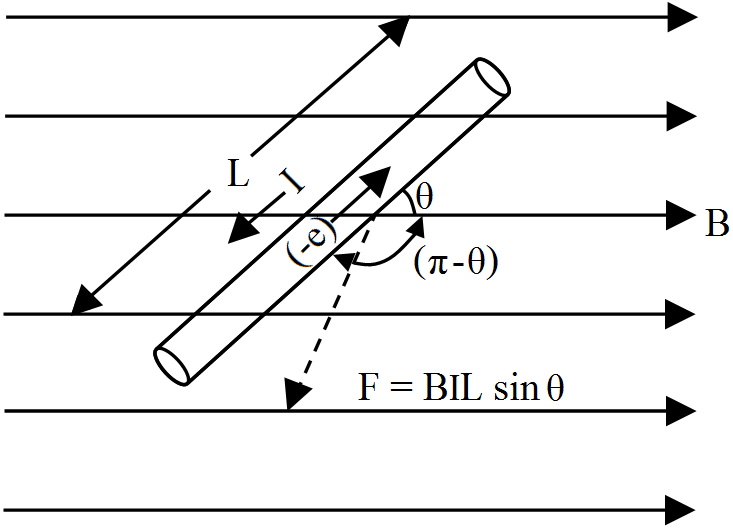
Derive an expression for the force experienced by a current carrying straight conductor placed in a magnetic field. Under what condition is this force maximum?

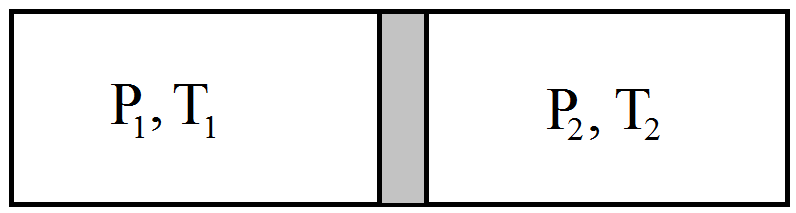
The figure shows an adiabatic cylindrical tube of volume V0 divided in two parts by a frictionless adiabatic separator. Initially, the separator is kept in the middle, an ideal gas at pressure p1 and temperature T1 is injected into the left part and another ideal gas at pressure p2 and temperature T2 is injected into the right part. $\frac{\text{C}_\text{P}}{\text{C}_\text{V}}=\gamma$ is the same for both the gases. The separator is slid slowly and is released at a position where it can stay in equilibrium. Find,

  1. The volumes of the two parts.
  2. The heat given to the gas in the left part.
  3. The final common pressure of the gases.

When a metal plate is exposed to a monochromatic beam of light of wavelength 400nm, a negative potential of 1.1V is needed to stop the photocurrent. Find the threshold wavelength for the metal.
A radioactive isotope has a half-life of T years. How long will it take the activity to reduce to
  1. 3.125%,
  2. 1% of its original value?
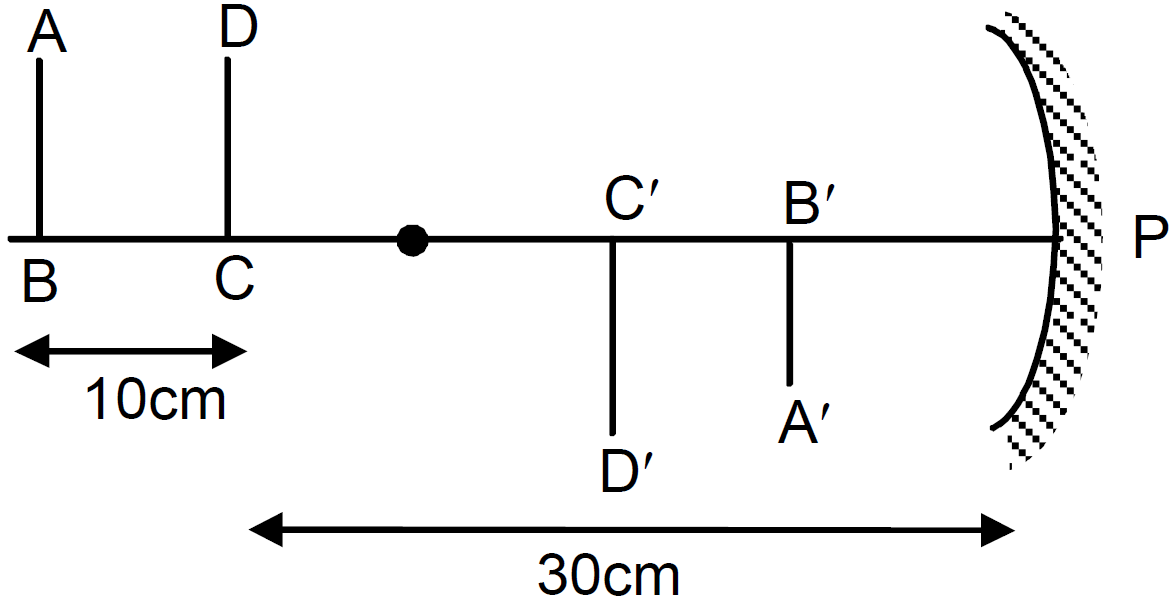
A U-shaped wire is placed before a concave mirror having radius of curvature 20cm. Find the total length of the image.

A capacitor of capacitance $5.00\mu\text{F}$ is charged to 24.0V and another capacitor of capacitance $6.0\mu\text{F}$ is charged to 12.0V:
  1. Find the energy stored in each capacitor.
  2. The positive plate of the first capacitor is now connected to the negative plate of the second and vice versa. Find the new charges on the capacitors.
  3. Find the loss of electrostatic energy during the process.
  4. Where does this energy go?
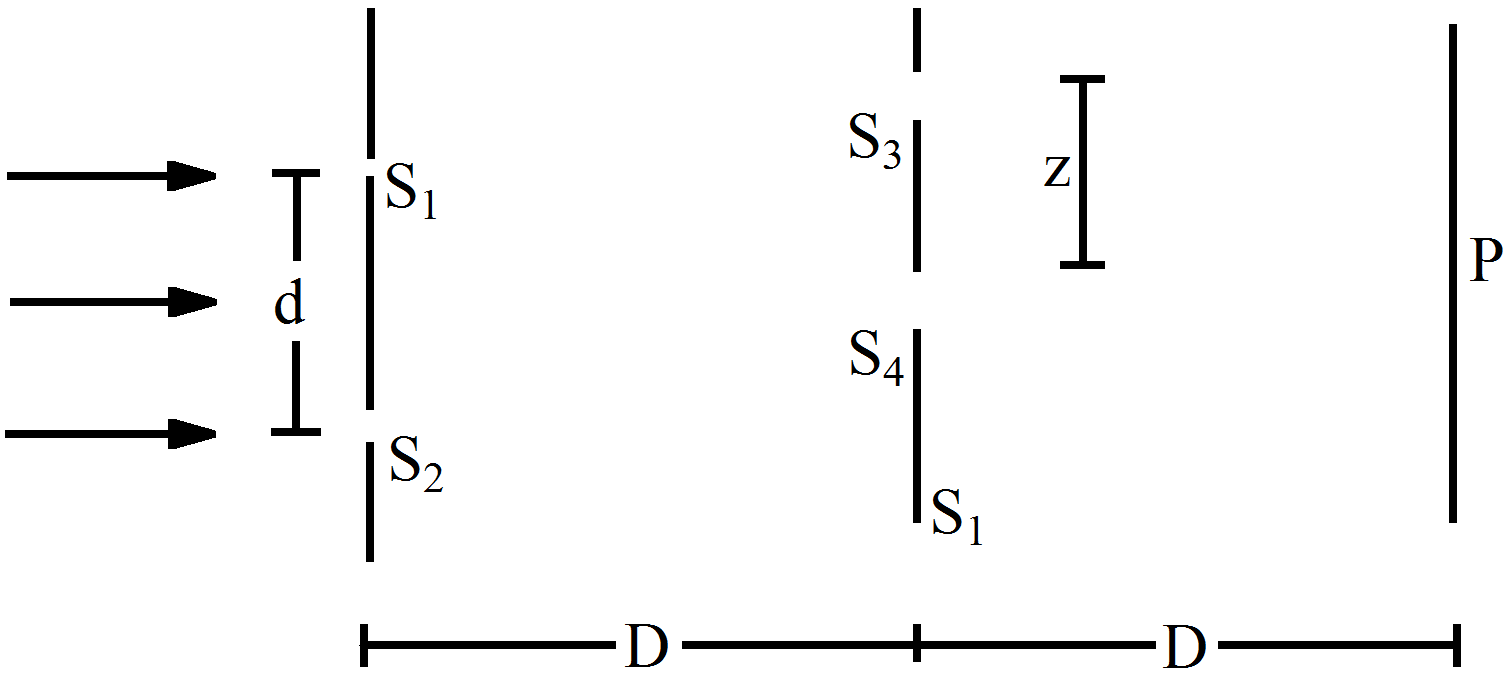
Consider the arrangement shown in figure. By some mechanism, the separation between the slits S3 and S4 can be changed. The intensity is measured at the point P which is at the common perpendicular bisector

of S1S2 and S3S4. When $\text{z}=\frac{\text{D}\lambda}{2\text{d}},$ intensity measured at P is I. Find this intensity when z is equal to:

  1. $\frac{\text{D}\lambda}{\text{d}}$

  2. $\frac{3\text{D}\lambda}{2\text{d}}$

  3. $\frac{2\text{D}\lambda}{\text{d}}$

Shiv had a high tension tower erected on his farm land. He kept complaining to the authorities to remove it since it occupied a large portion of his land. His uncle, who was a teacher, explained to him the need for erecting these towers for efficient transmission of power. As Shiv got convinced and realised significance, he stopped complaining.
Based on the above paragraph, answer the following questions:
  1. Why is it necessary to transport power at high voltages?
  2. ‘A low power factor implies large power loss'. Explain.
  3. Write the two values displayed by Shiv and his Uncle.
A neutron initially at rest, decays into a proton, an electron and an antineutrino. The ejected electron has a momentum of 1.4 × 10⁻²⁶kg-m/s and the antineutrino 6.4 × 10⁻²⁷kg-m/s. Find the recoil speed of the proton:
  1. If the electron and the antineutrino are ejected along the same direction.
  2. If they are ejected along perpendicular directions. Mass of the proton = 1.67 × 10⁻²⁷kg.