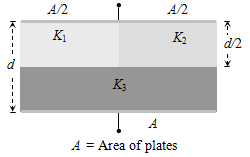
Question

A parallel plate capacitor of area A, plate separation d and capacitance C is filled with three different dielectric materials having dielectric constants  and   as shown. If a single dielectric material is to be used to have the same capacitance C in this capacitor, then its dielectric constant k is given by
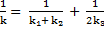
(a)  
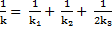
(b)  

(c) k =  

(d)  

Answer

(b)  

Need a full question paper?

Generate a complete, print-ready paper with questions like this in minutes — across 16+ boards, with answer keys.

Start Generating Free

Similar questions

The condition for observing Fraunhofer diffraction from a single slit is that the light wavefront incident on the slit should be

(a) Spherical

(b) Cylindrical

(c) Plane 

(d) Elliptical

The coil of the moving coil galvanometer is wound over an aluminium frame:

Which of the following statements is incorrect about hysteresis

(a) This effect is common to all ferromagnetic substances

(b) The hysteresis loop area is proportional to the thermal energy developed per unit volume of the material

(c) The hysteresis loop area is independent of the thermal energy developed per unit volume of the material

(d) The shape of the hysteresis loop is characteristic of the material

Mark the correct options:

Two condensers of capacities 2C and C are joined in parallel and charged upto potential V. The battery is removed and the condenser of capacity C is filled completely with a medium of dielectric constant K. The p.d. across the capacitors will now be

(a)  

(b)

(c)

(d)

Which of the following graph represents magnetic field (B) versus distance $r$ from the centre of a long straight conducting wire of uniform cross sectional area carrying steady current I and radius $a$ ?

A coil of wire of a certain radius has 600 turns and a self inductance of 108 mH. The self inductance of a 2nd  similar coil of 500 turns will be

(a) 74 mH

(b) 75 mH

(c)  76 mH

(d) 77 mH

The electric field in a region is directed outward and is proportional to the distance r from the origin. Taking the electric potential at the origin to be zero,
Holes are created when:

Thermal neutrons can cause fission in

(a)  

(b)  

(c)  

(d)