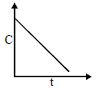
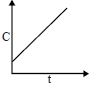
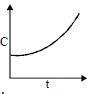
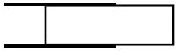
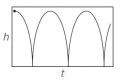
A parallel plate capacitor with a dielectric slab completely occupying the space between the plates is charged by a battery and then disconnected. The slab is pulled out with a constant speed. Which of the following curves represent qualitatively the variation of the capacitance $C$ of the system with time?
Experience the future of education. Simply download our apps or reach out to us for more information. Let's shape the future of learning together!No signup needed.*
Figure shows a solid conducting sphere of radius $1 m$, enclosed by a metallic shell of radius $3 \,m$ such that their centres coincide. If outer shell is given a charge of $6 \,\mu C$ and inner sphere is earthed, find magnitude charge on the surface of inner shell is ............. $\mu C$
Two parallel plate capacitors have their plate areas $100 \,cm ^2$ and $500 \,cm ^2$ respectively. If they have the same charge and potential and the distance between the plates of the first capacitor is $0.5 \,mm$, then the distance between the plates of the second capacitor is ........ $cm$
A capacitor $4\,\mu F$ charged to $50\, V$ is connected to another capacitor of $2\,\mu F$ charged to $100 \,V$ with plates of like charges connected together. The total energy before and after connection in multiples of $({10^{ - 2}}\,J)$ is
The capacity of a condenser is $4 \times {10^{ - 6}}$ farad and its potential is $100\,\,volts$. The energy released on discharging it fully will be.......$Joule$
A parallel plate air capacitor has a capacitance $C$. When it is half filled with a dielectric of dielectric constant $5$, the percentage increase in the capacitance will be.....$\%$
Three capacitors each of $4\,\,\mu F$ are to be connected in such a way that the effective capacitance is $6\,\,\mu F.$ This can be done by connecting thern
A network of four capacitors of capacity equal to $C_1 = C, C_2 = 2C, C_3 = 3C$ and $C_4 = 4C$ are conducted in a battery as shown in the figure. The ratio of the charges on $C_2$ and $C_4$ is
The charge given to a hollow sphere of radius $10\, cm$ is $3.2×10^{-19}\, coulomb$. At a distance of $4\, cm$ from its centre, the electric potential will be
The electric potential varies in space according to the relation $V = 3x + 4y$. A particle of mass $0.1\,\, kg$ starts from rest from point $(2, 3·2)$ under the influence of this field. The charge on the particle is $+1\,\, μC$. Assume $V$ and $(x, y)$ are in $S.I.$ $units$ . The time taken to cross the $x-$ axis is.....$s$