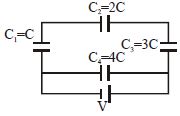
A network of four capacitors of capacity equal to $C_1 = C, C_2 = 2C, C_3 = 3C$ and $C_4 = 4C$ are conducted in a battery as shown in the figure. The ratio of the charges on $C_2$ and $C_4$ is
Diffcult


Download our appand get started for free
Experience the future of education. Simply download our apps or reach out to us for more information. Let's shape the future of learning together!No signup needed.*
Similar Questions
- 1If $4 \times {10^{20}}eV$ energy is required to move a charge of $0.25$ coulomb between two points. Then what will be the potential difference between them......$V$View Solution
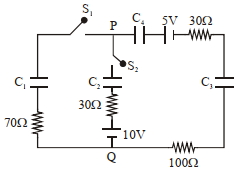
- 2In the circuit shown, initially there is no charge on capacitors and keys $S _1$ and $S _2$ are open. The values of the capacitors are $C _1=10 \mu F , C _2=30 \mu F$ and $C _3= C _4=80 \mu F$.View Solution
Which of the statement($s$) is/are correct ?
$(1)$ The keys $S _1$ is kept closed for long time such that capacitors are fully charged. Now key $S _2$ is closed, at this time, the instantaneous current across $30 \Omega$ resistor (between points $P$ and $Q$ ) will be $0.2 A$
$(2)$ If key $S _1$ is kept closed for long time such that capacitors are fully charged, the voltage difference between points $P$ and $Q$ will be $10 V$.
$(3)$ At time $t =0$, the key $S _1$ is closed, the instantaneous current in the closed circuit will be $25 mA$.
$(4)$ If key $S _1$ is kept closed for long time such that capacitors are fully charged, the voltage across the capacitors $C _1$ will be $4 V$.
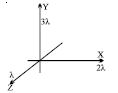
- 3The diagram shows three infinitely long uniform line charges placed on the $X, Y $ and $Z$ axis. The work done in moving a unit positive charge from $(1, 1, 1) $ to $(0, 1, 1) $ is equal toView Solution
- 4A $40$ $\mu F$ capacitor in a defibrillator is charged to $3000\,V$. The energy stored in the capacitor is sent through the patient during a pulse of duration $2\,ms$. The power delivered to the patient is......$kW$View Solution
- 5An electron of mass $m$ and charge $e$ is accelerated from rest through a potential difference $V$ in vacuum. Its final velocity will beView Solution
- 6In free space, a particle $A$ of charge $1\,\mu C$ is held fixed at a point $P.$ Another particle $B$ of the same charge and mass $4\,\mu g$ is kept at a distance of $1\,mm$ from $P$. If $B$ is released, then its velocity at a distance of $9\,mm$ from $P$ is [ Take $\frac{1}{{4\pi {\varepsilon _0}}} = 9 \times {10^9}\,N{m^2}{C^{ - 2}}$ ]View Solution
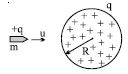
- 7A bullet of mass $m$ and charge $q$ is fired towards a solid uniformly charged sphere of radius $R$ and total charge $+ q$. If it strikes the surface of sphere with speed $u$, find the minimum speed $u$ so that it can penetrate through the sphere. (Neglect all resistance forces or friction acting on bullet except electrostatic forces)View Solution
- 8A capacitor stores $60\ \mu C$ charge when connected across a battery. When the gap between the plates is filled with a dielectric , a charge of $120\ \mu C$ flows through the battery , if the initial capacitance of the capacitor was $2\ \mu F$, the amount of heat produced when the dielectric is inserted.......$\mu J$View Solution
- 9View SolutionA parallel plate capacitor is charged by connecting it to a battery. The battery is disconnected and the plates of the capacitor are pulled apart to make the separation between the plates twice. Again the capacitor is connected to the battery (with same polarity) then
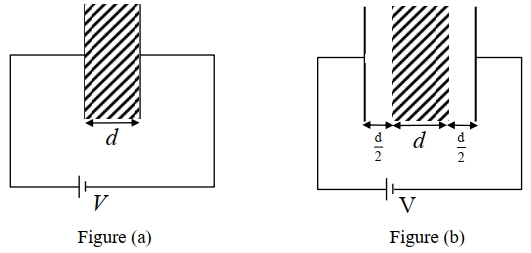
- 10A medium having dielectric constant $K>1$ fills the space between the plates of a parallel plate capacitor. The plates have large area, and the distance between them is $d$. The capacitor is connected to a battery of voltage $V$. as shown in Figure ($a$). Now, both the plates are moved by a distance of $\frac{d}{2}$ from their original positions, as shown in Figure ($b$).View Solution
In the process of going from the configuration depicted in Figure ($a$) to that in Figure ($b$), which of the following statement($s$) is(are) correct?