Question
A parallel$-$plate capacitor with the plate area $100\ cm^2$ and the separation between the plates $1.0\ cm$ is connected across a battery of emf $24$ volts. Find the force of attraction between the plates.

Answer

$A = 100\ cm^2 = 10^{-2}m^2$
$d = 1\ cm = 10^{-2}m$
$V = 24V_0$
$\therefore$ The capacitance $\text{C}=\frac{\epsilon_0\text{A}}{\text{d}}=\frac{8.85\times10^{-12}\times10^{-2}}{10^{-2}}=8.85\times10^{-12}$
$\therefore$ The energy stored $\text{C}_1=\Big(\frac{1}{2}\Big)\text{CV}^2$
$=\Big(\frac{1}{2}\Big)\times10^{-12}\times(24)^2$
$=2548.8\times10^{-12}$
$\therefore$ The forced attraction between the plates $=\frac{\text{C}_1}{\text{d}}=\frac{2548.8\times10^{-12}}{10^{-2}}=2.54\times10^{-7}\text{N.}$

Need a full question paper?

Generate a complete, print-ready paper with questions like this in minutes — across 16+ boards, with answer keys.
Start Generating Free

Similar questions

In an intrinsic semiconductor the energy gap $E_{g}$ is $1.2eV$. Its hole mobility is much smaller than electron mobility and independent of temperature. What is the ratio between conductivity at $600K$ and that at $300K$? Assume that the temperature dependence of intrinsic carrier concentration $n_i$ is given by,
$\text{n}_{\text{i}}=\text{n}_{\text{0}}\ {\text{exp}}\Big(-\frac{\text{E}_\text{g}}{2{\text{K}_{\text{B}}}{\text{T}}}\Big)$
where $n_0$ is a constant.
Using Huygens' principle, draw a diagram to show propagation of a wavefront originating from a monochromatic point source. Explain briefly.
$4 \times 10^{23}$ tritium atoms are contained in a vessel. The half$-$life of decay tritium nuclei is $12.3y$. Find:
  1. The activity of the sample.
  2. The number of decay in the next $10$ hours.
  3. The number of decays in the next $6.15y$.
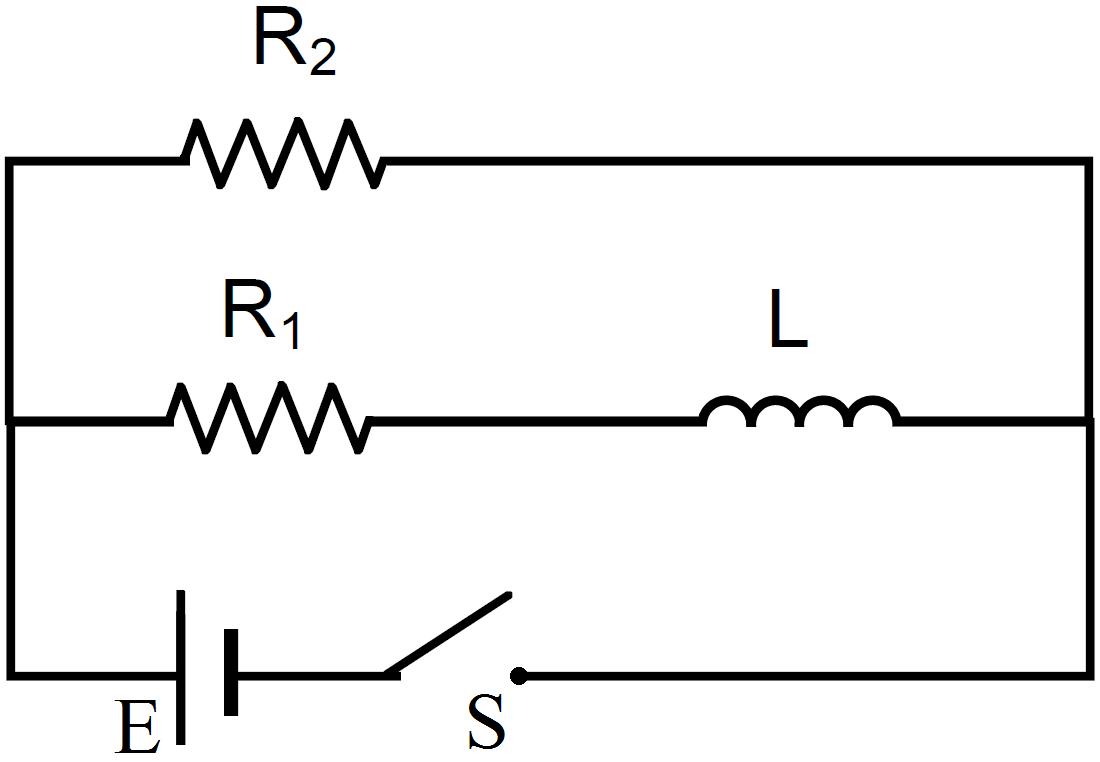
Consider the circuit shown in figure:
  1. Find the current through the battery a long time after the switch S is closed.
  2. Suppose the switch is again opened at $t = 0$. What is the time constant of the discharging circuit?
  3. Find the current through the inductor after one time constant.
A spherical conductor of radius 12cm has a charg of $1.6 \times 10^{-7} C$ distributed uniformly on its surface. What is the electric field:
(a) inside the sphere
(b) just outside the sphere
(c) at a point 18 cm from the centre of the sphere?
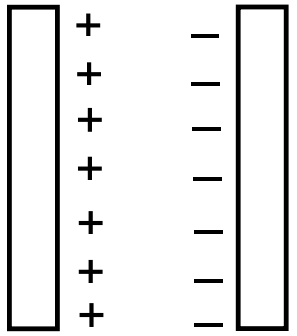
Two large conducting plates are placed parallel to each other and they carry equal and opposite charges with surface density $\sigma$ as shown in figure. Find the electric field:
  1. At the left of the plates.
  2. In between the plates.
  3. At the right of the plates.
A block of mass $2.0\ kg$ is pushed down an inclined plane of inclination $37^\circ$ with a force of $20N$ acting parallel to the incline. It is found that the block moves on the incline with an acceleration of $10m/s^2$. If the block started from rest, find the work done.
  1. By the applied force in the first second.
  2. By the weight of the block in the first second.
  3. By the frictional force acting on the block in the first second. Take $g = 10m/s^2.$
A motorcycle has to move with a constant speed on an overbridge which is in the form of a circular arc of radius R and has a total length L. Suppose the motorcycle starts from the highest point.
  1. What can its maximum velocity be for which the contact with the road is not broken at the highest point?
  2. If the motorcycle goes at speed $\frac{1}{\sqrt2}$ times the maximum found in part (a), where will it lose the contact with the road?
  3. What maximum uniform speed can it maintain on the bridge if it does not lose contact anywhere on the bridge?
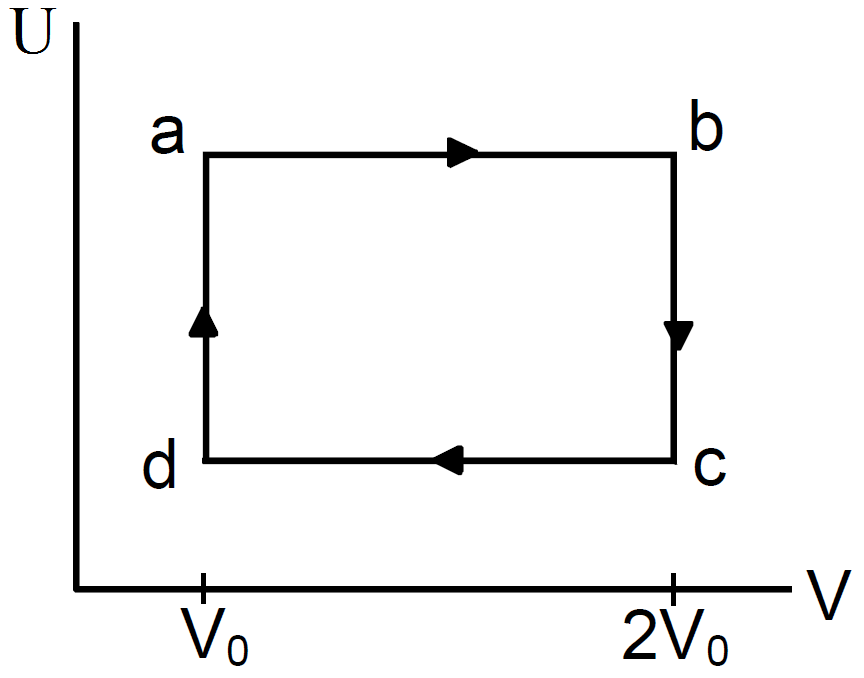
Figure. shows the variation in the internal energy $U$ with the volume $V$ of $2.0\ mol$ of an ideal gas in a cyclic process abcda. The temperatures of the gas at $b$ and $c$ are $500K$ and $300K$ respectively. Calculate the heat absorbed by the gas during the process.
State Gauss's Theorem and prove it.