Question
State Gauss's Theorem and prove it.

Answer

Gauss's Law : It states that 'The total electric flux $\Phi_{E}$ through any closed surface is $(\frac{1}{\in_{0}})$ times the total charge $q$ enclosed inside the closed surface, where ɛ0 is the permittivity of free space."
That is $\Phi_{E}=\oint_{S}\vec{E}.\vec{dS}=\frac{q}{\in_{0}}$
This is integral form of Gauss's law.
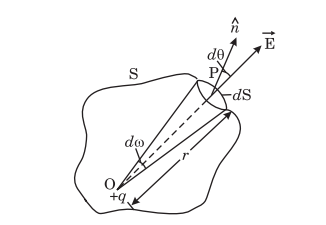
Proof : Consider a closed surface S, surrounding a point charge $+q$ and also consider a small area $d S$ on the closed surface S . (adjacent fig.) Let $d \omega$ be the solid angle subtended by area $d S$ at $O$. Then, electric flux over the area $d S$ is
$d \Phi_{E}=\overrightarrow{E} \cdot \hat{n} d S$
where $\hat{n}$ is the unit vector normal to $d S$.
The electric flux or the total electric normal induction through the whole of closed surface $S$ is
$\Phi_{E}=\oint_{S} \overrightarrow{E} \cdot \hat{n} d S$ ...(1)
The electric intensity at a point on $d S$ due to charge $q$ is given by :
$\overrightarrow{E}=\frac{q \hat{r}}{4 \pi \varepsilon_0 r^2}$ ...(2)
where $\hat{r}$ is a unit vector in the direction of $\vec{E}$.
Image
Substituting relation (2) in (1),
$\Phi_{E}=\oint_{S}\left(\frac{q \hat{r} \cdot \hat{n}}{4 \pi \varepsilon_0 r^2}\right) d S $
$\Rightarrow \Phi_{E}=\oint_{S}\left(\frac{q d S \cos \theta}{4 \pi \varepsilon_0 r^2}\right) $ ...(3)
$\text { But } d \omega=\frac{d S \cos \theta}{r^2}$
∴ Relation (3) takes the following form:
$\Phi_{E}=\frac{q}{4 \pi \varepsilon_0} \oint d \omega .$ ...(4)
The solid angle subtended by any closed surface at any point inside the surface $=4 \pi$ staradian i.e., $\oint d \omega= 4 \pi$
Substituting it in relation (4),
$\Phi_{E}=\frac{q}{4 \pi \varepsilon_0}(4 \pi) $
$\Rightarrow \Phi_{ E }=\frac{q}{\varepsilon_0}$ ...(5)

Need a full question paper?

Generate a complete, print-ready paper with questions like this in minutes — across 16+ boards, with answer keys.
Start Generating Free

Similar questions

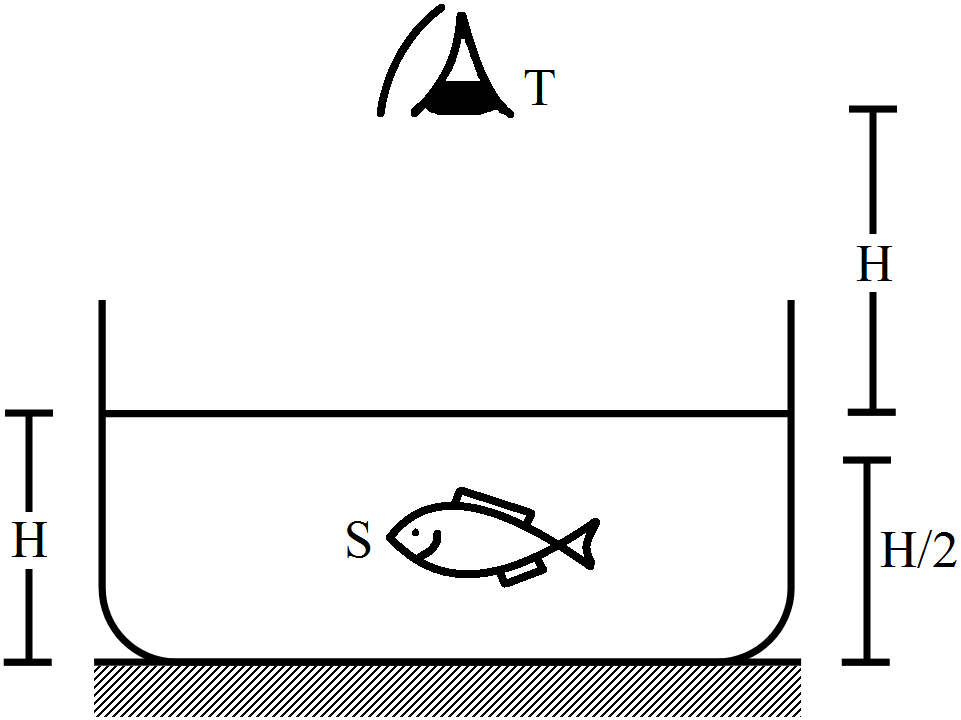
Consider the situation in figure. The bottom of the pot is a reflecting plane mirror, S is a small fish and T is a human eye. Refractive index of water is.
  1. At what distance(s) from itself will the fish see the image(s) of the eye?
  2. At what distance(s) from itself will the eye see the image(s) of the fish.
The $\text{K}_\alpha$ and $\text{K}_\beta$ X-rays of molybdenum have wavelengths 0.71A and 0.63A respectively. Find the wavelength of $\text{L}_\alpha$ X-ray of molybdenum.
  1. State the two Kirchhoff's laws. Explain briefly how these rules are justified.
  2. The current is drawn from a cell of emf E and internal resistance r connected to the network of resistors each of resistance r as shown in the figure. Obtain the expression for (i) the current draw from the cell and (ii) the power consumed in the network.
A charged particle of charge $e$ and mass $m$ is moving in an electric field $E$ and magnetic field $B.$ Construct dimensionless quantities and quantities of dimension $[T]^{-1}.$
A hollow sphere of radius $2\ cm$ is attached to an $18\ cm$ long thread to make a pendulum. Find the time period of oscillation of this pendulum. How does it differ from the time period calculated using the formula for a simple pendulum?
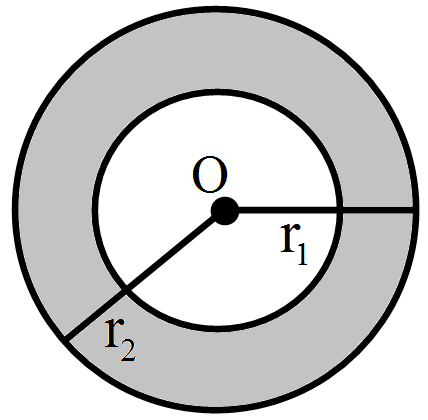
A charge $Q$ is distributed uniformly within the material of a hollow sphere of inner and outer radii $r_1$ and $r_2 \ ($figure$)$. Find the electric field at a point $P$ a distance $x$ away from the centre for $r_1 < x < r_2$ Draw a rough graph showing the electric field as a function of $x$ for $O < x < 2r_2 \ ($figure$)$.
The work function of a photoelectric material is 4.0eV.
  1. What is the threshold wavelength?
  2. Find the wavelength of light for which the stopping potential is 2.5V.
  1. An electron moves along a circle of radius 1m in a perpendicular magnetic field of strength 0.50T. What would be its speed? Is it reasonable?
  2. If a proton moves along a circle of the same radius in the same magnetic field, what would be its speed?
Define resistivity of a conductor. Plot a graph showing the variation of resistivity with temperature for a metallic conductor. How does one explain such a behaviour, using the mathematical expression of the resistivity of a material?
Derive the expression for the magnetic field at the site of a point nucleus in a hydrogen atom due to the circular motion of the electron. Assume that the atom is in its ground state and give the answer in terms of fundamental constants.