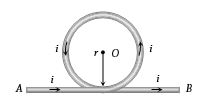
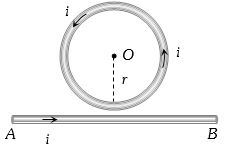
A part of a long wire carrying a current $i$ is bent into a circle of radius $r$ as shown in figure. The net magnetic field at the centre $O$ of the circular loop is
Medium


Download our appand get started for free
Experience the future of education. Simply download our apps or reach out to us for more information. Let's shape the future of learning together!No signup needed.*
Similar Questions
- 1The resistance of a galvanometer is $25\, ohm$ and it requires $50\,\mu A$ for full deflection. The value of the shunt resistance required to convert it into an ammeter of $5\, amp$ isView Solution
- 2A steady eletric current is flowing through a cylindrical wireView Solution
$(a)$ the electric field at the axis of wire is zero
$(b)$ the magnetic field at the axis of wire is zero
$(c)$ the electric field in the vicinity of wire is Zero.
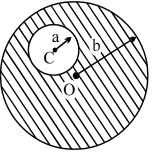
$(d)$ the magnetic field in the vicinity of wire is Zero - 3A long straight metal rod has a very long hole of radius $‘a’$ drilled parallel to the rod axis as shown in the figure. If the rod carries a current $‘i’$ find the value of magnetic induction on the axis of the hole, where $OC = c$View Solution
- 4Two infinitely long straight wires lie in the $\mathrm{xy}$-plane along the lines $\mathrm{x}=+R$. The wire located at $\mathrm{x}=+\mathrm{R}$ carries a constant current $\mathrm{I}_1$ and the wire located at $\mathrm{x}=-R$ carries a constant current $\mathrm{I}_2$. A circular loop of radius $R$ is suspended with its centre at $(0,0, \sqrt{3} R)$ and in a plane parallel to the xy-plane. This loop carries a constant current $/$ in the clockwise direction as seen from above the loop. The current in the wire is taken to be positive if it is in the $+\hat{\mathrm{j}}$ direction. Which of the following statements regarding the magnetic field $\dot{B}$ is (are) true?View Solution
$(A)$ If $I_1=I_2$, then B' cannot be equal to zero at the origin $(0,0,0)$
$(B)$ If $\mathrm{I}_1>0$ and $\mathrm{I}_2<0$, then $\mathrm{B}$ can be equal to zero at the origin $(0,0,0)$
$(C)$ If $\mathrm{I}_1<0$ and $\mathrm{I}_2>0$, then $\mathrm{B}$ can be equal to zero at the origin $(0,0,0)$
$(D)$ If $\mathrm{I}_1=\mathrm{I}_2$, then the $\mathrm{z}$-component of the magnetic field at the centre of the loop is $\left(-\frac{\mu_0 \mathrm{I}}{2 \mathrm{R}}\right)$
- 5Two long straight parallel wires, carrying (adjustable) current $I_1$ and $I_2$, are kept at a distance $d$ apart. If the force $'F'$ between the two wires is taken as 'positive' when the wires repel each other and 'negative' when the wires attract each other, the graph showing the dependence of $'F'$, on the product $I_1 I_2$, would beView Solution
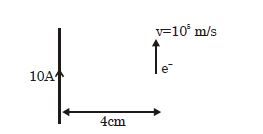
- 6An $e^-$ is moving parallel to a long current carrying wire as shown. Force on electron isView Solution
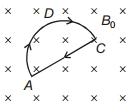
- 7Figure shows a conducting loop $A D C A$ carrying current $i$ and placed in a region of uniform magnetic field $B_0$. The part $A D C$ forms a semicircle of radius $R$. The magnitude of force on the semicircle part of the loop is equal toView Solution
- 8An electron (mass = $9.1 \times {10^{ - 31}}$ $kg$; charge = $1.6 \times {10^{ - 19}}$ $C$) experiences no deflection if subjected to an electric field of $3.2 \times {10^5}$ $V/m$, and a magnetic fields of $2.0 \times {10^{ - 3}} \,Wb/m^2$. Both the fields are normal to the path of electron and to each other. If the electric field is removed, then the electron will revolve in an orbit of radius.......$m$View Solution
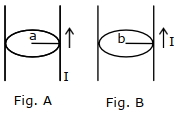
- 9Figure $A$ and $B$ shown two long straight wires of circular cross-section ($a$ and $b$ with $a$ $<$ $b$), carrying current $I$ which is uniformly distributed across the cross-section. The magnitude of magnetic field $B$ varies with radius $r$ and can be represented asView Solution
- 10An electron moving in a circular orbit of radius $r$ makes $n$ rotations per second. The magnetic field produced at the centre has magnitudeView Solution