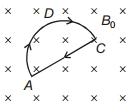
Figure shows a conducting loop $A D C A$ carrying current $i$ and placed in a region of uniform magnetic field $B_0$. The part $A D C$ forms a semicircle of radius $R$. The magnitude of force on the semicircle part of the loop is equal to
Easy


Download our appand get started for free
Experience the future of education. Simply download our apps or reach out to us for more information. Let's shape the future of learning together!No signup needed.*
Similar Questions
- 1A current is flowing through a thin cylindrical shell of radius $R$. If energy density in the medium, due to magnetic field, at a distance $r$ from axis of the shell is equal to $U$ then which of the following graphs is correctView Solution
- 2A current $I$ flows along the length of an infinitely long, straight and thin-walled pipe. ThenView Solution
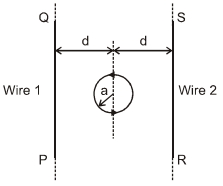
- 3The figure shows a circular loop of radius a with two long parallel wires (numbered $1$ and $2$) all in the plane of the paper. The distance of each wire from the centre of the loop is $d$. The loop and the wires are carrying the same current $I$. The current in the loop is in the counterclockwise direction if seen from above.$Image$View Solution
$1.$ When $d \approx$ a but wires are not touching the loop, it is found that the net magnetic filed on the axis of the loop is zero at a height $h$ above the loop. In that case
$(A)$ current in wire $1$ and wire $2$ is the direction $P Q$ and $R S$, respectively and $h \approx a$
$(B)$ current in wire $1$ and wire $2$ is the direction $PQ$ and $SR$, respectively and $h \approx a$
$(C)$ current in wire $1$ and wire $2$ is the direction $PQ$ and $SR$, respectively and $h \approx 1.2 a$
$(D)$ current in wire $1$ and wire $2$ is the direction $PQ$ and $RS$, resepectively and $h \approx 1.2 a$
$2.$ Consider $d \gg a$, and the loop is rotated about its diameter parallel to the wires by $30^{\circ}$ from the position shown in the figure. If the currents in the wires are in the opposite directions, the torque on the loop at its new position will be (assume that the net field due to the wires is constant over the loop)
$(A)$ $\frac{\mu_0 I^2 a^2}{d}$ $(B)$ $\frac{\mu_0 I^2 a^2}{2 d}$ $(C)$ $\frac{\sqrt{3} \mu_0 I^2 a^2}{d}$ $(D)$ $\frac{\sqrt{3} \mu_0 I^2 a^2}{2 d}$
Give the answer question $1$ and $2.$
- 4The dimensional formula for the physical quantityis $\frac{{{E^2}{\mu _0}{\varepsilon _0}}}{{{B^2}}}$ ($E =$ electric field and $B =$ magnetic field)View Solution
- 5A wire in the form of a circular loop of one turn carrying a current produces a magnetic field $B$ at the centre. If the same wire is looped into a coil of two turns and carries the same current, the new value of magnetic induction at the centre isView Solution
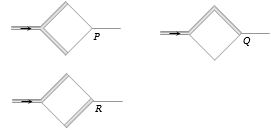
- 6Two thick wires and two thin wires, all of the same materials and same length form a square in the three different ways $P$, $Q$ and $R$ as shown in fig with current connection shown, the magnetic field at the centre of the square is zero in casesView Solution
- 7A long solenoid is producing magnetic field on its axis is $B$. If it is cuts into four equal parts and for same current, half number of turns wound on any on piece than value of magnetic field on it axis becomesView Solution
- 8A particle of mass $m$ and charge $q$, accelerated by a potential difference $V$ enters a region of a uniform transverse magnetic field $B$. If $d$ is the thickness of the region of $B$, the angle $\theta$ through which the particle deviates from the initial direction on leaving the region is given byView Solution
- 9A charged particle of charge $q$ and mass $m$, gets deflected through an angle $\theta$ upon passing through a square region of side $a$, which contains a uniform magnetic field $B$ normal to its plane. Assuming that the particle entered the square at right angles to one side, what is the speed of the particle?View Solution
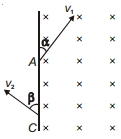
- 10A particle of charge $-q$ and mass $m$ enters a uniform magnetic field $\vec{B}$ at $A$ with speed $v_1$ at an angle $\alpha$ and leaves the field at $C$ with speed $v_2$ at an angle $\beta$ as shown. ThenView Solution