Question
A part of the early classification of elements has been given below:
$\text{H}\ \ \ \ \ \ \ \text{Li} \ \ \ \ \ \ \ \text{Be} \ \ \ \ \ \ \ \ \ \text{B}\ \ \ \ \ \ \ \text{C}\ \ \ \ \ \ \ \text{N}\ \ \ \ \ \ \ \text{O}\\\text{F}\ \ \ \ \ \ \ \text{Na}\ \ \ \ \ \ \text{Mg}\ \ \ \ \ \ \ \text{Al}\ \ \ \ \ \ \text{Si}\ \ \ \ \ \ \ \text{P}\ \ \ \ \ \ \ \ \text{S}$
  1. Which law of classification of element is illustrated by the above arrangement of elements?
  2. Name the scientist who proposed such a classification of elements.
  3. Why is such a classification of elements compared with a characteristics of musical scale?
  4. State one limitation of this classification of elements.
Answer

  1. Newlands' law of octaves is illustrated by the above arrangement of elements.
  2. John Newlands is the scientist who proposed this classification of elements.
  3. This classification is compared with a characteristic of the musical scale because the repetition of the properties of elements is just like the repetition of the eighth note in an octave of music.
  1. Limitation:
Newlands' law of octaves could only be applied up to the element calcium.

Need a full question paper?

Generate a complete, print-ready paper with questions like this in minutes — across 16+ boards, with answer keys.

Start Generating Free

Similar questions

 The mass of the earth is $6 \times 10^{24} kg$. The distance between the earth and the sun is $1.5 \times 10^{11} m$. If the gravitational force between the two is $3.5 \times 10^{22} N$, what is the mass of the sun? Use $G=6.7 \times 10^{-11} N m ^2 kg^{-2}$
Describe the human male reproductive system.
The top part A of the flask-shaped reproductive organ X in the flower of a plant secrets a surgery substance into its lower part B which goes towards the bottom part C of the flask-shaped organ. When a tiny grain D coming from the top part E of another reproductive organ Y i the flower falls on part A, it grows a long tube F through the organ X i response to the sugary substance and reaches the bottom part C of flask-shaped organ to carry out fertilisation.
  1. Name parts (i) organ X, and (ii) organ Y, inside the flower?
  2. Name parts (i) A (ii) B, and (iii) C, of flask-shaped organ.
  3. Name (i) grain D, and (ii) part E of organ Y.
  4. Name the tube F.
  5. What is the phenomenon of growing a long tube in response to sugary substance in the process of fertilisation in a flower known as?
Write the names of all the major endocrine glands present in the human body. Which of these glands also function as exocrine glands?
A potted plant is growing in a transparent glass jar. In this plant, X and Y are the two growing parts having a lot of meristematic tissue. It is observed that the part X of this plant exhibits positive geotropism but negative phototropism. On the other hand, part Y of this plant exhibits negative geotropism but positive phototropism.
  1. Name the part X of plant.
  2. Name the part Y of plant.
  3. Which part of the plant, X or Y, will exhibit positive hydrotropism?
  4. Which part of the plant, X or Y, can have tendrils on it?
  5. Which phytohormone causes the part X to exhibit negative phototropism?
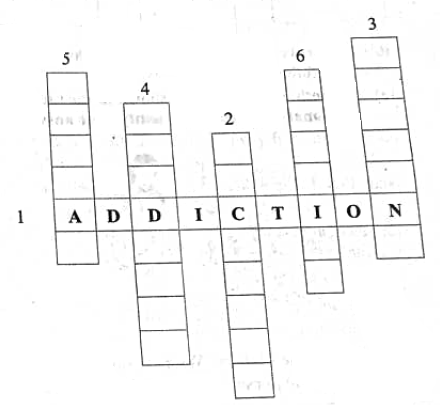
Solve the following cross word:
Image

(1) Continuous consumption of alcoholic and tobacco materials.
(2) This app may cause the cyber crimes.
(3) A remedy to resolve stress.
(4) Requirement for stress free life.
(5) Various factors affect __________ health.
(6) Art of preparing food items.
Why do we need to manage our natural resources?
Aluminium oxide is called an amphoteric oxide.
Write short notes: Characteristics of Carbon.
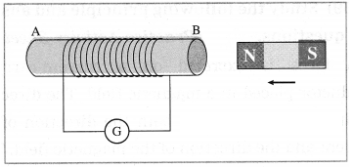
Take a coil AB having 10-15 turns. Connect the two ends of the coil to the galvanometer as shown in Figure. Take a strong bar magnet. (1) Move the north pole of the magnet towards the end B of the coil.
Image

Observe the deflection of the pointer in the galvanometer. Note the direction of the deflection (i.e. right or left). (2) Now repeat this with the south pole of the magnet towards the end B of the coil. Again observe the deflection. Note its direction. (3) What will happen if instead of the magnet, the coil is moved? (4) If both the coil and the magnet are kept stationary, do you observe any deflection? (5) Compare the direction of the deflection when the north pole of the magnet is moved towards the end B of the coil with that when the end B of the coil is moved away from the north pole of the magnet. (6) What conclusions do you draw from the observations?