Question
Describe the human male reproductive system.

Answer


Image
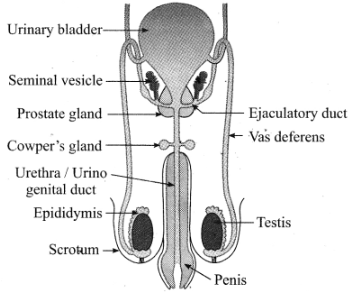
In human male reproductive system, the reproductive organs are as follows:
  • Testes, different types of duct systems and glands.
  • Testes are in pair. Each testis lies in the scrotum which lies outside to abdominal cavity.
  • Testes -consist of numerous seminiferous tubules. The germinal epithelium of seminiferous tubules form sperms by undergoing meiosis.
  • These sperm cells are immature.
  • They are pushed gradually through various duct systems till the penis.
  • This path is as follows:
    Rete testis → vas efferentia → epididymis → vasa deferentia → Ejaculatory duct → urethra
  • As the sperms are travelling, they gradually become mature. They are made capable to perform process of fertilization.
  • Seminal vesicles (in pairs), Single prostate gland and a pair of Cowper’s glands secrete their secretions. These secretions and the sperms together form semen.
  • This semen is deposited in the vagina with help of penis.

Need a full question paper?

Generate a complete, print-ready paper with questions like this in minutes — across 16+ boards, with answer keys.

Start Generating Free

Similar questions

Describe the $IUPAC$ rules of naming organic compounds.
Observe the pictures given below.
Image
Read the paragraph and answer the questions given below:
Locomotion is considered as an important j characteristics of the animals. However, animals belonging to Porifera are said to be sedentary. Every 1 other phylum has typical locomotory organs. E.g. Nereis crawls with the help of parapodia, whereas earthworm buries in soil by setae. Spiders have four pairs of walking legs, crab has five while all insects have three pairs of walking legs. The walking legs are also called appendages. Starfish moves with the help of tube feet. Snails and bivalves use muscular foot for locomotion. Birds flying with their spread out wings and fish swimming with their fins, both have spindle-shaped body tapering at both the ends. While flying or swimming such body offers least resistance during locomotion. Mammals have two pairs of limbs while animals like snakes are limbless. Other animals belonging to the class of snakes also have very weak limbs which make them creep on the ground.
Questions and Answers:
(1) What are the locomotory organs in phylum Annelida?
(2) Which phylum has a characteristic of jointed appendages?
(3) Which the locomotory organ of animals belong to Phylum Mollusca?
(4) Which class of animals show weak legs?
(5) In which class of animals the forelimbs are modified?
When the solution of substance X is added to a solution of potassium iodide, then a yellow solid separates out from the solution:
  1. What do you think substance X is likely to be?
  2. Name the substance which the yellow solid consists of.
  3. Which characteristic of chemical reaction is illustrated by this example?
  4. Write a balanced chemical equation for the reaction which takes place. Mention the physical states of all the reactant and products involved in the chemical equation.
What is hydroelectricity? Explain the basic principle of generation of hydroelectricity with the help of a labelled diagram.
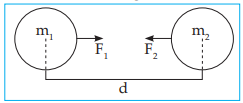
Observe the figure and answer the following questions
Image

Question
(i) What are the masses of the objects shown?
(ii) What is the distance between their centres?
(iii) Write gravitational force between them.
(iv) Why gravitation constant is called universal constant?
(v) What will happen to gravitational force if mass of one of the objects is doubled?
(vi) What is the value of universal constant in SI?
What is radioactive pollution? What are its effects?
The sea water contains water beetles, tadpole, fish and weeds.
  1. Write a food chain comprising all the given organisms?
  2. Which organisms in the food chain are (i) herbivore, and (ii) carnivores?
  3. Which organisms are (i) predators, and (ii) prey?
  4. Which organisms can trap solar energy to make food?
  5. Which organism is a secondary consumer?
Name the hormones secreted by the following endocrine glands:
  1. Thyroid gland.
  2. Parathyroid glands.
  3. Pancreas.
  4. Adrenal glands.
Write a short note.
Specific heat capacity