A particle $A$ has charge $ + q$ and a particle $B$ has charge $ + \,4q$ with each of them having the same mass $m$. When allowed to fall from rest through the same electric potential difference, the ratio of their speed $\frac{{{v_A}}}{{{v_B}}}$ will become
Easy
Download our app for free and get started
(b) Using $v = \sqrt {\frac{{2QV}}{m}} $ $==>$ $v \propto \sqrt Q $ $==>$ $\frac{{{v_A}}}{{{v_B}}} = \sqrt {\frac{{{Q_A}}}{{{Q_B}}}} = \sqrt {\frac{q}{{4q}}} = \frac{1}{2}$

Download our appand get started for free
Experience the future of education. Simply download our apps or reach out to us for more information. Let's shape the future of learning together!No signup needed.*
Similar Questions
- 1The potential at a point, due to a positive charge of $100\,\mu C$ at a distance of $9\,m$, isView Solution
- 2A positively charged ring is in $y-z$ plane with its centre at origin. A positive test charge $q_0$, held at origin is released along $x$-axis, then its speedView Solution
- 3Two electrons are moving towards each other, each with a velocity of $10^6 \,m / s$. What will be closest distance of approach between them is ......... $m$View Solution
- 4In the given circuit, $C _1=2\,\mu F , C _2=0.2\,\mu F$, $C _3=2\,\mu F , C _4=4\,\mu F,$ $C _5=2\,\mu F , C _6=2\,\mu F$, the charge stored on capacitor $C _4$ is $.....\mu C$.View Solution
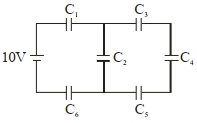
- 5There exists a uniform electric field $E=4 \times 10^5 \,Vm ^{-1}$ directed along negative $x$-axis such that electric potential at origin is zero. Acharge of $-200 \,\mu C$ is placed at origin, and a charge of $+200 \,\mu C$ is placed at $(3 \,m , 0)$. The electrostatic potential energy of the system is ...........$J$View Solution
- 6Let $V$ and $E$ are potential and electric field intensity at a point thenView Solution
- 7View SolutionTwo capacitors of equal capacity are first connected in parallel and then in series. The ratio of the total capacities in the two cases will be
- 8A parallel plate air capacitor is charged to a potential difference of $V$. After disconnecting the battery, distance between the plates of the capacitor is increased using an insulating handle. As a result, the potential difference between the platesView Solution
- 9Electric field at a point $(x, y, z)$ is represented by $\vec E = 2x\hat i + {y^2}\hat j$ if potential at $(0,0,0)$ is $2\, volt$ find potential at $(1, 1, 1)$View Solution
- 10Three charges $-q, Q$ and $-q$ are placed respectively at equal distances on a straight line. If the potential energy of the system of three charges is zero, then what is the ratio of $Q: q$ ?View Solution