The potential at a point, due to a positive charge of $100\,\mu C$ at a distance of $9\,m$, is
Easy


Download our appand get started for free
Experience the future of education. Simply download our apps or reach out to us for more information. Let's shape the future of learning together!No signup needed.*
Similar Questions
- 1Two capacitors of capacitances $3\,\mu \,F$ and $6\,\mu F$ are charged to a potential of $12 \,V$ each. They are now connected to each other, with the positive plate of each joined to the negative plate of the other. The potential difference across each will be......$volt$View Solution
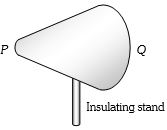
- 2Figure shows a charged conductor resting on an insulating stand. If at the point $P$ the charge density is $\sigma $, the potential is $V$ and the electric field strength is $E$, what are the values of these quantities at point $Q$View Solution
Charge density potential Electric intensity
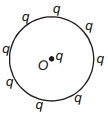
- 3A point charge $q$ is surrounded by eight identical charges at distance $r$ as shown in figure. How much work is done by the forces of electrostatic repulsion when the point charge at the centre is removed to infinity?View Solution
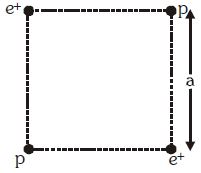
- 4Two positrons $(e^+)$ and two protons $(p)$ are kept on four corners of a square of side $a$ as shown in figure. The mass of proton is much larger than the mass of positron. Let $q$ denotes the charge on the proton as well as the positron then the kinetic energies of one of the positrons and one of the protons respectively after a very long time will be-View Solution
- 5An electron of mass $m$ and charge $e$ is accelerated from rest through a potential difference $V$ in vacuum. The final speed of the electron will beView Solution
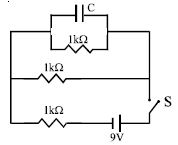
- 6A capacitor $C = 100$ $ \mu F$ is connected to three resistor each of resistance $1$ $k\Omega$ and a battery of $emf$ $9\,V$. The switch $S$ has been closed for long time so as to charge the capacitor. When switch $S$ is opened, the capacitor discharges with time constant......$ms$View Solution
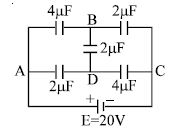
- 7The figure shows a diagonal symmetric arrangement of capacitors and a battery. The potential of the point $B$ and $D$ areView Solution
- 8Three point charges $Q, 4Q $ and $16Q $ are placed on a straight line $9$ $cm$ long. Charges are placed in such a way that the system has minimum potential energy. ThenView Solution
- 9Three concentric metal shells $A, B$ and $C$ of respective radii $a, b$ and $c (a < b < c)$ have surface charge densities $+\sigma,-\sigma$ and $+\sigma$ respectively. The potential of shell $B$ isView Solution
- 10Let $V$ and $E$ are potential and electric field intensity at a point thenView Solution