MCQ
A particle doing simple harmonic motion, amplitude $= 4\ cm,$ time period $= 12\sec.$ Ratio of time taken by it in going from its mean position to $2\ cm$ and from $2\ cm$ to extreme position is:
  • A
    $1$
  • B
    $\frac{1}{3}$
  • C
    $\frac{1}{4}$
  • $\frac{1}{2}$

Answer

Correct option: D.
$\frac{1}{2}$
Here, $a = 4\ cm; T = 12s.$ If t is the time takeo by particle in going fiom mean position to $2\ cm,$ then using
$\text{y}=\text{a}\sin\omega\text{t},$ we have $2=4\sin\frac{2\pi}{\text{T}}\text{t}$
$\sin\frac{2\pi}{\text{T}}\text{t}=\frac{2}{4}=\frac{1}{2}=\sin\frac{\pi}{6}$
$\text{t}=1\text{sec}.$
Time taken by particle to go from mean position to extreme position $=\frac{\text{T}}{4}=\frac{12}{4}=3\text{s}$
Therefore, time taken by Particle in going from $2\ cm$ to $4\ cm ($i.e., extreme position$)$
$\text{t}'=3-1=2\text{s}$
$\therefore$ So $\frac{\text{t}}{\text{t}'}=\frac{1}{2}$

Need a full question paper?

Generate a complete, print-ready paper with questions like this in minutes — across 16+ boards, with answer keys.

Start Generating Free

Similar questions

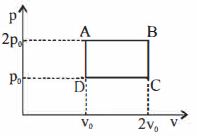
The above $P-V$ diagram represents the thermodynamic cycle of an engine, operating with an ideal monatomic gas. The amount of heat, extracted from the source in a single cycle is
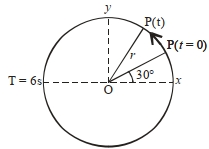
For particle $P$ revolving round the centre $O$ with radius of circular path $r$ and angular velocity $\omega$, as shown in below figure, the projection of $OP$ on the $x$-axis at time $t$ is $.................$.
An ideal gas expands from volume $V_1$ to $V_2$. This may be achieved by either of the three processes: isobaric, isothermal and adiabatic. Let $\Delta U$ be the change in internal energy of the gas, $Q$ be the quantity of heat added to the system and $W$ be the work done by the system on the gas. Identify which of the following statements is false for $\Delta U$?
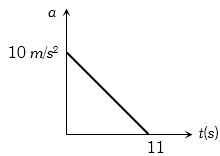
A particle starts from rest. Its acceleration $(a)$ versus time $(t)$ is as shown in the figure. The maximum speed of the particle will be.....$m/s$
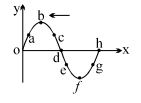
The figure represents the instantaneous picture of a transverse harmonic wave traveling along the negative $x$-axis. Choose the correct alternative $(s)$ related to the movement of the nine points shown in the figure.  The points moving downwards is/are
Find the value of $\frac{1.53 \times 0.9995}{1.592}$ with due regard for significant figures
$4200\, J$ of work is required for
$A$ man is sitting in $a$ smooth groove on a horizontal circular table at the edge by holding a rope joined to the centre. The moment of inertia of table is $I$. Mass of man $= M$. Man now pulls the rope so that he comes to the centre. The angular velocity of the table :
$A$ disc of circumference $s$ is at rest at a point $A$ on a horizontal surface when a constant horizontal force begins to act on its centre. Between $A$ and $B$ there is sufficient friction to prevent slipping, and the surface is smooth to the right of $B$. $AB = s$. The disc moves from $A$ to $B$ in time $T$. To the right of $B$,
In an experiment four quantities $a, b, c$ and $d$ are measured with percentage error $1\%, 2\%, 3\%$ and $4\%$ respectively. Quantity $w$ is calculated as follows $w\, = \,\frac{{{a^4}{b^3}}}{{{c^2}\sqrt D }}$  error in the measurement of $w$ is .......... $\%$