MCQ
An ideal gas expands from volume $V_1$ to $V_2$. This may be achieved by either of the three processes: isobaric, isothermal and adiabatic. Let $\Delta U$ be the change in internal energy of the gas, $Q$ be the quantity of heat added to the system and $W$ be the work done by the system on the gas. Identify which of the following statements is false for $\Delta U$?
  • A
    $\Delta U$ is least under adiabatic process.
  • $\Delta U$ is greatest under adiabatic process.
  • C
    $\Delta U$ is greatest under the isobaric process.
  • D
    $\Delta U$ in isothermal process lies in-between the values obtained under isobaric and adiabatic processes.

Answer

Correct option: B.
$\Delta U$ is greatest under adiabatic process.
b
We know that, $\Delta U \propto \Delta T$

For isotherm, $\Delta T=0 \Rightarrow \Delta U=0$

For adiabat, $\Delta Q=0 \Rightarrow \Delta U=-\Delta W<0$

For isobar, $\Delta V \propto \Delta T \Rightarrow \Delta T>0 \Rightarrow \Delta U>0$

Let the internal energy change be $\Delta U_{1}, \Delta U_{2}, \Delta U_{3}$ for the isotherm, adiabat, isobar respectively.

Then $\Delta U_{3}>\Delta U_{1}>\Delta U_{2}$

Thus option $b$ is only false

Need a full question paper?

Generate a complete, print-ready paper with questions like this in minutes — across 16+ boards, with answer keys.

Start Generating Free

Similar questions

In an angular $SHM$ angular amplitude of oscillation is $\pi $ $rad$ and time period is $0.4\,sec$ then calculate its angular velocity at angular displacement $ \pi/2 \,rad$. ..... $rad/sec$
Two paper screens $A$ and $B$ are separated by a distance of $100\,m$. A bullet pierces $A$ and then $B$. The hole in $B$ is $10\,cm$ below the hole in $A$. If the bullet is travelling horizontally at the time of hitting $A$, then the velocity of the bullet at $A$ is $.......\,m / s$
Work done in converting one gram of ice at $-10°C$ into steam at $100°C$ is ....... $J$
If $C_P, C_V$ are molar specific heats of a solid and $R$ is universal gas constant, then:
In supplying $400$ calories of heat to a system, the work done will be
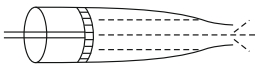
Figure below shows a liquid being pushed out of the tube by a piston having area of cross section $2.0\,cm ^2$. The area of cross section at the outlet is $10\,mm ^2$. If the piston is pushed at a speed of $4\,cm s ^{-1}$, the speed of outgoing fluidis $.........\,cm s ^{-1}$.
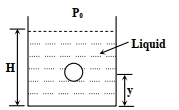
A small spherical monoatomic ideal gas bubble $\left(\gamma=\frac{5}{3}\right)$ is trapped inside a liquid of density $\rho_{\ell}$ (see figure). Assume that the bubble does not exchange any heat with the liquid. The bubble contains n moles of gas. The temperature of the gas when the bubble is at the bottom is $\mathrm{T}_0$, the height of the liquid is $\mathrm{H}$ and the atmospheric pressure is $\mathrm{P}_0$ (Neglect surface tension).

Figure: $Image$

$1.$ As the bubble moves upwards, besides the buoyancy force the following forces are acting on it

$(A)$ Only the force of gravity

$(B)$ The force due to gravity and the force due to the pressure of the liquid

$(C)$ The force due to gravity, the force due to the pressure of the liquid and the force due to viscosity of the liquid

$(D)$ The force due to gravity and the force due to viscosity of the liquid

$2.$ When the gas bubble is at a height $\mathrm{y}$ from the bottom, its temperature is

$(A)$ $\mathrm{T}_0\left(\frac{\mathrm{P}_0+\rho_0 \mathrm{gH}}{\mathrm{P}_0+\rho_t \mathrm{gy}}\right)^{2 / 5}$

$(B)$ $T_0\left(\frac{P_0+\rho_t g(H-y)}{P_0+\rho_t g H}\right)^{2 / 5}$

$(C)$ $\mathrm{T}_0\left(\frac{\mathrm{P}_0+\rho_t \mathrm{gH}}{\mathrm{P}_0+\rho_t \mathrm{gy}}\right)^{3 / 5}$

$(D)$ $T_0\left(\frac{P_0+\rho_t g(H-y)}{P_0+\rho_t g H}\right)^{3 / 5}$

$3.$ The buoyancy force acting on the gas bubble is (Assume $R$ is the universal gas constant)

$(A)$ $\rho_t \mathrm{nRgT}_0 \frac{\left(\mathrm{P}_0+\rho_t \mathrm{gH}\right)^{2 / 5}}{\left(\mathrm{P}_0+\rho_t \mathrm{gy}\right)^{7 / 5}}$

$(B)$ $\frac{\rho_{\ell} \mathrm{nRgT}_0}{\left(\mathrm{P}_0+\rho_{\ell} \mathrm{gH}\right)^{2 / 5}\left[\mathrm{P}_0+\rho_{\ell} \mathrm{g}(\mathrm{H}-\mathrm{y})\right]^{3 / 5}}$

$(C)$ $\rho_t \mathrm{nRgT} \frac{\left(\mathrm{P}_0+\rho_t g \mathrm{H}\right)^{3 / 5}}{\left(\mathrm{P}_0+\rho_t g \mathrm{~g}\right)^{8 / 5}}$

$(D)$ $\frac{\rho_{\ell} \mathrm{nRgT}_0}{\left(\mathrm{P}_0+\rho_{\ell} \mathrm{gH}\right)^{3 / 5}\left[\mathrm{P}_0+\rho_t \mathrm{~g}(\mathrm{H}-\mathrm{y})\right]^{2 / 5}}$

Give the answer question $1,2,$ and $3.$
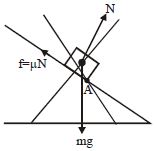
When a cube is in limiting equilibrium on an inclined plane and it is about to topple. The coefficient of friction between cube and plane is:-
A ball dropped from some height coves half of its total during the last second of its free fall. Find:
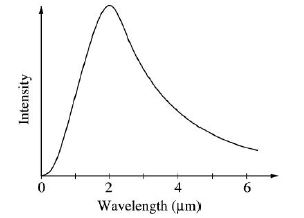
The distribution of relative intensity $I (\lambda)$ of blackbody radiation from a solid  object versus the wavelength $\lambda$ is shown in the figure. If the Wien displacement law  onstant is $2.9 × 10^{-3}\  mK$, what is the approximate temperature of the object ....... $K$