A particle executes $S.H.M.$ with amplitude $'a'$ and time period $V$. The displacement of the particle when its speed is half of maximum speed is $\frac{\sqrt{ x } a }{2} .$ The value of $x$ is $\ldots \ldots \ldots$
JEE MAIN 2021, Medium
Download our app for free and get started
$V =\omega \sqrt{ A ^{2}- x ^{2}} \quad V _{\max }= A\omega$
$\frac{ A\omega }{2}=\omega \sqrt{ A ^{2}- x ^{2}}$
$\frac{ A ^{2}}{4}= A ^{2}- x ^{2}$
$x ^{2}=\frac{3 A ^{2}}{4}$
$x =\frac{\sqrt{3}}{2} \,A$

Download our appand get started for free
Experience the future of education. Simply download our apps or reach out to us for more information. Let's shape the future of learning together!No signup needed.*
Similar Questions
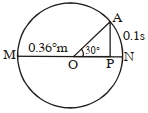
- 1The point $A$ moves with a uniform speed along the circumference of a circle of radius $0.36\, m$ and covers $30^{\circ}$ in $0.1\, s$. The perpendicular projection $'P'$ from $'A'$ on the diameter $MN$ represents the simple harmonic motion of $'P'.$ The restoration force per unit mass when $P$ touches $M$ will be ...... $N$View Solution
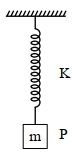
- 2A force of $6.4\, N$ stretches a vertical spring by $0.1 \,m$. The mass that must be suspended from the spring so that it oscillates with a period of $\left( {\frac{\pi }{4}} \right)sec$. is ... $kg$View Solution
- 3A person of mass $M$ is, sitting on a swing of length $L$ and swinging with an angular amplitude $\theta_0$. If the person stands up when the swing passes through its lowest point, the work done by him, assuming that his centre of mass moves by a distance $l\, ( l < < L)$, is close toView Solution
- 4In simple harmonic motion, the total mechanical energy of given system is E. If mass of oscillating particle $P$ is doubled then the new energy of the system for same amplitude is:View Solution
- 5View SolutionTwo oscillating systems; a simple pendulum and a vertical spring-mass-system have same time period of motion on the surface of the Earth. If both are taken to the moon, then-
- 6Time period of a particle executing $SHM$ is $8\, sec.$ At $t = 0$ it is at the mean position. The ratio of the distance covered by the particle in the $1^{st}$ second to the $2^{nd}$ second is :View Solution
- 7A point performs simple harmonic oscillation of period $T$ and the equation of motion is given by $x=Asin$$\left( {\omega t + \frac{\pi }{6}} \right)$. After the elapse of what fraction of the time period the velocity of the point will be equal to half of its maximum velocity?View Solution
- 8The variation of kinetic energy $(KE)$ of a particle executing simple harmonic motion with the displacement $(x)$ starting from mean position to extreme position $(A)$ is given byView Solution
- 9A particle is executing $SHM$ along a straight line. Its velocities at distance $x_1$ and $x_2$ from the mean position are $V_1$ and $V_2$ respectively. Its time period isView Solution
- 10A bob of mass $'m'$ suspended by a thread of length $l$ undergoes simple harmonic oscillations with time period ${T}$. If the bob is immersed in a liquid that has density $\frac{1}{4}$ times that of the bob and the length of the thread is increased by $1 / 3^{\text {rd }}$ of the original length, then the time period of the simple harmonic oscillations will be :-View Solution