A person of mass $M$ is, sitting on a swing of length $L$ and swinging with an angular amplitude $\theta_0$. If the person stands up when the swing passes through its lowest point, the work done by him, assuming that his centre of mass moves by a distance $l\, ( l < < L)$, is close to
JEE MAIN 2019, Diffcult
Download our app for free and get started
Angular momentum conservation
$\mathrm{MV}_{0} \mathrm{L}=\mathrm{MV}_{1}(\mathrm{L}-\ell)$
$V_{1}=V_{0}\left(\frac{L}{L-\ell}\right)$
$\mathrm{w}_{\mathrm{g}}+\mathrm{w}_{\mathrm{p}}=\Delta \mathrm{KE}$
$-m g \ell+w_{p}=\frac{1}{2} m\left(V_{1}^{2}-V_{0}^{2}\right)$
$w_{p}=m g \ell+\frac{1}{2} m V_{0}^{2}\left(\left(\frac{L}{L-\ell}\right)^{2}-1\right)$
$=m g \ell+\frac{1}{2} m V_{0}^{2}\left(\left(1-\frac{L}{L-\ell}\right)^{-2}-1\right)$
Now, $\ell<<\mathrm{L}$
By, Binomial approximation
$=m g \ell+\frac{1}{2} m V_{0}^{2}\left(\left(1+\frac{L}{L-\ell}\right)^{-2}-1\right)$
$=m g \ell+\frac{1}{2} m V_{0}^{2}\left(\frac{2 \ell}{L}\right)$
$\mathrm{W}_{\mathrm{P}}=\mathrm{mg} \ell+\mathrm{mV}_{0}^{2} \frac{\ell}{\mathrm{L}}$
Here, $\mathrm{V}_{0}=$ maximum velocity $=\omega \times \mathrm{A}=(\sqrt{\frac{\mathrm{g}}{\mathrm{L}}})\left(\theta_{0} \mathrm{L}\right)$
$\mathrm{So}, \mathrm{w}_{\mathrm{p}}=\mathrm{mg} \ell+\mathrm{m}\left(\theta_{0} \sqrt{\mathrm{gL}}\right)^{2} \frac{\ell}{\mathrm{L}}$
$=m g \ell\left(1+\theta_{0}^{2}\right)$

Download our appand get started for free
Experience the future of education. Simply download our apps or reach out to us for more information. Let's shape the future of learning together!No signup needed.*
Similar Questions
- 1The displacement $x$ (in metres) of a particle performing simple harmonic motion is related to time $t$ (in seconds) as $x = 0.05\cos \left( {4\,\pi \,t + \frac{\pi }{4}} \right)$. The frequency of the motion will be ..... $Hz$View Solution
- 2A sphere of radius $r$ is kept on a concave mirror of radius of curvature $R$. The arrangement is kept on a horizontal table (the surface of concave mirror is frictionless and sliding not rolling). If the sphere is displaced from its equilibrium position and left, then it executes $S.H.M.$ The period of oscillation will beView Solution
- 3View SolutionA simple pendulum is taken from the equator to the pole. Its period
- 4The angular frequency of a spring block system is $\omega _0.$ This system is suspended from the ceiling of an elevator moving downwards with a constant speed $v_0.$ The block is at rest relative to the elevator. Lift is suddenly stopped. Assuming the downwards as a positive direction, choose the wrong statement :View Solution
- 5For a particle executing simple harmonic motion, the kinetic energy $K$ is given by $K = {K_o}{\cos ^2}\omega t$. The maximum value of potential energy isView Solution
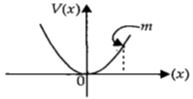
- 6A particle of mass $m$ is released from rest and follows a parabolic path as shown. Assuming that the displacement of the mass from the origin is small, which graph correctly depicts the position of the particle as a function of time $?$View Solution
- 7Time period of a particle executing $SHM$ is $8\, sec.$ At $t = 0$ it is at the mean position. The ratio of the distance covered by the particle in the $1^{st}$ second to the $2^{nd}$ second is :View Solution
- 8A particle moves on $x-$ axis according to the equation $x = x_0\,\,sin^2\,\omega t,$ the motion is simple harmonicView Solution
- 9A particle executes $S.H.M.$ of amplitude A along $x$-axis. At $t =0$, the position of the particle is $x=\frac{A}{2}$ and it moves along positive $x$-axis the displacement of particle in time $t$ is $x=A \sin (\omega t+\delta)$, then the value $\delta$ will beView Solution
- 10The maximum velocity of a body undergoing $S.H.M$. is $0.2\,m/s$ and its acceleration at $0.1\,m$ from the mean position is $0.4\,m/s^2$. The amplitude of the $S.H.M.$ is .... $m$View Solution