Question
A particle executes the motion described by $\text{x}(\text{t})=\text{x}_0(1-\text{e}^{-\gamma\text{t}});\text{t}\ge0,\text{x}_0>0.$ Where does the particle start and with what velocity?

Answer

$\text{x}(\text{t})=\text{x}_0[1-\text{e}^{-\gamma\text{t}}]\ \ \ ...(\text{i})$ $\text{v}(\text{t})=\frac{\text{dx(t)}}{\text{dt}}=\frac{\text{d}}{\text{dt}}[\text{x}_0(1-\text{e}^{\gamma\text{t}})]=+\text{x}_0\gamma\text{e}^{-\gamma\text{t}}\ \ \ ...(\text{ii})$ $\text{a}(\text{t})=\frac{\text{dv}}{\text{dt}}=\frac{\text{d}[+\text{x}_0\gamma^2\text{e}^{-\gamma^4}]}{2}=-\text{x}_0\gamma^2\text{e}^{-\gamma\text{t}}\ \ \ ..(\text{iii})$ $(\text{i})\text{At, t}=0\ \ \text{x}(0)=\text{x}_0[1-\text{e}^0]=\text{x}_0(1-1)=0$ $\text{v}(0)=\text{x}_0\gamma\text{e}^0=\text{x}_0\gamma$ Hence, the particle start from x = 0 with velocity $\text{v}_0=\text{x}_0\gamma.$

Need a full question paper?

Generate a complete, print-ready paper with questions like this in minutes — across 16+ boards, with answer keys.
Start Generating Free

Similar questions

A motor boat covers the distance between two spots on the river in time of 8 hours and 12 hours downstream and upstream respectively. What is the time required for the boat to cover this distance in still water?
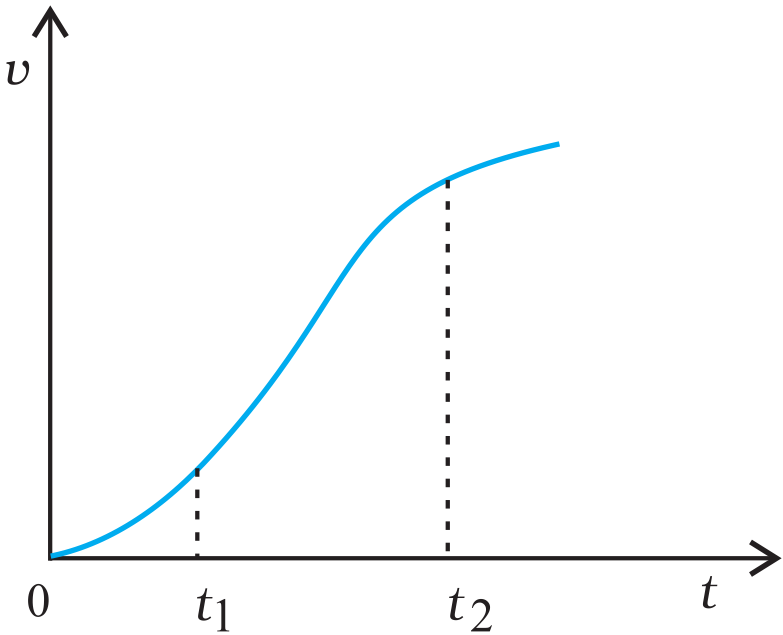
The velocity-time graph of a particle in one-dimensional motion is shown in:

Which of the following formulae are correct for describing the motion of the particle over the time-interval $t_1$ to $t_2$:
a. $x\left(t_2\right)=x\left(t_1\right)+v\left(t_1\right)\left(t_2-t_1\right)+(1 / 2) a\left(t_2-t_1\right)^2$
b. $v\left(t_2\right)=v\left(t_1\right)+a\left(t_2-t_1\right)$
c. $v_{\text {average }}=\left(x\left(t_2\right)-x\left(t_1\right)\right) /\left(t_2-t_1\right)$
d. $\mathrm{a}_{\text {average }}=\left(\mathrm{v}\left(\mathrm{t}_2\right)-\mathrm{v}\left(\mathrm{t}_1\right)\right) /\left(\mathrm{t}_2-\mathrm{t}_1\right)$
e. $x\left(t_2\right)=x\left(t_1\right)+v_{\text {average }}\left(t_2-t_1\right)+(1 / 2) a_{\text {average }}\left(t_2-t_1\right)^2$
f. $x\left(t_2\right)-x\left(t_1\right)=$ area under the v-t curve bounded by the $t$-axis and the dotted line shown.
A cylinder containing a gas is lifted from the first floor to the second floor. What is the amount of work done on the gas? What is the amount of work done by the gas? Is the internal energy of the gas increased? Is the temperature of the gas increased?
An ideal refrigerator is working between the temperature of ice and temperature of atmosphere at $300K$. Find the energy which has been supplied to it to freeze $2kg$ of water at $0°C$. Given that latent heat of ice $3.33 × 10⁵J/ kg$.
5 g of a gas is contained in a rigid container and is heated from $15^{\circ} \mathrm{C}$ to $25^{\circ} \mathrm{C}$. Specific heat capacity of the gas at constant volume is $0.172 \mathrm{cal} {-\mathrm{g}^{-1}{ }^{\circ} \mathrm{C}^{-1}}$ and the mechanical equivalent of heat is $4.2 \mathrm{~J}-\mathrm{cal}^{-1}$. Calculate the change in the internal energy of the gas.
Express unified atomic mass unit in kg.
What is a couple? What effect does it have on a body? Show that moment of couple is same irrespective of the point of rotation of the body.
What is the nature of sound waves in air? How is the speed of sound waves in atmosphere affected by the $(i)$ humidity $(ii)$ temperature?
A wire carries an alternating current $\text{i}=\text{i}_0\sin\omega\text{t}.$ Is there an electric field in the vicinity of the wire?
Briefly explain how physics is related to technology.