MCQ
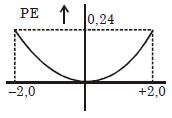
A particle executing $S.H.M.$ its potential energy $V/S$ displacement graph is given  by The value of restoring force constant is ..... $N/m$
  • $12$
  • B
    $24$
  • C
    $6$
  • D
    $48$

Answer

Correct option: A.
$12$
a
Here $\frac{1}{2} \mathrm{KA}^{2}=24$

$A=2$

Need a full question paper?

Generate a complete, print-ready paper with questions like this in minutes — across 16+ boards, with answer keys.
Start Generating Free

Similar questions

The heavier nuclei tend to have larger $\frac{\text{N}}{\text{Z}}$ ratio because:
  1. A neutron is heavier than a proton.
  2. A neutron is an unstable particle.
  3. A neutron does not exert electric repulsion.
  4. Coulomb forces have longer range compared to the nuclear forces.
If $x, v$ and $a$ denote the displacement, the velocity and the acceleration of a particle executing simple harmonic motion of time period $T$, then, which of the following does not change with time?
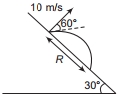
A projectile is launched with a speed of $10\,m / s$ at an angle $60^{\circ}$ with the horizontal from a sloping surface of inclination $30^{\circ}$. The range $R$ is $........\,m$ (Take $g=10\,m / s ^2$ )
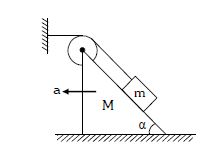
In the adjoining figure if acceleration of $M$ with respect to ground is $a$, then
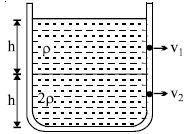
Equal volumes of two immiscible liquids of densities $\rho$ and $2\rho$ are filled in a vessel as shown in figure. Two small holes are punched at depth $h/ 2$ and $3h/2$ from the surface of lighter liquid. If $v_1 $ and $v_2 $ are the velocities of a flux at these two holes, then $v_1/v_2 $ is : 
The earth (mass $ = 6 \times {10^{24}}\,kg)$) revolves round the sun with angular velocity $2 \times {10^{ - 7}}\,rad/s$ in a circular orbit of radius $1.5 \times {10^8}\,km$. The force exerted by the sun on the earth in newtons, is
A particle is moving with a constant speed along a straight line path. A force is not required to
A particle moves in $\mathrm{x}-\mathrm{y}$ plane under the influence of a force $\vec{F}$ such that its linear momentum is $\vec{P}(t)=\hat{i} \cos (k t)-\hat{j} \sin (k t)$. If $k$ is constant, the angle between $\overrightarrow{\mathrm{F}}$ and $\overrightarrow{\mathrm{P}}$ will be :
In a sonometer wire, the tension is maintained by suspending a $50.7 kg$ mass from the free end of the wire. The suspended mass has a volume of $ 0.0075 \, m^3$. The fundamental frequency of the wire is $260 Hz$. If the suspended mass is completely submerged in water, the fundamental frequency will become .... $Hz$ (take $g = 10 ms^{-2}$)
A small steel sphere of mass $m$ is falling vertically through a viscous liquid with a constant speed $v$ . Which row in the table correctly describes the changes with time in the kinetic energy and gravitational potential energy of the sphere?

Kinetic Energy || Gravitational Potential Energy