A particle executing $SHM$ of amplitude $4\,cm$ and $T = 4s.$ The time taken by it to move from $+2\,cm$ to $+2\sqrt 3\,cm$ is
Diffcult
Download our app for free and get started
$\mathrm{x}=\mathrm{a} \sin \omega \mathrm{t}$
$2=4 \sin \omega t_{1} \Rightarrow \frac{1}{2}=\sin \omega t_{1} \Rightarrow \omega t_{1}=\frac{\pi}{6}$
and $2 \sqrt{3}=4 \sin \omega \mathrm{t}_{2} \quad \Rightarrow \frac{\sqrt{3}}{2}=\omega \mathrm{t}_{2}=\frac{2 \pi}{6}$
$\therefore \omega\left(t_{2}-t_{1}\right)=\frac{2 \pi}{6}-\frac{\pi}{6}=\frac{\pi}{6}$
$\Rightarrow \mathrm{t}_{2}-\mathrm{t}_{1}=\frac{\pi}{6} \times \frac{1}{\omega}=\frac{\pi}{6} \times \frac{\mathrm{T}}{2 \pi}=\frac{\mathrm{T}}{12}=\frac{4}{12}=\frac{1}{3} \mathrm{s}$

Download our appand get started for free
Experience the future of education. Simply download our apps or reach out to us for more information. Let's shape the future of learning together!No signup needed.*
Similar Questions
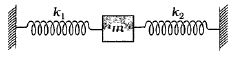
- 1Two springs, of force constants $k_1$ and $k_2$ are connected to a mass $m$ as shown. The frequency of oscillation of the mass is $f$ If both $k_1$ and $k_2$ are made four times their original values, the frequency of oscillation becomesView Solution
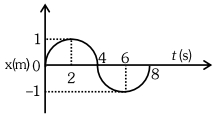
- 2The $x-t$ graph of a particle performing simple harmonic motion is shown in the figure. The acceleration of the particle at $t=2 s$ is :View Solution
- 3A simple pendulum has time period 't'. Its time period in a lift which is moving upwards with acceleration $3 ms ^{-2}$ isView Solution
- 4A particle performs simple harmonic motion with amplitude A. Its speed is increased to three times at an instant when its displacement is $\frac{2 \mathrm{~A}}{3}$. The new amplitude of motion is $\frac{\mathrm{nA}}{3}$. The value of $\mathrm{n}$ is____.View Solution
- 5For a body executing $S.H.M. :$View Solution
$(a)$ Potential energy is always equal to its $K.E.$
$(b)$ Average potential and kinetic energy over any given time interval are always equal.
$(c)$ Sum of the kinetic and potential energy at any point of time is constant.
$(d)$ Average $K.E.$ in one time period is equal to average potential energy in one time period.
Choose the most appropriate option from the options given below:
- 6Velocity at mean position of a particle executing $S.H.M.$ is $v$, they velocity of the particle at a distance equal to half of the amplitudeView Solution
- 7A simple pendulum of length $l$ and mass $m$ of the bob is suspended in a car that is travelling with a constant speed $v$ around a circular path of radius $R$. If the pendulum undergoes oscillations with small amplitude about its equilibrium position, the frequency of its oscillations will beView Solution
- 8Two springs of force constants $300\, N / m$ (Spring $A$) and $400$ $N / m$ (Spring $B$ ) are joined together in series. The combination is compressed by $8.75\, cm .$ The ratio of energy stored in $A$ and $B$ is $\frac{E_{A}}{E_{B}} .$ Then $\frac{E_{A}}{E_{B}}$ is equal toView Solution
- 9A mass m oscillates with simple harmonic motion with frequency $f = \frac{\omega }{{2\pi }}$ and amplitude A on a spring with constant $K$ , thereforeView Solution
- 10There is a simple pendulum hanging from the ceiling of a lift. When the lift is stand still, the time period of the pendulum is $T$. If the resultant acceleration becomes $g/4,$ then the new time period of the pendulum isView Solution