MCQ
A particle has initial velocity of $\left( {\widehat i + \widehat j} \right)\, m/s$ and an acceleration of $\left( {\widehat i + \widehat j} \right)\, m/s^2$. Its speed after $10s$ will be :-
  • A
    $11\, m/s$
  • B
    $22\, m/s$
  • C
    $2 \sqrt {11}\, m/s$
  • $11\sqrt 2 \,m/s$

Answer

Correct option: D.
$11\sqrt 2 \,m/s$
d
$\overrightarrow{\mathrm{v}}=\overrightarrow{\mathrm{u}}+\overrightarrow{\mathrm{a} t}$

$\overrightarrow{\mathrm{v}}=(\hat{\mathrm{i}}+\hat{\mathrm{j}})+(\hat{\mathrm{i}}+\hat{\mathrm{j}}) \cdot 10$

$\overrightarrow{\mathrm{v}}=11 \hat{\mathrm{i}}+11 \hat{\mathrm{j}}$

$|\overrightarrow{\mathrm{v}}|=11 \sqrt{2} \mathrm{m} / \mathrm{s}$

Need a full question paper?

Generate a complete, print-ready paper with questions like this in minutes — across 16+ boards, with answer keys.

Start Generating Free

Similar questions

The persistence of sound in a room after the source of sound is turned off is called reverberation. The measure of reverberation time is the time required for sound intensity to decrease by $60 \,dB$. It is given that the intensity of sound falls off as $I_0 \exp \left(-c_1 \alpha\right)$ where $I_0$ is the initial intensity, $c_1$ is a dimensionless constant with value $1 / 4$. Here, $\alpha$ is a positive constant which depends on the speed of sound, volume of the room, reverberation time, and the effective absorbing area $A_e$. The value of $A_e$ is the product of absorbing coefficient (with value between $0$ and $1,1$ being a perfect absorber) and the area of the room. For a concert hall of volume $600 \,m ^3$, the value of $A_e$ (in $m ^2$ ) required to give a reverberation time of $1 s$ is closest to (speed of sound in air $=340 \,m / s$ )
As the temperature is increased, the time period of a pendulum.
A wire fixed at the upper end stretches by length $l$ by applying a force $F$. The work done in stretching is
If momentum $[ P ]$, area $[ A ]$ and time $[ T ]$ are taken as fundamental quantities, then the dimensional formula for coefficient of viscosity is :
Young's modulus of elasticity $Y$ is expressed in terms of three derived quantities, namely, the gravitational constant $G$, Planck's constant $h$ and the speed of light $c$, as $Y=c^\alpha h^\beta G^\gamma$. Which of the following is the correct option?
The isothermal bulk modulus of a gas at atmospheric pressure is
A wound watch spring has $...........$ energy.
Two masses $2 \,kg$ and $3 \,kg$ are attached to the end of the string passed over a pulley fixed at the top. The tension and acceleration are
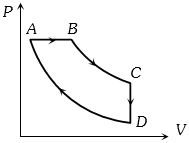
A cyclic process $ABCD$ is shown in the figure $P-V$ diagram. Which of the following curves represent the same process
Ice is used in a cooler in order to cool its contents. Which of the following will speed up the cooling process?