MCQ
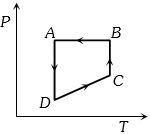
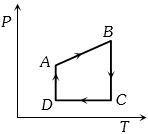
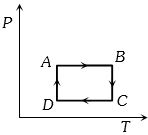
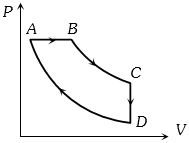
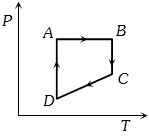
A cyclic process $ABCD$ is shown in the figure $P-V$ diagram. Which of the following curves represent the same process

  • B

  • C

  • D

Answer

Correct option: A.

a
(a) $AB$ is isobaric process, $BC$ is isothermal process, $CD$ is isometric process and $DA$ is isothermal process
These process are correctly represented by graph $ (a).$

Need a full question paper?

Generate a complete, print-ready paper with questions like this in minutes — across 16+ boards, with answer keys.
Start Generating Free

Similar questions

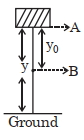
In the given figure, the block of mass $m$ is dropped from the point ' $A$ '. The expression for kinetic energy of block when it reaches point ' $B$ ' is ................
An iron sphere weighing $10\, N$ rests in a $V$ shaped smooth trough whose sides form an angle of $60^o$ as shown in the figure. Then the reaction forces are
For a particle performing uniform circular motion, choose the correct statement$(s)$ from the following:
  1. Magnitude of particle velocity $($speed$)$ remains constant.
  2. Particle velocity remains directed perpendicular to radius vector.
  3. Direction of acceleration keeps changing as particle moves.
  4. Angular momentum is constant in magnitude but direction keeps changing.
The amplitude of a wave represented by displacement equation $y = \frac{1}{{\sqrt a }}\sin \omega t \pm \frac{1}{{\sqrt b }}\cos \omega t$ will be
The moment of inertia of a uniform semicircular wire of mass $m$ and radius $r$, about an axis passing through its centre of mass and perpendicular to its plane is ..........
A travelling wave passes a point of observation. At this point, the time interval between successive crests is $0.2$ seconds and
For a certain organ pipe three successive resonance frequencies are observed at $425 \,\,Hz$, $595\,\, Hz$ and $765\,\, Hz$ respectively. If the speed of sound in air is $340 \,\,m/s$, then the length of the pipe is .... $m$
What is the velocity of the bob of a simple pendulum at its mean position, if it is able to rise to vertical height of $10cm$  ......... $m/s$ (Take $g = 9.8\,m/{s^2})$
Certain neutron stars are believed to be rotating at about $1\,rev/\sec $. If such a star has a radius of $ 20\, km$, the acceleration of an object on the equator of the star will be
A particle starts from rest, accelerates at $2 \,ms^{-2}$ for $10\,s$ and then goes for constant speed for $30\,s$ and then decelerates at $ 4\, ms^{-2}$ till it stops. What is the distance travelled by it.........$m$