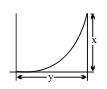
$A$ particle having charge $q$ enters a region of uniform magnetic field $\vec B$ (directed inwards) and is deflected a distance $x$ after travelling a distance $y$. The magnitude of the momentum of the particle is:
Advanced
Download our app for free and get started

Download our appand get started for free
Experience the future of education. Simply download our apps or reach out to us for more information. Let's shape the future of learning together!No signup needed.*
Similar Questions
- 1A galvanometer having coil resistance $10 \ \Omega$ shows a full scale deflection for a current of $3 \mathrm{~mA}$. For it to measure a current of $8 \mathrm{~A}$, the value of the shunt should be:View Solution
- 2A straight conductor carries a current of $5A$. An electron travelling with a speed of $5 \times {10^6}\,m{s^{ - 1}}$ parallel to the wire at a distance of $0.1\,m$ from the conductor, experiences a force ofView Solution
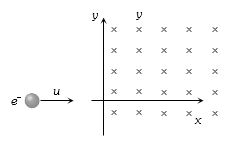
- 3An electron moving with a speed $u$ along the positive $x-$axis at $y = 0$ enters a region of uniform magnetic field $\overrightarrow B = - {B_0}\hat k$ which exists to the right of $y$-axis. The electron exits from the region after some time with the speed $v$ at co-ordinate $y$, thenView Solution
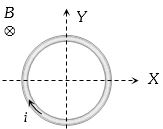
- 4A conducting loop carrying a current $I$ is placed in a uniform magnetic field pointing into the plane of the paper as shown. The loop will have a tendency toView Solution
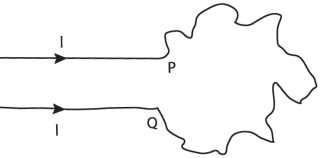
- 5Assertion $(A):$ A wire bent into an irregular shape with the points $P$ and $Q$ fixed. If a current $I$ passed through the wire, then the area enclosed by the irregular portion of the wire increases.View Solution
Reason $(R):$ Opposite currents carrying wires repel each other.
- 6An insulating thin rod of length $l$ has a linear charge density $\rho \left( x \right) = {\rho _0}\,\frac{x}{l}$ on it. The rod is rotated about an axis passing through the origin $(x = 0)$ and perpendicular to the rod. If the rod makes $n$ rotations per second, then the time averaged magnetic moment of the rod isView Solution
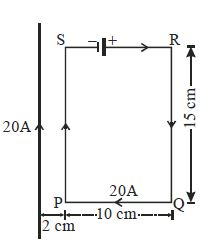
- 7The resultant force on the current loop $PQRS$ due to a long current carrying conductor will beView Solution
- 8Consider two thin identical conducting wires covered with very thin insulating material. One of the wires is bent into a loop and produces magnetic field $B_1,$ at its centre when a current $I$ passes through it.The second wire is bent into a coil with three identical loops adjacent to each other and produces magnetic field $B_2$ at the centre of the loops when current $I/3$ passes through it. The ratio $B_1 : B_2$ isView Solution
- 9The current sensitivity of a moving coil galvanometer increases by $20 \%$ when its resistance is doubled. Calculate, by what factor does the voltage sensitivity change?View Solution
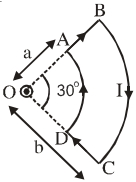
- 10A current loop $ABCD$ is held fixed on the plane of the paper as shown in the figure. The arcs $ BC$ (radius $= b$) and $DA $ (radius $= a$) of the loop are joined by two straight wires $AB $ and $CD$. A steady current $I$ is flowing in the loop. Angle made by $AB$ and $CD$ at the origin $O$ is $30^o $. Another straight thin wire with steady current $I_1$ flowing out of the plane of the paper is kept at the origin.View Solution
The magnitude of the magnetic field $(B)$ due to the loop $ABCD$ at the origin $(O)$ is :