MCQ
A particle initially at rest moves along the $x$-axis. Its acceleration varies with time as $a=4\,t$. If it starts from the origin, the distance covered by it in $3\,s$ is $...........\,m$
  • A
    $12$
  • $18$
  • C
    $24$
  • D
    $36$

Answer

Correct option: B.
$18$
b
$a=4 t$

Integrating,

$v=\frac{4 t^2}{2}=2 t^2$

again integrating

$d=\frac{2 t^3}{3}$

$t=3$

$d=\frac{2 \times 27}{3}=2 \times 9=18$

Need a full question paper?

Generate a complete, print-ready paper with questions like this in minutes — across 16+ boards, with answer keys.
Start Generating Free

Similar questions

$B _{ X }$ and $B _{ Y }$ are the magnetic field at the centre of two coils of two coils $X$ and $Y$ respectively, each carrying equal current. If coil $X$ has $200$ turns and $20 cm$ radius and coil $Y$ has $400$ turns and $20 cm$ radius, the ratio of $B _{ X }$ and $B _{ Y }$ is
The graph between $E$ and $v$ is
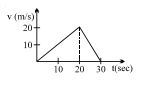
$v-t$ graph of an object of mass $1\,\, kg$ is shown
A charge $q$ is placed at the center of one of the surface of a cube. The flux linked with the cube is :-
The velocity of a small ball of mass ' $m$ ' and density $d _{1}$, when dropped in a container filled with glycerine, becomes constant after some time. If the density of glycerine is $d _{2}$, then the viscous force acting on the ball, will be
A charged particle is released from rest in a region of uniform electric and magnetic fields which are parallel to each other. The particle will move on a
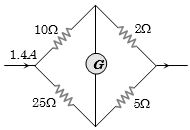
In the circuit shown in the figure, the current flowing in $2\,\Omega $ resistance ............... $A$
The self produced $emf$ of a coil is $25\,volts$. When the current in it is changed at uniform rate from $10\,A$ to $25\, A$ in $1\,s$, the change in the energy of the inductance is......$J$
A uniform chain of length $L$ which hanges partially from a table, is kept in equilibrium by friction. The maximum length that can withstand without slipping is $l$ , then coefficient of friction between the table and the chain is
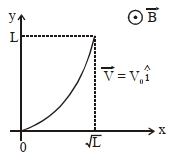
A conducting wire of parabolic shape, initially $y=x^2$, is moving with velocity $\overrightarrow{ V }= V _0 \hat{ i }$ in a nonuniform magnetic field $\vec{B}=B_0\left(1+\left(\frac{y}{L}\right)^\beta\right) \hat{k}$, as shown in figure. If $V_0, B_0, L$ and $\beta$ are positive constants and $\Delta \phi$ is the potential difference developed between the ends of the wire, then the correct statement(s) is/are:

$(1)$ $|\Delta \phi|$ remains the same if the parabolic wire is replaced by a straight wire, $y=x$ initially, of length $\sqrt{2} L$

$(2)$ $|\Delta \phi|$ is proportional to the length of the wire projected on the $y$-axis.

$(3)$ $|\Delta \phi|=\frac{1}{2} B _0 V _0 L$ for $\beta=0$

$(4)$ $|\Delta \phi|=\frac{4}{3} B_0 V_0 L$ for $\beta=2$