MCQ
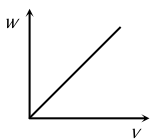
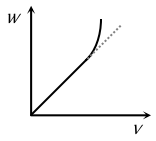
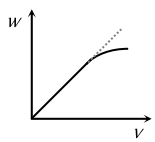
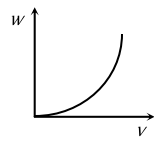
A particle, initially at rest on a frictionless horizontal surface, is acted upon by a horizontal force which is constant in size and direction. A graph is plotted between the work done $(W)$ on the particle, against the speed of the particle, $(v)$. If there are no other horizontal forces acting on the particle the graph would look like
  • A

    Image
  • B

    Image
  • C

    Image

  • Image

Answer

Correct option: D.

Image
(d) Work done = change in kinetic energy$W=\frac{1}{2} m v^2 \therefore W \propto v^2$graph will be parabolic in nature

Need a full question paper?

Generate a complete, print-ready paper with questions like this in minutes — across 16+ boards, with answer keys.

Start Generating Free

Similar questions

A ball is dropped from top of a tower of $100 m$ height. Simultaneously another ball was thrown upward from bottom of the tower with a speed of $50 m / s \left(g=10 m / s ^2\right)$. They will cross each other after
A metal ball of mass $2 \mathrm{~kg}$ moving with a velocity of $36 \mathrm{~km} / \mathrm{h}$ has an head on collision with a stationary ball of mass $3 \mathrm{~kg}$. If after the collision, the two balls move together, the loss in kinetic energy due to collision is
An object $1 \mathrm{~cm}$ tall is placed $4 \mathrm{~cm}$ infront of a mirror. In order to produce an upright image of $3 \mathrm{~cm}$ height one needs a
The area of cross-section of a wire of length 1.1 metre is $1 mm$. It is loaded with $1 kg$. If Young's modulus of copper is $1.1 \times 10^{11} N / m ^2$, then the increase in length will be (If $\left.g=10 m / s ^2\right)$
A simple harmonic progressive wave is represented by the equation : $y=8 \sin 2 \pi(0.1 x-2 t)$ where $x$ and $y$ are in $\mathrm{cm}$ and $t$ is in seconds. At any instant the phase difference between two particles separated by $2.0 \mathrm{~cm}$ in the $x-$ direction is
Davission and Germer experiment proved
The mass of a planet that has a moon whose time period and orbital radius are $T$ and $R$ respectively can be written as
The period of oscillation of a simple pendulum is given by $T=2 \pi \sqrt{\frac{l}{g}}$ where $l$ is about $100 cm$ and is known to have $1 mm$ accuracy. The period is about $2 s$. The time of 100 oscillations is measured by a stop watch of least count $0.1 s$. The percentage error in $g$ is
A stone of mass $m$ is tied to a string of length $l$ and rotated in a circle with a constant speed $v$. If the string is released, the stone flies
A rope of length $L$ is pulled by a constant force $F$. What is the tension in the rope at a distance $x$ from the end where the force is applied