MCQ 11 Mark
Four smooth steel balls of equal mass at rest are free to move along a straight line without friction. The first ball is given a velocity of $0.4 \mathrm{~m} / \mathrm{s}$. It collides head on with the second elastically, the second one similarly with the third and so on. The velocity of the last ball is
- ✓
$0.4 \mathrm{~m} / \mathrm{s}$
- B
$0.2 \mathrm{~m} / \mathrm{s}$
- C
$0.1 \mathrm{~m} / \mathrm{s}$
- D
$0.05 \mathrm{~m} / \mathrm{s}$
AnswerCorrect option: A. $0.4 \mathrm{~m} / \mathrm{s}$
In head on elastic collision velocity get interchanged (if masses of particle are equal). i.e. the last ball will move with the velocity of first ball i.e $0.4 \mathrm{~m} /\mathrm{s}$
View full question & answer→MCQ 21 Mark
Consider elastic collision of a particle of mass $m$ moving with a velocity $u$ with another particle of the same mass at rest. After the collision the projectile and the struck particle move in directions making angles $\theta_1$ and $\theta_2$ respectively with the initial direction of motion. The sum of the angles. $\theta_1+\theta_2$, is
- A
$45^{\circ}$
- ✓
$90^{\circ}$
- C
$135^{\circ}$
- D
$180^{\circ}$
AnswerCorrect option: B. $90^{\circ}$
(b) If the masses are equal and target is at rest and after collision both masses moves in different direction. Then angle between direction of velocity will be $90^{\circ}$, ifcollision is elastic.
View full question & answer→MCQ 31 Mark
An object of mass $3 \mathrm{~m}$ splits into three equal fragments. Two fragments have velocities $\hat{v j}$ and $\hat{v i}$. The velocity of the third fragment is
AnswerCorrect option: C. $-v(\hat{i}+\hat{j})$
View full question & answer→MCQ 41 Mark
$1$ a.m.u. is equivalent to
- A
$1.6 \times 10^{-12}$ Joule
- B
$1.6 \times 10^{-19}$ Joule
- ✓
$1.5 \times 10^{-10}$ Joule
- D
$1.5 \times 10^{-19}$ Joule
AnswerCorrect option: C. $1.5 \times 10^{-10}$ Joule
$1 \mathrm{amu}=1.66 \times 10^{-27} \mathrm{~kg}$
$E=mc^2=1.66 \times10^{-27} \times \left(3 \times 10^8\right)^2=1.5 \times 10^{-10} \mathrm{~J}$
View full question & answer→MCQ 51 Mark
A particle of mass ' $m$ ' and charge ' $q$ ' is accelerated through a potential difference of ' $\mathrm{V}$ ' volt. Its energy is
View full question & answer→MCQ 61 Mark
The energy which an $e^{-}$acquires when accelerated through a potential difference of 1 volt is called
View full question & answer→MCQ 71 Mark
Two bodies of masses $1 \mathrm{~kg}$ and $5 \mathrm{~kg}$ are dropped gently from the top of a tower. At a point $20 \mathrm{~cm}$ from the ground, both the bodies will have the same
Answer(c) Velocity of fall is independent of the mass of the falling body.
View full question & answer→MCQ 81 Mark
Two identical cylindrical vessels with their bases at same level each contains a liquid of density $\rho$. The height of the liquid in one vessel is $h_1$ and that in the other vessel is $h_2$. The area of either base is$A$. The work done by gravity in equalizing the levels when the two vessels are connected, is
- A
$\left(h_1-h_2\right) g \rho$
- B
$\left(h_1-h_2\right) g A \rho$
- C
$\frac{1}{2}\left(h_1-h_2\right)^2 g A \rho$
- ✓
$\frac{1}{4}\left(h_1-h_2\right)^2 g A \rho$
AnswerCorrect option: D. $\frac{1}{4}\left(h_1-h_2\right)^2 g A \rho$
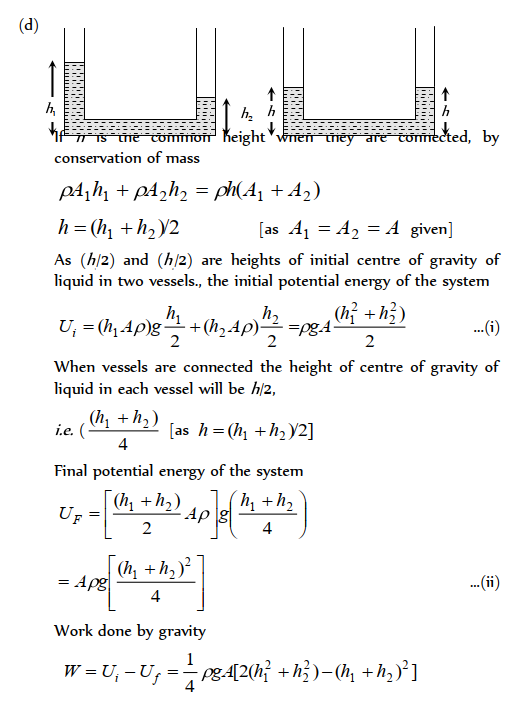
$=\frac{1}{4} \rho g A\left(h_1 \sim h_2\right)^2$ View full question & answer→MCQ 91 Mark
The average power required to lift a $100 \mathrm{~kg}$ mass through a height of $50$ metres in approximately $50$ seconds would be
- A
$50 \mathrm{~J} / \mathrm{s}$
- B
$5000 \mathrm{~J} / \mathrm{s}$
- C
$100 \mathrm{~J} / \mathrm{s}$
- ✓
$980\mathrm{~J}/\mathrm{s}$
AnswerCorrect option: D. $980\mathrm{~J}/\mathrm{s}$
$P=\frac{m g h}{t}=\frac{100 \times 9.8 \times 50}{50}=980\mathrm{~J}/\mathrm{s}$
View full question & answer→MCQ 101 Mark
A body of mass $10 \mathrm{~kg}$ is dropped to the ground from a height of $10$ metres. The work done by the gravitational force is $\left(g=9.8 \mathrm{~m} / \mathrm{sec}^2\right)$
- A
$-490$ Joules
- B
$+490$ Joules
- C
$-980$ Joules
- ✓
$+980$ Joules
AnswerCorrect option: D. $+980$ Joules
As the body moves in the direction of force therefore work done by gravitationalforcewill be positive.
$W=F S=m g h=10 \times 9.8 \times 10=980 J$
View full question & answer→MCQ 111 Mark
Two masses $m_A$ and $m_B$ moving with velocities $v_A$ and $v_B$ in opposite directions collide elastically. After that the masses $m_A$ and $m_B$ move with velocity $v_B$ and $v_A$ respectively. The ratio $\left(m_A / m_B\right)$ is
Answer(a) Since bodies exchange their velocities, hence their masses are equal so that $\frac{m_A}{m_B}=1$
View full question & answer→MCQ 121 Mark
The work done against gravity in taking $10 \mathrm{~kg}$ mass at $1 \mathrm{~m}$ height in lsec will be
- A
$49 \mathrm{~J}$
- ✓
$98 \mathrm{~J}$
- C
$196 \mathrm{~J}$
- D
AnswerCorrect option: B. $98 \mathrm{~J}$
Work done $=m g h=10 \times 9.8 \times 1=98 \mathrm{~J}$
View full question & answer→MCQ 131 Mark
A ball is released from certain height. It loses $50 \%$ of its kinetic energy on striking the ground. It will attain a height again equal to
- A
One fourth the initial height
- ✓
- C
Three fourth initial height
- D
Answer(b) Because $50 \%$ loss in kinetic energy will affect its potential energy and due to this ball will attain only half of the initial height.
View full question & answer→MCQ 141 Mark
A space craft of mass $M$ is moving with velocity $V$ and suddenly explodes into two pieces. A part of it of mass $m$ becomes at rest, then the velocity of other part will be
- ✓
$\frac{M V}{M-m}$
- B
$\frac{M V}{M+m}$
- C
$\frac{m V}{M-m}$
- D
$\frac{(M+m) V}{m}$
AnswerCorrect option: A. $\frac{M V}{M-m}$
After explosion $m$ mass comes at rest and let Rest $(M-m)$ mass moves with velocity$v$.
By the law of conservation of momentum $M V=(M-m) v$
$\Rightarrow v=\frac{M V}{(M-m)}$
View full question & answer→MCQ 151 Mark
A steel ball of radius $2 \mathrm{~cm}$ is at rest on a frictionless surface. Another ball of radius $4 \mathrm{~cm}$ moving at a velocity of $81 \mathrm{~cm} / \mathrm{sec}$ collides elastically with first ball. After collision the smaller ball moves with speed of
- A
$81 \mathrm{~cm} / \mathrm{sec}$
- B
$63 \mathrm{~cm} / \mathrm{sec}$
- ✓
$144 \mathrm{~cm} / \mathrm{sec}$
- D
AnswerCorrect option: C. $144 \mathrm{~cm} / \mathrm{sec}$
View full question & answer→MCQ 161 Mark
A body of mass $50 \mathrm{~kg}$ is projected vertically upwards with velocity of $100 \mathrm{~m} / \mathrm{sec} .5$ seconds after this body breaks into $20 \mathrm{~kg}$ and $30 \mathrm{~kg}$. If $20 \mathrm{~kg}$ piece travels upwards with $150 \mathrm{~m} / \mathrm{sec}$, then the velocity of other block will be
- ✓
$15 \mathrm{~m} / \mathrm{sec}$ downwards
- B
$15 \mathrm{~m} / \mathrm{sec}$ upwards
- C
$51 \mathrm{~m} / \mathrm{sec}$ downwards
- D
$51 \mathrm{~m} / \mathrm{sec}$ upwards
AnswerCorrect option: A. $15 \mathrm{~m} / \mathrm{sec}$ downwards
(a) Velocity of $50 \mathrm{~kg}$. mass after $5\mathrm{sec}$ of projection $(v=ugt=100-9.8\times 5=51 \mathrm{~m} / \mathrm{s})$
At this instant momentum of body is in upward direction $P_{\text{initial }}=50 \times 51=2550 \mathrm{~kg}-\mathrm{m} / \mathrm{s}$
After breaking $20 \mathrm{~kg}$ piece travels upwards with $150 \mathrm{~m} / \mathrm{s}$ let the speed of$30\mathrm{~kg}$ mass is $VP_{\text {final }}=20 \times 150+30 \times V$
By the law of conservation of momentum
$P_{\text {initial }} =P_{\text {final }} \Rightarrow 2550=20 \times150+30\times V \Rightarrow V=-15 \mathrm{~m} / \mathrm{s}$
i.e. it moves in downward direction.
View full question & answer→MCQ 171 Mark
An object of $1 \mathrm{~kg}$ mass has a momentum of $10 \mathrm{~kg} \mathrm{~m} / \mathrm{sec}$ then the kinetic energy of the object will be
- A
$100 \mathrm{~J}$
- ✓
$50 \mathrm{~J}$
- C
$1000 \mathrm{~J}$
- D
$200 \mathrm{~J}$
AnswerCorrect option: B. $50 \mathrm{~J}$
(b) $E=\frac{P^2}{2 m}=\frac{(10)^2}{2 \times 1}=50 \mathrm{~J}$
View full question & answer→MCQ 181 Mark
A ball is dropped from a height $h$. If the coefficient of restitution be $e$, then to what height will it rise after jumping twice from the ground
- A
$e h / 2$
- B
$2 e h$
- C
$e h$
- ✓
$e^4 h$
AnswerCorrect option: D. $e^4 h$
(d) $h_n=h e^{2 n}$, if $n=2$ then $h_n=h e^4$
View full question & answer→MCQ 191 Mark
A sphere of mass $m$ moving with a constant velocity $u$ hits another stationary sphere of the same mass. If $e$ is the coefficient of restitution, then the ratio of the velocity of two spheres after collision will be
- ✓
$\frac{1-e}{1+e}$
- B
$\frac{1+e}{1-e}$
- C
$\frac{e+1}{e-1}$
- D
$\frac{e-1}{e+1} t^2$
AnswerCorrect option: A. $\frac{1-e}{1+e}$
View full question & answer→MCQ 201 Mark
An inelastic ball is dropped from a height of $100 \mathrm{~m}$. Due to earth, $20 \%$ of its energy is lost. To what height the ball will rise
- ✓
$80 \mathrm{~m}$
- B
$40 \mathrm{~m}$
- C
$60 \mathrm{~m}$
- D
$20 \mathrm{~m}$
AnswerCorrect option: A. $80 \mathrm{~m}$
(a) $m g h=\frac{80}{100} \times m g \times 100 \Rightarrow h=80 m$
View full question & answer→MCQ 211 Mark
In the elastic collision of objects
- A
Only momentum remains constant
- B
Only K.E. remains constant
- ✓
- D
View full question & answer→MCQ 221 Mark
A tennis ball is released from height $h$ above ground level. If the ball makes inelastic collision with the ground, to what height will it rise after third collision
- ✓
$h e^6$
- B
$e^2 h$
- C
$e^3 h$
- D
AnswerCorrect option: A. $h e^6$
(a) $\quad h_n=h e^{2 n}$ after third collision $h_3=h e^6 \quad$ [as $n=3$ ]
View full question & answer→MCQ 231 Mark
A particle of mass $m$ moving with velocity $V_0$ strikes a simple pendulum of mass $m$ and sticks to it. The maximum height attained by the pendulum will be
- ✓
$h=\frac{V_0^2}{8 g}$
- B
$\sqrt{V_0 g}$
- C
$2 \sqrt{\frac{V_0}{g}}$
- D
$\frac{V_0^2}{4 g}$
AnswerCorrect option: A. $h=\frac{V_0^2}{8 g}$
View full question & answer→MCQ 241 Mark
A big ball of mass $M$, moving with velocity $u$ strikes a small ball of mass $m$, which is at rest. Finally small ball obtains velocity $u$ and big ball $v$. Then what is the value of $v$
- ✓
$\frac{M-m}{M+m} u$
- B
$\frac{m}{M+m} u$
- C
$\frac{2 m}{M+m} u$
- D
$\frac{M}{M+m} u$
AnswerCorrect option: A. $\frac{M-m}{M+m} u$
View full question & answer→MCQ 251 Mark
A car of mass $1250 \mathrm{~kg}$ is moving at $30 \mathrm{~m} / \mathrm{s}$. Its engine delivers $30 \mathrm{~kW}$ while resistive force due to surface is $750\ N$. What max acceleration can be given in the car
- A
$\frac{1}{3} \mathrm{~m} / \mathrm{s}^2$
- B
$\frac{1}{4} m / s^2$
- ✓
$\frac{1}{5} \mathrm{~m} / \mathrm{s}^2$
- D
$\frac{1}{6} m / \mathrm{s}^2$
AnswerCorrect option: C. $\frac{1}{5} \mathrm{~m} / \mathrm{s}^2$
Force produced by the engine $F=\frac{P}{v}=\frac{30 \times 10^3}{30}=10 \mathrm{~N}$
$\text { Acceleration }= \frac{\text{Forwardforcebyengine}}{ \text{resistiveforce}}{\text { mass of car }} $
$ =\frac{1000-750}{1250}=\frac{250}{1250}=\frac{1}{5}\mathrm{~m}\mathrm{s}^2$
View full question & answer→MCQ 261 Mark
A bomb of $12 \mathrm{~kg}$ divides in two parts whose ratio of masses is $1: 3$. If kinetic energy of smaller part is $216 \mathrm{~J}$, then momentum of bigger part in $\mathrm{kgm} / \mathrm{sec}$ will be
View full question & answer→MCQ 271 Mark
If the increase in the kinetic energy of a body is $22 \%$, then the increase in the momentum will be
- A
$22 \%$
- B
$44 \%$
- ✓
$10 \%$
- D
$300 \%$
AnswerCorrect option: C. $10 \%$
$P=\sqrt{2 m E}$. If (m) is constant then
$\frac{P_2}{P_1}=\sqrt{\frac{E_2}{E_1}}=\sqrt{\frac{1.22 E}{E}}$
$\Rightarrow \frac{P_2}{P_1}=\sqrt{1.22} =1.1 $
$\Rightarrow P_2=1.1 P_1$
$\Rightarrow P_2=P_1+0.1 P_1=P_1+10 \% \text { of } P_1$
So the momentumwill increase by $10 \%$
View full question & answer→MCQ 281 Mark
A particle $P$ moving with speed $v$ undergoes a head -on elastic collision with another particle $Q$ of identical mass but at rest. After the collision
- A
Both $P$ and $Q$ move forward with speed $\frac{v}{2}$
- B
Both $P$ and $Q$ move forward with speed $\frac{v}{\sqrt{2}}$
- ✓
$P$ comes to rest and $Q$ moves forward with speed $v$
- D
$P$ and $Q$ move in opposite directions with speed $\frac{v}{\sqrt{2}}$
AnswerCorrect option: C. $P$ comes to rest and $Q$ moves forward with speed $v$
View full question & answer→MCQ 291 Mark
A body of mass $m$ moving with velocity $v$ collides head on with another body of mass $2 \mathrm{~m}$ which is initially at rest. The ratio of K.E. of colliding body before and after collision will be
- A
$1: 1$
- B
$2: 1$
- C
$4: 1$
- ✓
$9: 1$
AnswerCorrect option: D. $9: 1$
$\frac{ KE _{\text {before }}}{ kE _{\text {after }}}=\frac{\frac{1}{2} mv ^2}{\frac{1}{2} mv _1^2}=\frac{ V ^2}{V_1^2} $
$ \text { Since } V _1=\frac{ m _1- m _2}{m_1+ m _2} V_1=\frac{ m -2 m}{ m +2 m} V =-\frac{ V }{3}$
$ \text { Hence ratio of } KE =\frac{ V ^2}{V_1^2}=9: 1$
View full question & answer→MCQ 301 Mark
The spring extends by $x$ on loading, then energy stored by the spring is : (if $T$ is the tension in spring and $k$ is spring constant)
- ✓
$\frac{T^2}{2 k}$
- B
$\frac{T^2}{2 k^2}$
- C
$\frac{2 k}{T^2}$
- D
$\frac{2 T^2}{k}$
AnswerCorrect option: A. $\frac{T^2}{2 k}$
(a) $U=\frac{F^2}{2 k}=\frac{T^2}{2 k}$
View full question & answer→MCQ 311 Mark
A body moving with velocity $v$ has momentum and kinetic energy numerically equal. What is the value of $v$
- ✓
$2 \mathrm{~m} / \mathrm{s}$
- B
$\sqrt{2} m / s$
- C
$1 \mathrm{~m} / \mathrm{s}$
- D
$0.2 \mathrm{~m} / \mathrm{s}$
AnswerCorrect option: A. $2 \mathrm{~m} / \mathrm{s}$
(a) $P=E \Rightarrow m v=\frac{1}{2} m v^2 \Rightarrow v=2 \mathrm{~m} / \mathrm{s}$
View full question & answer→MCQ 321 Mark
A particle moves from position $\vec{r}_1=3 \hat{i}+2 \hat{j}-6 \hat{k}$ to position $\vec{r}_2=14 \hat{i}+13 \hat{j}+9 \hat{k}$ under the action of force $4 \hat{i}+\hat{j}+3 \hat{k} N$. The work done will be
- ✓
$100 \mathrm{~J}$
- B
$50 \mathrm{~J}$
- C
$200 \mathrm{~J}$
- D
$75 \mathrm{~J}$
AnswerCorrect option: A. $100 \mathrm{~J}$
(a)$W=\vec{F} \cdot\left(\overrightarrow{r_2}-\overrightarrow{r_1}\right)=(4 \hat{i}+\hat{j}+3 \hat{k})(11 \hat{i}+11 \hat{j}+15 \hat{k}$
$W=44+11+45=100\text{Joule}$
View full question & answer→MCQ 331 Mark
A cylinder of mass $10 \mathrm{~kg}$ is sliding on a plane with an initial velocity of $10 \mathrm{~m} / \mathrm{s}$. If coefficient of friction between surface and cylinder is 0.5 , then before stopping it will describe
- A
$12.5 \mathrm{~m}$
- B
$5 \mathrm{~m}$
- C
$7.5 \mathrm{~m}$
- ✓
$10 \mathrm{~m}$
AnswerCorrect option: D. $10 \mathrm{~m}$
(d) $s=\frac{u^2}{2 \mu g}=\frac{10 \times 10}{2 \times 0.5 \times 10}=10 \mathrm{~m}$
View full question & answer→MCQ 341 Mark
A body of mass $40 \mathrm{~kg}$ having velocity $4 \mathrm{~m} / \mathrm{s}$ collides with another body of mass $60 \mathrm{~kg}$ having velocity $2 \mathrm{~m} / \mathrm{s}$. If the collision is inelastic, then loss in kinetic energy will be
- A
$440 \mathrm{~J}$
- B
$392 \mathrm{~J}$
- ✓
$48 \mathrm{~J}$
- D
$144 \mathrm{~J}$
AnswerCorrect option: C. $48 \mathrm{~J}$
Loss in kinetic energy$=\frac{1}{2} \frac{m_1}{ m_2}\left(u_1-u_2\right){^2}{m_1+m_2}$
$=\frac{1}{2}\left(\frac{40 \times 60}{40+60}\right)(4-2)^2=48 \mathrm{~J}$
View full question & answer→MCQ 351 Mark
The quantity that is not conserved in an inelastic collision is
MCQ 361 Mark
Two bodies having same mass $40 \mathrm{~kg}$ are moving in opposite directions, one with a velocity of $10 \mathrm{~m} / \mathrm{s}$ and the other with $7 \mathrm{~m} / \mathrm{s}$. If they collide and move as one body, the velocity of the combination is
- A
$10 \mathrm{~m} / \mathrm{s}$
- B
$7 \mathrm{~m} / \mathrm{s}$
- C
$3 \mathrm{~m} / \mathrm{s}$
- ✓
$1.5 \mathrm{~m} / \mathrm{s}$
AnswerCorrect option: D. $1.5 \mathrm{~m} / \mathrm{s}$
(d) By the conservation of momentum$40 \times 10+(40) \times(-7)=80 \times v \Rightarrow v=1.5 \mathrm{~m} / \mathrm{s}$
View full question & answer→MCQ 371 Mark
A body of mass $5 \mathrm{~kg}$ moving with a velocity $10 \mathrm{~m} / \mathrm{s}$ collides with another body of the mass $20 \mathrm{~kg}$ at, rest and comes to rest. The velocity of the second body due to collision is
- ✓
$2.5 \mathrm{~m} / \mathrm{s}$
- B
$5 \mathrm{~m} / \mathrm{s}$
- C
$7.5 \mathrm{~m} / \mathrm{s}$
- D
$10 \mathrm{~m} / \mathrm{s}$
AnswerCorrect option: A. $2.5 \mathrm{~m} / \mathrm{s}$
(a) Momentum conservation$5\times10+20\times0=5\times0+20\times v\Rightarrow v=2.5\mathrm{~m}/ \mathrm{s}$
View full question & answer→MCQ 381 Mark
If a shell fired from a cannon, explodes in mid air, then
- ✓
Its total kinetic energy increases
- B
lts total momentum increases
- C
lts total momentum decreases
- D
AnswerCorrect option: A. Its total kinetic energy increases
View full question & answer→MCQ 391 Mark
If a force $\vec{F}=4 \hat{i}+5 \hat{j}$ causes a displacement $\vec{s}=3 \hat{i}+6 \hat{k}$, work done is
- A
$4 \times 6$ unit
- B
$6 \times 3$ unit
- C
$5 \times 6$ unit
- ✓
$4 \times 3$ unit
AnswerCorrect option: D. $4 \times 3$ unit
(d) $W=\vec{F} \cdot s=(4 \hat{i}+5 \hat{j}+0 \hat{k}) \cdot(3 \hat{i}+0 \hat{j}+6\hat{k})=4 \times 3$ units
View full question & answer→MCQ 401 Mark
If a man increase his speed by $2 \mathrm{~m} / \mathrm{s}$, his K.E. is doubled, the original speed of the man is
- A
$(1+2 \sqrt{2}) \mathrm{m} / \mathrm{s}$
- B
$4 \mathrm{~m} / \mathrm{s}$
- ✓
$(2+2 \sqrt{2}) \mathrm{m} / \mathrm{s}$
- D
$(2+\sqrt{2}) \mathrm{m} / \mathrm{s}$
AnswerCorrect option: C. $(2+2 \sqrt{2}) \mathrm{m} / \mathrm{s}$
Initial kinetic energy $E=\frac{1}{2} mv^2$
Final kinetic energy $2E=\frac{1}{2m}(v+2)^2$
by solving equation (i) and (ii) we get $v=(2+2 \sqrt{2}) \mathrm{m} / \mathrm{s}$
View full question & answer→MCQ 411 Mark
A force of $2 \hat{i}+3 \hat{j}+4 \hat{k}\ N$ acts on a body for 4 second, produces a displacement of $(3 \hat{i}+4 \hat{j}+5 \hat{k})\ m$. The power used is
- ✓
$9.5 \mathrm{~W}$
- B
$7.5 \mathrm{~W}$
- C
$6.5 \mathrm{~W}$
- D
$4.5 \mathrm{~W}$
AnswerCorrect option: A. $9.5 \mathrm{~W}$
(a) $\quad P=\frac{\vec{F} \cdot \vec{s}}{t}=\frac{(2 \hat{i}+3 \hat{j}+4 \hat{k})\cdot(3 \hat{i}+4 \hat{j}+5 \hat{k})}{4}=\frac{38}{4}=9.5 \mathrm{~W}$
View full question & answer→MCQ 421 Mark
The kinetic energy acquired by a body of mass $m$ is travelling some distance $s$, starting from rest under the actions of a constant force, is directly proportional to
- ✓
$m^0$
- B
$m$
- C
$m^2$
- D
$\sqrt{m}$
Answer(a) K.E. acquired by the body $=$ work done on the body$K . E .=\frac{1}{2} m v^2=F$ S i.e. it does not depend upon the mass of the body although velocity depends upon the mass$v^2 \propto \frac{1}{m}$[If $F$ and $s$ are constant]
View full question & answer→MCQ 431 Mark
A spring with spring constant $k$ is extended from $x=0$ to $x=x_1$.The work done will be
- A
$k x_1^2$
- ✓
$\frac{1}{2} k x_1^2$
- C
$2 k x_1^2$
- D
$2 k x_1$
AnswerCorrect option: B. $\frac{1}{2} k x_1^2$
View full question & answer→MCQ 441 Mark
A spring with spring constant $k$ when stretched through $1 \mathrm{~cm}$, the potential energy is $U$. If it is stretched by $4 \mathrm{~cm}$. The potential energy will be
- A
$4 U$
- B
$8 U$
- ✓
$16 \mathrm{U}$
- D
$2 U$
AnswerCorrect option: C. $16 \mathrm{U}$
(c) Potential energy $U=\frac{1}{2} k x^2$$\therefore U \propto x^2$ [if (k=$constant]If elongation made 4 times then potential energy will become 16 times.
View full question & answer→MCQ 451 Mark
A body of mass $m$ is at rest. Another body of same mass moving with velocity $\mathrm{V}$ makes head on elastic collision with the first body. After collision the first body starts to move with velocity
- ✓
$\mathrm{V}$
- B
$2 \mathrm{~V}$
- C
- D
AnswerCorrect option: A. $\mathrm{V}$
View full question & answer→MCQ 461 Mark
Four particles given, have same momentum which has maximum kinetic energy
Answer$E=\frac{P^2}{2 m} \therefore E \propto \frac{1}{m}$ (If $P=$constant) i.e.thelightest particle will possess maximum kinetic energy and in the given option mass of electron is minimum.
View full question & answer→MCQ 471 Mark
Due to a force of $(6 \hat{i}+2 \hat{j}) N$ the displacement of a body is $(3 \hat{i}-\hat{j}) m$, then the work done is
- ✓
$16 \mathrm{~J}$
- B
$12 \mathrm{~J}$
- C
$8 \mathrm{~J}$
- D
AnswerCorrect option: A. $16 \mathrm{~J}$
Work done $=\vec{F} \cdot \vec{S}$
$=(6 \hat{i}+2 \hat{j})\cdot(3\hat{i}\hat{j})=6\times 3-2 \times 1=18-2=16 \mathrm{~J}$
View full question & answer→MCQ 481 Mark
A mass of $100 \mathrm{~g}$ strikes the wall with speed $5 \mathrm{~m} / \mathrm{s}$ at an angle as shown in figure and it rebounds with the same speed. If the contact time is $2 \times 10^{-3} \mathrm{sec}$, what is the force applied on the mass by the wall
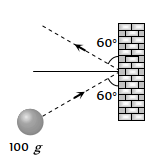
AnswerCorrect option: C. $250 \sqrt{3} N$ to left
Force $=$ Rate of change of momentumInitial momentum $\vec{P}_1=mv\sin\theta\hat{i}+m v \cos \theta \hat{j}$
Final momentum $(\vec{P_2})=mv\sin\theta\hat{i}+mv\cos\theta\hat{j}$
$[\therefore\vec{F}=\frac{\Delta\vec{P}}{\Delta t}=\frac{-2mv\sin\theta}{2\times10^{-3}}$
Substituting $m=0.1 \mathrm{~kg}, v=5 \mathrm{~m} / \mathrm{s}, \theta=60^{\circ}$
Forceon the ball $\vec{F}=-250 \sqrt{3}\ N$Negative sign indicates direction of the force
View full question & answer→MCQ 491 Mark
Two bodies of masses $m$ and $4 \mathrm{~m}$ are moving with equal K.E. The ratio of their linear momentums is
- A
$4: 1$
- B
$1: 1$
- ✓
$1: 2$
- D
$1: 4$
AnswerCorrect option: C. $1: 2$
$9.5 \mathrm{~W}$
$P=\sqrt{2 m E}$
$ \therefore P \propto \sqrt{m} \Rightarrow \frac{P_1}{P_2}=\sqrt{\frac{m_1}{m_2}}=\sqrt{\frac{m}{4 m}}=\frac{1}{2}$
View full question & answer→MCQ 501 Mark
When a spring is stretched by $2 \mathrm{~cm}$, it stores $100 \mathrm{~J}$ of energy. If it is stretched further by $2 \mathrm{~cm}$, the stored energy will be increased by
- A
$100 \mathrm{~J}$
- B
$200 \mathrm{~J}$
- ✓
$300 \mathrm{~J}$
- D
$400 \mathrm{~J}$
AnswerCorrect option: C. $300 \mathrm{~J}$
(c)$100=\frac{1}{2} k x^2 \quad \text { (given) } $
$W=\frac{1}{2}k\left(x_2^2-x_1^2\right)=\frac{1}{2} k\left[(2 x)^2-x^2\right] $
$=3 \times\left(\frac{1}{2} kx^2\right)=3 \times 100=300 \mathrm{~J}$
View full question & answer→