Question
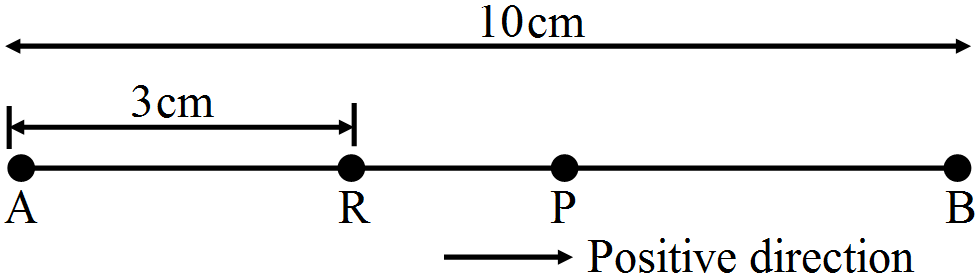
A particle is in linear simple harmonic motion between two points A and B, 10cm apart. Take the direction from A to B as positive direction and give the signs of velocity and acceleration on the particle when it is:
  1. At the end B.
  2. At 3cm away from A going towards B.

Answer


  1. At the end B velocity is zero. Here acceleration and force are negative as they are directed along BR i.e., along negative direction.
  2. At 3cm away from A going towards B, the particle is at R, with a tendency to move along RP which is positive direction, here velocity, acceleration are all positive.

Need a full question paper?

Generate a complete, print-ready paper with questions like this in minutes — across 16+ boards, with answer keys.

Start Generating Free

Similar questions

If the velocity of light (c), the constant of gravitation (G) and Planck's constant (h) be chosen as the fundamental units, find the dimensions of mass, length and time in the new system.
The vector sum of a system of non-collinear forces acting on a rigid body is given to be non-zero. If the vector sum of all the torques due to the system of forces about a certain point is found to be zero, does this mean that it is necessarily zero about any arbitrary point?
Show that the coefficient of volume expansion for a solid substance is three times its coefficient of linear expansion.
A vertical spring with constant 200N/ m has a light platform on its top. When a 500g mass is kept on the platform spring compresses 2.5cm. Mass is now pushed down 7.50cm further and released. How far above later position will the mass fly? (g = 10ms-2).
Define the restoring force and it characteristic in case of an oscillating body.
Calculate the % increase in the length of a wire of diameter 2.5mm stretched by a force of 100kg f. Y for the wire = 12.5 × 10¹¹ dyne cm-2.
If ice on poles melts, then what is the change in duration of day?
A nearsighted person cannot see beyond 25cm. Assuming that the separation of them glass from the eye is 1cm, find the power of lens needed to see distant objects.
What is a heat engine? What is the best way to increase efficiency of a heat engine? Is it possible to design a thermal engine that has 100% efficiency?
What important conclusions can be obtained from the study of velocity-time graph for a particle moving in one-dimension? Explain.