MCQ
A particle is in uniform circular motion, then its velocity is perpendicular to
  • A
    All of these
  • B
    Centripetal acceleration
  • C
    Angular velocity
  • Net force

Answer

Correct option: D.
Net force
d
(d)

$V \perp a _{ c }$

if in uniform circular motion then only centripetal force occurs net force $=$ centripetal force

so netforce $\perp a_v$

Need a full question paper?

Generate a complete, print-ready paper with questions like this in minutes — across 16+ boards, with answer keys.
Start Generating Free

Similar questions

The period of a simple pendulum is doubled, when
A uniform cube of side $a$ and mass $m $ rests on a rough horizontal table. $A$ horizontal force $F $ is applied normal to one of the faces at a point that is directly above the centre of the face, at a height $\frac{{3a}}{4}$ above the base. The minimum value of $F$ for which the cube begins to tilt about the edge is (assume that the cube does not slide)
Heat given to a system is $35$ joules and work done by the system is $15$ joules. The change in the internal energy of the system will be ..... $J$
Three solids of masses ${m_1},\,{m_2}$ and ${m_3}$ are connected with weightless string in succession and are placed on a frictionless table. If the mass ${m_3}$ is dragged with a force T, the tension in the string between ${m_2}$ and ${m_3}$ is
The equation of travelling wave is $y=a \sin 2 \pi\left(p t-\frac{x}{5}\right)$. Then the ratio of maximum particle velocity to wave velocity is ...........
The mean kinetic energy of a gas at $300 K$ is $100 J.$ The mean energy of the gas at $450 K$ is equal to ...... $J$
A $60\, kg$ man stands on a spring scale in the lift. At some instant he finds, scale reading has changed from $60\, kg$ to $50\,kg$ for a while and then comes back to the original mark. What should we conclude ?
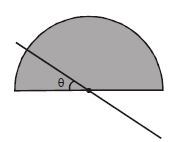
Moment of inertia of a semicircular disc of mass $M$ and radius $R$ about the shown axis is
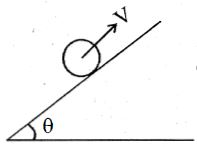
The sphere is performing rolling up an inclined plane, the frictional force is
A body covers a distance of $2\,m$ under the influence of a force $F = 15 -4x$ $newton$ , where $x$ is the distance covered by the particle in metre. The work done by the force is ............ $\mathrm{J}$