MCQ
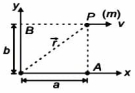
A particle is moving along a straight line parallel to $x$-axis with constant velocity. Find angular momentum about the origin in vector form
  • A
    $+m v^2 b \hat{k}$
  • $-m v b \hat{k}$
  • C
    $-2 m v b \hat{k}$
  • D
    $-m v b \hat{j}$

Answer

Correct option: B.
$-m v b \hat{k}$
b
(b)

Need a full question paper?

Generate a complete, print-ready paper with questions like this in minutes — across 16+ boards, with answer keys.
Start Generating Free

Similar questions

A liquid is filled in a spherical container of radius $R$ till a height $h$.At this positions the liquid surface at the edges is also horizontal. The contact angle is 
A stone projected with a velocity u at an angle $\theta$ with the horizontal reaches maximum height $H_1$. When it is projected with velocity u at an angle $\left( {\frac{\pi }{2} - \theta } \right)$ with the horizontal, it reaches maximum height $ H_2$. The relation between the horizontal range R of the projectile, $H_1$ and $H_2$ is
A person with his hand in his pocket is skating on ice at the rate of $10 m / s$ and describes a circle of radius $50 m$. What is his inclination to vertical: $\left( g =10 m / sec ^2\right)$
From which Newton's law the other two laws can be derived?
A stone is projected vertically up from the bottom of a water tank. Assuming no water resistance it will go up and come down in same time but if water drag is present then the time it takes to go up, $t_{up}$ and the time it takes to come down, $t_{down}$ are related as
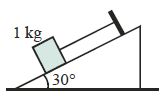
The coefficient of friction between two surfaces is $\mu  = 0.8$.The tension in the string shown in the figure is ........ $N$ 
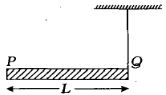
A rod $PQ$ of mass $M$ and length $L$ is hinged at end $P.$ The rod is kept horizontal by a massless string tied to point $Q$ as shown in figure. When string is cut, the initial angular acceleration of the rod is
Pressure is applied to an enclosed fluid. It is:
Match List$-I$ with List$-II:$

List$-I$ List$-II$
$(A)$ $3$ Translational degrees of freedom $(I)$ Monoatomic gases
$(B)$ $3$ Translational,$2$ rotational degrees of freedoms $(II)$ Polyatomic gases
$(C)$ $3$ Translational,$2$ rotational and $1$ vibrational degrees of freedom $(III)$ Rigid diatomic gases
$(D)$ $3$ Translational,$3$ rotational and more than one vibrational degrees of freedom $(IV)$ Nonrigid diatomic gases

Choose the correct answer from the options given below:

The frequency changes by $10\%$ as a sound source approaches a stationary observer with constant speed $v_s$. What would be the percentage change in frequency as the source recedes the observer with the same speed. ... $\%$ Given that $v_s < v$. ($v =$ speed of sound in air)