MCQ
From which Newton's law the other two laws can be derived?
  • A
    First to second and third
  • First and third from second
  • C
    Third to first and second
  • D
    The above statement is impossible

Answer

Correct option: B.
First and third from second
B

Need a full question paper?

Generate a complete, print-ready paper with questions like this in minutes — across 16+ boards, with answer keys.
Start Generating Free

Similar questions

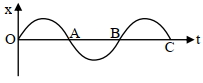
The variation of displacement with time of a particle executing free simple harmonic motion is shown in the figure. The potential energy ${U}({x})$ versus time $({t})$ plot of the particle is correctly shown in figure:
Dimensional formula for angular momentum is
Which of the following properties of light conclusively support wave theory of light?
  1. Light obeys laws of reflection.
  2. Speed of light in water is smaller than the speed in vacuum.
  3. Light shows interference.
  4. Light shows photoelectric effect.
Two bodies of mass $m$ and $9 m$ are placed at a distance $R$. The gravitational potential on the line joining the bodies where the gravitational field equals zero, will be ( $G=$ gravitational constant) :
For a body moving in a circular path, a condition for no skidding if $\mu $ is the coefficient of friction, is
A cyclist on a level road takes a sharp circular turn of radius $3 \;m \;\left( g =10 \;ms ^{-2}\right)$. If the coefficient of static friction between the cycle tyres and the road is $0.2$, at which of the following speeds will the cyclist not skid while taking the turn?
The velocity of a bus, moving on a smooth road, is increased from $8\ m/ s$ to $32\ m/ s$ in $120s.$ During this process, the potential energy of the bus:
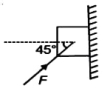
Block $A$ of mass $4 \;kg$ is to be kept at rest against a smooth vertical wall by applying a force $F$ as shown in figure. The force required is .......... $N$ $\left(g=10 m / s ^2\right)$
Three waves of equal frequency having amplitudes $10 \,\mu \, m, 4  \, \mu \,m$ and $7 \mu m$ arrive at a given point with successive phase difference of $\frac{\pi }{2}$. The amplitude of the resulting wave in $\mu \,m$ is given by
Three particles ${P}, {Q}$ and ${R}$ are moving along the vectors ${A}=\hat{{i}}+\hat{{j}}, {B}=\hat{{j}}+\hat{{k}}$ and ${C}=-\hat{{i}}+\hat{{j}}$ respectively. They strike on a point and start to move in different directions. Now particle $P$ is moving normal to the plane which contains vector $\vec{A}$ and $\vec{B} .$ Similarly particle $Q$ is moving normal to the plane which contains vector $\vec{A}$ and $\vec{C} .$ The angle between the direction of motion of $P$ and $Q$ is $\cos ^{-1}\left(\frac{1}{\sqrt{x}}\right)$. Then the value of $x$ is ...... .