MCQ
A particle is moving in a straight line with initial velocity and uniform acceleration $a$. If the sum of the distance travelled in $t^{\text {th }}$ and $( t +1)^{ th }$ seconds is $100 cm$, then its velocity after $t$ seconds, in $.........cm / s$, is
  • A
    $80$
  • $50$
  • C
    $20$
  • D
    $30$

Answer

Correct option: B.
$50$
b
(b) 

Sum of distance travelled in $t^{t h}$ and $(t+1)^{t h}$ seconds is $100 cm$

$u+\frac{a}{2}(2 t-1)+u+\frac{a}{2}(2(t+1)-1)=100$

$2 u+2 a t=100$

$u+a t=100 / 2$

$\Rightarrow v=50 cm / s$

Need a full question paper?

Generate a complete, print-ready paper with questions like this in minutes — across 16+ boards, with answer keys.

Start Generating Free

Similar questions

Which of the following quantities does not depend upon the orbital radius of the satellite.
A copper ring has a diameter of exactly $25 \,\,mm$ at its temperature of $0^o C$. An aluminium sphere has a diameter of exactly $25.05\,\, mm$ at its temperature of $100^o C$. The sphere is placed on top of the ring and two are allowed to come to thermal equilibrium, no heat being lost to the surrounding. The sphere just passes through the ring at the equilibrium temperature. The ratio of the mass of the sphere & ring is : (given : $\alpha_{Cu} = 17 × 10^{-6} /^o C, \alpha = 2.3 × 10^{-5} /^o C,$ specific heat of $Cu = 0.0923 Cal/g^o C$ and specific heat of $Al = 0.215 cal/g^o C$)
The electric and the magnetic field, associated with an e.m. wave, propagating along the $+\, z-$axis, can be represented by
Two polaroids are placed in the path of unpolarized beam of intensity $I_0$ such that no light is emitted from the second polaroid. If a third polaroid whose polarization axis makes an angle $\theta $ with the polarization axis of first polaroid, is placed between these polaroids, then the intensity of light emerging from the last polaroid will be 
As a wave propagates
In which of the following cases is the contact force between $A$ and $B$ maximum $(m_A = m_B = 1 kg)$
An air column in a pipe, which is closed at one end, will be in resonance with a vibrating body of frequency $166 \,Hz$, if the length of the air column is .... $m$
Consider a metallic cube of edge length $L$. Its resistance, $R$, measured across its opposite faces is $R =\frac{ m _{ e } v }{ ne ^2 L ^2}$, where $n$ is the number density and $v$ is the drift speed of electrons in the cube, and $e$ and $m _{ e }$ are the charge and mass of an electron respectively. Assuming the de-Broglie wavelength of the electron to be $L$, the maximum resistance of the sample is closest to ............. $\,\Omega$ $\left(e=1.60 \times 10^{-19} \,C ; m _{ e }=9.11 \times 10^{-31} \,kg\right.$; Planck's constant, $h=6.63 \times 10^{-34} \,Js$ )
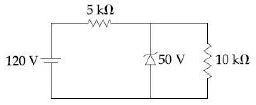
For the circuit shown below, the current through the Zener diode is......$mA$
A body of mass ${m_1}$ moving with a velocity$ 3 ms^{-1}$ collides with another body at rest of mass ${m_2}.$After collision the velocities of the two bodies are $2 ms^{-1} \,and \, 5ms^{-1}$ respectively along the direction of motion of ${m_1}$ The ratio $ \frac{m_1}{m_2}= $