Question
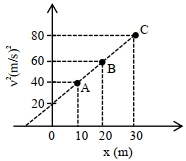
A particle is moving with constant acceleration $'a'.$ Following graph shows $v^{2}$ versus $x$ (displacement) plot. The acceleration of the particle is $......{m} / {s}^{2}$
Answer

${y}={m} {x}+{C}$

${v}^{2}=\frac{20}{10} {x}+20$

${v}^{2}=2 {x}+20$

$2 {v} \frac{{d} {v}}{{d} {x}}=2$

$\therefore {a}={v} \frac{{d} {v}}{{d} {x}}=1$

Need a full question paper?

Generate a complete, print-ready paper with questions like this in minutes — across 16+ boards, with answer keys.
Start Generating Free

Similar questions

In a junction diode, the holes are due to
A mercury drop does not spread on a glass plate because the angle of contact between glass and mercury is
The escape velocity of a body on an imaginary planet which is thrice the radius of the earth and double the mass of the earth is $({v_e}$ is the escape velocity of earth)
A particle performs simple harmonic motion with amplitude $A$. Its speed is trebled at the instant that it is at a distance $\frac{{2A}}{3}$ from equilibrium position. The new amplitude of the motion is
Uniform electric field of magnitude $100$ $V/m$ in space is directed along the line $y = 3 + x$. Find the potential difference between point $A$ $ (3, 1)$ $\&$ $B$ $(1, 3)$.......$V$
The dependence of binding energy per nucleon, ${B_N}$ on the mass number, $A,$ is represented by
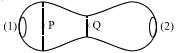
Ametallic conductor of irregular cross-section is as shown in the figure. Aconstant potential difference is applied across the ends $(1)$ and $(2)$. Then :
The maximum percentage errors in the measurement of mass (M), radius (R) and angular velocity $(\omega)$ of a ring are $2 \%, 1 \%$ and $1 \%$ respectively, then find the maximum percenta? error in the measurement of its rotational kinetic energy $\left(K=\frac{1}{2} I \omega^{2}\right)$
Work function of lithium and copper are respectively $2.3\ eV$ and $4.0\ eV$. Which one of the metal will be useful for the photoelectric cell working with visible light ? $(h = 6.6 × 10^{-34} J-s, c = 3 ×10^8 m/s)$
A body welghs $200 \;\mathrm{N}$ on the surface of the earth. ......$N$ will it weigh half way down to the centre of the earth?