MCQ
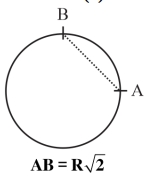
A particle is moving with constant speed in a circular path. When the particle turns by an angle $90^{\circ}$, the ratio of instantaneous velocity to its average velocity is $\pi: x \sqrt{2}$. The value of $x$ will be $.........$
  • $2$
  • B
    $5$
  • C
    $1$
  • D
    $7$

Answer

Correct option: A.
$2$
a
Let instantaneous velocity be v. time,

$t =\frac{\text { Arc length }}{ v }=\frac{2 \pi \frac{ R }{4}}{ v }=\frac{\pi R }{2 v }$ average velocity,

$\langle v \rangle =\frac{ AB }{ t }=\frac{ R \sqrt{2}(2 v )}{\pi R }=\frac{2 \sqrt{2} V }{\pi}$

$\Rightarrow \frac{ V }{\langle V \rangle} =\frac{\pi}{2 \sqrt{2}} .$

Need a full question paper?

Generate a complete, print-ready paper with questions like this in minutes — across 16+ boards, with answer keys.

Start Generating Free

Similar questions

If $R$ is the radius of the earth and $g$ the acceleration due to gravity on the earth's surface, the mean density of the earth is
The horizontal range and the maximum height of a projectile are equal . The angle of projection of the projectile is
The escape velocity of a body from earth is about $11.2 \,km / s$. Assuming the mass and radius of the earth to be about $81$ and $4$ times the mass and radius of the moon, the escape velocity in $km / s$ from the surface of the moon will be .......
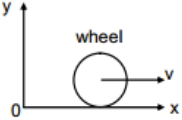
Given $V _{ CM }=2\; m / s , m =2\; kg , R =4\; m $

Find angular momentum of ring about origin if it is in pure rolling. $kgm ^{2} / s$

With increase in temperature, the viscosity of:
A particle executes $S.H.M.$ and its position varies with time as $x=A$ sin $\omega t$. Its average speed during its motion from mean position to mid-point of mean and extreme position is
A sample contains mixture of helium and oxygen gas. The ratio of root mean square speed of helium and oxygen in the sample, is:
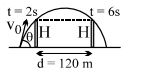
A projectile crosses two walls of equal height $H$ symmetrically as shown If the horizontal distance between the two walls is $d = 120\,\, m$, then the range of the projectile is ........ $m$
A sphere is rotating about a diameter:
  1. The particles on the surface of the sphere do not have any linear acceleration.
  2. The particles on the diameter mentioned above do not have any linear acceleration.
  3. Different particles on the surface have different angular speeds.
  4. All the particles on the surface have same linear speed.
A long spring is stretched by 2cm and its potential energy is V. If the spring is stretched by 10cm, its potential energy will be: