A particle is oscillating according to the equation $X = 7\cos 0.5\pi t$, where $t$ is in second. The point moves from the position of equilibrium to maximum displacement in time ..... $\sec$
Medium
Download our app for free and get started
(c) From given equation$\omega = \frac{{2\pi }}{T} = 0.5\pi ⇒ T = 4\,sec$
Time taken from mean position to the maximum displacement $ = \frac{1}{4}T = 1\,sec.$

Download our appand get started for free
Experience the future of education. Simply download our apps or reach out to us for more information. Let's shape the future of learning together!No signup needed.*
Similar Questions
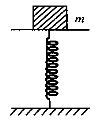
- 1A mass of $2.0\, kg$ is put on a flat pan attached to a vertical spring fixed on the ground as shown in the figure. The mass of the spring and the pan is negligible. When pressed slightly and released the mass executes a simple harmonic motion. The spring constant is $200\, N/m.$ What should be the minimum amplitude of the motion so that the mass gets detached from the pan (take $g = 10 m/s^2$).View Solution
- 2The energy of a particle executing simple harmonic motion is given by $E = Ax^2 + Bv^2$, where $x$ is the displacement from mean position $x = 0$ and $v$ is the velocity of the particle at $x$ then choose the incorrect statementView Solution
- 3A particle executes $SHM$ with amplitude of $20 \,cm$ and time period is $12\, sec$. What is the minimum time required for it to move between two points $10\, cm$ on either side of the mean position ..... $\sec$ ?View Solution
- 4Two pendulums have time periods $T$ and $\frac{{5T}}{4}.$They start $S.H.M.$ at the same time from the mean position. What will be the phase difference between them after the bigger pendulum has complete one oscillation ..... $^o$View Solution
- 5If $x = a\sin \left( {\omega t + \frac{\pi }{6}} \right)$ and $x' = a\cos \omega t$, then what is the phase difference between the two wavesView Solution
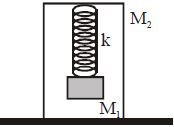
- 6$A$ block of mass $M_1$ is hanged by a light spring of force constant $k$ to the top bar of a reverse Uframe of mass $M_2$ on the floor. The block is pooled down from its equilibrium position by $a$ distance $x$ and then released. Find the minimum value of $x$ such that the reverse $U$ -frame will leave the floor momentarily.View Solution
- 7Two pendulums begins to swing simultaneously. The first pendulum makes $11$ full oscillations when the other makes $9$. The ratio of length of the two pendulums isView Solution
- 8The position, velocity and acceleration of a particle executing simple harmonic motion are found to have magnitudes of $4 \mathrm{~m}, 2 \mathrm{~ms}^{-1}$ and $16 \mathrm{~ms}^{-2}$ at a certain instant. The amplitude of the motion is $\sqrt{\mathrm{x}} \mathrm{m}$ where $\mathrm{x}$ is. . . . . . .View Solution
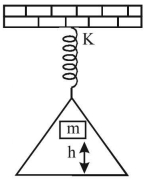
- 9A load of mass $m$ falls from a height $h$ on to the scale pan hung from the spring as shown in the figure. If the spring constant is $k$ and mass of the scale pan is zero and the mass $m$ does not bounce relative to the pan, then the amplitude of vibration isView Solution
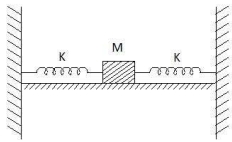
- 10In the figure given below. a block of mass $M =490\,g$ placed on a frictionless table is connected with two springs having same spring constant $\left( K =2 N m ^{-1}\right)$. If the block is horizontally displaced through ' $X$ 'm then the number of complete oscillations it will make in $14 \pi$ seconds will be $.........$View Solution