If $x = a\sin \left( {\omega t + \frac{\pi }{6}} \right)$ and $x' = a\cos \omega t$, then what is the phase difference between the two waves
Medium


Download our appand get started for free
Experience the future of education. Simply download our apps or reach out to us for more information. Let's shape the future of learning together!No signup needed.*
Similar Questions
- 1The bob of a simple pendulum executes simple harmonic motion in water with a period $t$, while the period of oscillation of the bob is ${t_0}$ in air. Neglecting frictional force of water and given that the density of the bob is $(4/3) ×1000 kg/m^3$. What relationship between $t$ and ${t_0}$ is trueView Solution
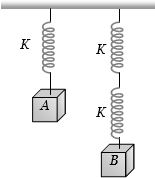
- 2The springs shown are identical. When $A = 4kg$, the elongation of spring is $1\, cm$. If $B = 6\,kg$, the elongation produced by it is ..... $ cm$View Solution
- 3A body oscillates with a simple harmonic motion having amplitude $0.05\, m .$ At a certain instant, its displacement is $0.01\, m$ and acceleration is $1.0 \,m / s ^{2} .$ The period of oscillation isView Solution
- 4Two damped spring-mass oscillating systems have identical spring constants and decay times. However, system $A's$ mass $m_A$ is twice system $B's$ mass $m_B$ . How do their damping constants, $b$ , compare ?View Solution
- 5View SolutionA particle is moving in a circle with uniform speed. Its motion is
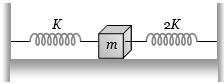
- 6Two springs of force constants $K$ and $2K$ are connected to a mass as shown below. The frequency of oscillation of the mass isView Solution
- 7For a periodic motion represented by the equation $Y=\sin \omega t+\cos \omega t$ The amplitude of the motion isView Solution
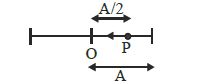
- 8A particle starts from a point $P$ at a distance of $A/2$ from the mean position $O$ and travels towards left as shown in the figure. If the time period of $SHM$ , executed about $O$ is $T$ and amplitude $A$ then the equation of motion of particle isView Solution
- 9Two simple harmonic motions are represented by equations ${y_1} = 4\,\sin \,\left( {10t + \phi } \right)$ and ${y_2} = 5\,\cos \,10\,t$ What is the phase difference between their velocities?View Solution
- 10A pendulume clock loses $12\;s$ a day if the temperature is $40^oC$ and gains $4\;s$ a day if the temperature is $20^oC$. The temperature at which the clock will show correct time, and the coeffecient of linear expansion $(\alpha)$ of the metal of the pendulum shaft are respectivelyView Solution