MCQ
A particle is performing simple harmonic motion
$(i)$ its velocity-displacement graph is parabolic in nature
$(ii)$ its velocity-time graph is sinusoidal in nature
$(iii)$ its velocity-acceleration graph is elliptical in nature
Correct answer is
  • A
    $(i), (ii)$ and $(iii)$
  • $(ii)$ and $(iii)$
  • C
    $(i)$ and $(ii)$
  • D
    $(i)$ and $(iii)$

Answer

Correct option: B.
$(ii)$ and $(iii)$
b
$(i)$ $\mathrm{v}=\omega \sqrt{\mathrm{A}^{2}-\mathrm{x}^{2}}$ $(ii)$ $\mathrm{v}=\mathrm{A} \omega \cos \omega \mathrm{t}$

$\mathrm{v}=\mathrm{A} \omega \cos \omega \mathrm{t} ; \mathrm{a}=\mathrm{A} \omega^{2} \sin \omega \mathrm{t}$

$\Rightarrow \frac{v^{2}}{A^{2} \omega^{2}}+\frac{a^{2}}{A^{2} \omega^{4}}=1$

$(ii)$ and $(iii)$ are correct

Need a full question paper?

Generate a complete, print-ready paper with questions like this in minutes — across 16+ boards, with answer keys.

Start Generating Free

Similar questions

In the diagram shown below all three rods are of equal length $L$ and equal mass $M$. The system is rotated such that rod $B$ is the axis. What is the moment of inertia of the system?
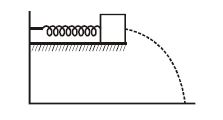
As shown in figure there is a spring block system. Block of mass $500\,g$ is pressed against a horizontal spring fixed at one end to compress the spring through $5.0\,cm$ . The spring constant is $500\,N/m$ . When released, calculate the distance where it will hit the ground $4\,m$ below the spring ? $(g = 10\,m/s^2)$
Two bodies are in equilibrium when suspended in water from the arms of a balance. The mass of one body is $36 g $ and its density is $9 g / cm^3$. If the mass of the other is $48 g$, its density in $g / cm^3$ is
A constant torque acting on a uniform circular wheel changes its angular momentum from L to 4L in 4 seconds. The magnitude of this torque is:
Two bodies moving towards each other collide and move away in opposite directions. There is some rise in temperature of bodies because a part of the kinetic energy is converted into
A rigid diatomic ideal gas undergoes an adiabatic process at room temperature. The rational between temperature and volume for the process is $TV^x =$ constant, then $x$ is
Two particles of the same mass are moving in circular orbits because of force, given by $F(r) = \frac{{ - 16}}{r}\, - \,{r^3}$ The first particle is at a distance $r = 1,$  and the second, at $r = 4.$  The best estimate for the ratio of kinetic energies of the first and the second particle is closest to
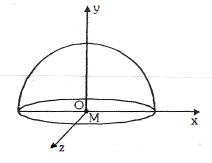
A hemisspherical shell of mass $2M$ and radius $6R$ and a point mass $M$ are performing circular motion due to their mutual gravitational interaetion Their positions are shown in figure at any moment of time during motion. If $r_1$ and $r_2$ are the radii of circular path of hemispherical shell and point mass respectively and ${\omega _1}$ and  ${\omega _2}$ are the angular speeds of hemi-spherical shell and point mass respectively, then choose the correct option
Total K.E. of a sphere of mass M rolling with velocity V is:
A block of mass $10\; \mathrm{kg}$ is in contact against the inner wall of a hollow cylindow cylindrical drum of radius $1 \;\mathrm{m}$. The coeffident of friction between the block and the inner wall of the cylinder is $0.1$. The minimum angular velocity needed for the cylinder to keep the block stationary when the cylinder is vertical and rotating about its axis, will be: ......$rad/s$ $\left(g-10 m / s^{2}\right)$