MCQ
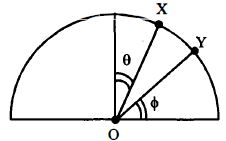
A particle is released on a vertical smooth semicircular track from point $X$ so that $OX$ makes angle $\theta $ from the vertical ( see figure). The normal reaction of the track on the particle vanishes at point $Y$ where $OY$ makes angle $\phi $ with the horizontal. Then
  • A
    $\sin \,\phi  = \,\cos \,\phi $
  • B
    $\sin \,\phi  = \frac{1}{2}\,\cos \,\theta $
  • $\sin \,\phi  = \frac{2}{3}\,\cos \,\theta $
  • D
    $\sin \,\phi  = \frac{3}{4}\,\cos \,\theta $
Answer

Correct option: C.
$\sin \,\phi  = \frac{2}{3}\,\cos \,\theta $
c
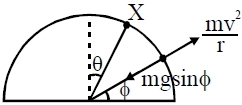
$\frac{\mathrm{mv}^{2}}{\mathrm{r}}=\mathrm{mg} \sin \phi$            $...(i)$

$\mathrm{mg} \mathrm{r} \cos \theta=\frac{1}{2} \mathrm{mv}^{2}+\mathrm{rg} \sin \phi$

$\frac{\mathrm{v}^{2}}{\mathrm{rg}}=2 \cos \theta-2 \sin \phi \ldots \ldots(\mathrm{ii})$

$\sin \phi=2 \cos \theta-2 \sin \phi$

$3 \sin \phi=2 \cos \theta$

$\sin \phi=\frac{2}{3} \cos \phi$

Need a full question paper?

Generate a complete, print-ready paper with questions like this in minutes — across 16+ boards, with answer keys.

Start Generating Free

Similar questions

In the situation as shown in figure time period of vertical oscillation of block for small displacements will be 
A solid sphere, a hollow sphere and and a ring are released from top of an inclined plane (frictionless) so that they slid down the plane. Then maximum acceleration down the plane is for (no rolling)
A carnot engine working between $300K$ and $600K$ has work output of $800J$ per cycle. The amount of heat energy supplied to the engine from source in each cycle is:
A thin rod of length $L$ is bent to form a semicircle. The mass of rod is $M$. What will be  the gravitational potential at the centre of the circle?
A car is going round a circle of radius $R_1$ with constant speed. Another car is going round a circle of radius $R_2$ with constant speed. If both of them take same time to complete the circles, the ratio of their angular speeds and linear speeds will be .........
The two specific heat capacities of a gas are measured as $C_P = (12.28 \pm 0.2)\, units$ and $C_V = (3.97 \pm 0.3)\, unit$. Find the value of the gas constant $(R)$
Two identical rods each of mass $M$. and length $l$ are joined in crossed position as shown in figure. The moment of inertia of this system about a bisector would be 
Dimension of $R$ (Resistance) is
A particle of unit mass undergoes one­ dimensional motion such that its velocity varies according to $ v(x)= \beta {x^{ - 2n}}$, where $\beta$ and $n$ are constants and $x$ is the position of the particle. The acceleration of the particle as a function of $x$, is given by
In a streamline flow: