MCQ
Dimension of $R$ (Resistance) is
  • A
    $M{L^2}{T^{ - 1}}$
  • $M{L^2}{T^{ - 3}}{A^{ - 2}}$
  • C
    $M{L^{ - 1}}{T^{ - 2}}$
  • D
    None of these

Answer

Correct option: B.
$M{L^2}{T^{ - 3}}{A^{ - 2}}$
b
(b) $R = \frac{V}{I}$$ = \left[ {\frac{{M{L^2}{T^{ - 3}}{A^{ - 1}}}}{A}} \right]$=$[M{L^2}{T^{ - 3}}{A^{ - 2}}]$

Need a full question paper?

Generate a complete, print-ready paper with questions like this in minutes — across 16+ boards, with answer keys.

Start Generating Free

Similar questions

The heat is flowing through a rod of length $50 cm$ and area of cross-section $5c{m^2}$. Its ends are respectively at ${25^o}C$ and ${125^o}C$. The coefficient of thermal conductivity of the material of the rod is $0.092 kcal/m×s×^\circ C$. The temperature gradient in the rod is
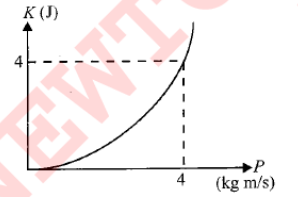
The graph between kinetic energy and momentum of a particle is plotted as shown in Fig. The mass of the moving particle is?
The absolute zero is the temperature at which
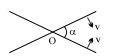
Find the speed of the intersection point $O$ of the two wires if the wires starts moving perpendicular to itself with speed $v$ as shown in figure.
Average pressure $p_{av}$ is defined as
While measuring the speed of sound by performing a resonance column experiment, a student gets the first resonance condition at a column length of $18\ cm$ during winter. Repeating the same experiment during summer, she measures the column length to be $x\ cm$ for the second resonance. Then
The velocities of $A$ and $B$ are $\vec{v}_A=2 \hat{i}+4 \hat{j}$ and $\vec{v}_B=3 \hat{i}-7 \hat{j}$ Velocity of $B$ as observed by $A$ is ..........
The excess pressure inside a soap bubble is thrice the excess pressure inside a second soap bubble. The ratio between the volume of the first and the second bubble is:
When a ceiling fan is switched on, it makes $10$ rotations in first $3\,seconds,$ How many rotations will it make in the next $3\,seconds.$ (Assume uniform angular acceleration)
The displacement of a particle moving in $S.H.M.$ at any instant is given by $y = a\sin \omega t$. The acceleration after time $t = \frac{T}{4}$ is (where $T$ is the time period)