MCQ
A particle is revolving in a circular path of radius $25 \,m$ with constant angular speed $12 \,rev/min$. Then the angular acceleration of particle is .......... $rad / s ^2$
  • A
    $2 \pi^2$
  • B
    $4 \pi^2$
  • C
    $\pi^2$
  • $0$

Answer

Correct option: D.
$0$
d
(d)

Angular acceleration is the rate of change of angular speed or angular velocity if $\vec{\omega}$ remains constant then

$\alpha=0$

Need a full question paper?

Generate a complete, print-ready paper with questions like this in minutes — across 16+ boards, with answer keys.

Start Generating Free

Similar questions

If the resultant of all the external forces acting on a system of particles is zero, then from an inertial frame, one can surely say that
For Boyle’s law to hold, the gas should be:
A wheel has angular acceleration of $3 .0\, rad/sec^2$ and an initial angular speed of $2.00\, rad/sec.$ In a time of $2\, sec$ it has rotated through an angle (in radian) of 
Three objects, $A :$ (a solid sphere), $B :$ (a thin circular disk) and $C :$ (a circular ring), each have the same mass $M$ and radius $R.$ They all spin with the same angular speed $\omega$ about their own symmetry axes. The amounts of work $(W)$ required to bring them to rest, would satisfy the relation
Which two of the given transverse waves will give stationary waves when get superimposed

${z_1} = a\cos (kx - \omega \,t)$.....$(A)$

${z_2} = a\cos (kx + \omega \,t)$.....$(B)$

${z_3} = a\cos (ky - \omega \,t)$..... $(C)$
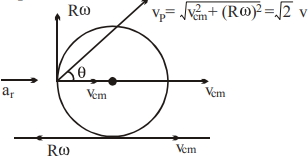
$A$ disc of radius $R$ is rolling purely on a flat horizontal surface, with a constant angular velocity. The angle between the velocity and acceleration vectors of point $P$ is
When a body of mass $1.0\, kg$ is suspended from a certain light spring hanging vertically, its length increases by $5\, cm$. By suspending $2.0\, kg$ block to the spring and if the block is pulled through $10\, cm$ and released the maximum velocity in it in $m/s$ is : (Acceleration due to gravity $ = 10\,m/{s^2})$
A car travels $6\, km$ towards north at an angle of $45^o$ to the east and then travels distance of $4\, km$ towards north at an angle $135^o$ to east. How far is the point from the starting point? What angle does the straight line joining its initial and final position makes with the east?
The time period of a satellite in a circular orbit of radius $R$ is $T$. The period of another satellite in a circular orbit of radius $9 R$ is............ $T$
A ball of mass $1\,\,kg.$  moving with a velocity of $4\,\,m/sec.$  collides with a stationary ball. The collision is oblique. After the collision the first moves at right angle to its, initial direction with a velocity of  $3\,\,m/s.$  The momentum of the second ball (in $kg.\,\,m/s.$ ) after collision would be nearly