MCQ
A particle moves along an arc of a circle of radius $R$ . Its velocity depends on the distance covered as $v = a\sqrt s$ , where $a$ is a constant then the angle $\alpha $ between the vector of the total acceleration and the vector of velocity as a function of $s$ will be
  • A
    $\tan \alpha  = \frac{R}{{2s}}$
  • $\tan \alpha  = \frac{2s}{{R}}$
  • C
    $\tan \alpha  = \frac{2R}{{s}}$
  • D
    $\tan \alpha  = \frac{s}{{2R}}$

Answer

Correct option: B.
$\tan \alpha  = \frac{2s}{{R}}$
b
$\mathrm{V}=\mathrm{a} \sqrt{\mathrm{S}}$

$\frac{d V}{d S}=\frac{9}{2 \sqrt{S}}$

$\mathrm{V} \frac{\mathrm{dV}}{\mathrm{dS}}=\mathrm{a} \sqrt{\mathrm{S}} \cdot \frac{\mathrm{a}}{2 \sqrt{\mathrm{S}}}=\frac{\mathrm{a}^{2}}{2}=$

$=$ tangential component $=\mathrm{q}_{\mathrm{t}}$

$\frac{V^{2}}{R}=a_{C}=\frac{a^{2} S}{R}$

$\therefore \tan \alpha=\frac{a_{c}}{a_{t}}=\frac{2 S}{R}$

Need a full question paper?

Generate a complete, print-ready paper with questions like this in minutes — across 16+ boards, with answer keys.

Start Generating Free

Similar questions

A point particle is acted upon by a restoring force $-k x^{3}$. The time-period of oscillation is $T$, when the amplitude is $A$. The time-period for an amplitude $2 A$ will be
Efficiency of all reversible heat engines working between same temperatures:
A projectile is fired at an angle of $45^o $ with the horizontal . Elevation angle of the projectile at its highest point as seen from the point of projection, is 
The frequency of vibration $f$ of a mass $m$ suspended from a spring of spring constant $K$ is given by a relation of this type $f = C\,{m^x}{K^y}$; where $C$ is a dimensionless quantity. The value of $x$ and $y$ are
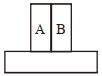
A bimetallic strip consists of metals $A$ and $B$. It is mounted rigidly as shown. The metal $A$ has higher coefficient of expansion compared to that of metal $B$. When the bimetallic strip is placed in a cold both, it will :
An engineer claims to have made an engine delivering $10 kW$ power with fuel consumption of $1\,g\,{s^{ - 1}}$. The calorific value of fuel is $2k cal/g$. His claim
When two small bubbles join to form a bigger one, energy is
A capillary tube of radius $r$ is dipped in a liquid of density $\rho$ and surface tension $S$. If the angle of contact is $\theta$, the pressure difference between the two surfaces in the beaker and the capillary
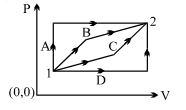
An ideal gas is taken from state $1$ to state $2$ through optional path $A, B, C \& D$ as shown in $P-V$ diagram. Let $Q, W$ and $U$ represent the heat supplied, work done $\&$ internal energy of the gas respectively. Then
A particle is thrown with a speed $u$ at an angle $\theta$ with the horizontal. When the particle makes an angle $\phi$ with the horizontal, its speed changes to $v$, where