MCQ
Efficiency of all reversible heat engines working between same temperatures:
  • Same
  • B
    Depend on the working substance
  • C
    Changes with change in pressure
  • D
    Depend on other physical quantities

Answer

Correct option: A.
Same
A

Need a full question paper?

Generate a complete, print-ready paper with questions like this in minutes — across 16+ boards, with answer keys.
Start Generating Free

Similar questions

A capillary tube $A$ is dipped in water. Another identical tube $B$ is dipped in soap$-$water solution. Which of the following shows the relative nature of the liquid columns in the two tubes?
A body of mass $1\,kg$ is thrown upwards with a velocity $20\, m/s.$ It momentarily comes to rest after attaining a height of $18\, m.$ How much energy is lost due to air friction ? ........... $\mathrm{J}$ $ (g = 10 \,m/s^2)$
A body revolved around the sun $27$ times faster then the earth what is the ratio of their radii
If the vector is a unit vector in the direction of A. So
A cylindrical plastic bottle of negligible mass of filled with $310\, ml$ of water and left floating in a pond with still water. If pressed downward slightly and released, it starts performing simple harmonic motion at angular frequency $\omega $. If the radius of the bottle is $2.5\, cm$ then $\omega $ is close to ..... $rad\, s^{-1}$  (density of water $= 10^3\, kg/m^3$)
From a building two balls $A$ and $B$ are thrown such that $A$ is thrown upwards and $B$ downwards (both vertically). If $v_{A}$ and $v_{B}$ are their respective velocities on reaching the ground, then
What is the relation between displacement, time and acceleration in case of a body having uniform acceleration
The gas which obeys Boyle's law for maximum range of temperature is
According to the theorem of parallel axes $I = {I_g} + M{d^2}$, the graph between $I$ and $d$ will be
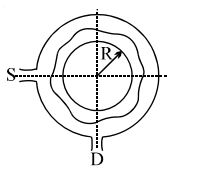
A narrow tube is bent in the form of a circle of radius $R,$ as shown in the figure. Two small holes $S$ and $D$ are made in the tube at the positions right angle to each other. A source placed at $S$ generated a wave of intensity $I_0$ which is equally divided into two parts : One part travels along the longer path, while the other travels along the shorter path. Both the part waves meet at the point $D$ where a detector is placed  The maximum value of $\lambda$ to produce a maxima at $D$ is given by