Question
A particle moves along the x-axis from $x = 0$ to $x = 5m$ under the influence of a force given by $f(x) = 7 - 2x + 3x^2$​​​​​​​. Calculate the work done.

Answer

As work done, dW = Fdx $\text{W}=\int_\limits{0}^{5}\text{F}.\text{dx}=\int_\limits{0}^{5}(7-2\text{x}+3\text{x}^2)\text{dx}$
$=\bigg[7\text{x}-\frac{2\text{x}^2}{2}+\frac{3\text{x}^3}{3}\bigg]^5_0$ $=7(5-0)-(5^2-0)+(5^3-0)$ $=135\text{J}$

Need a full question paper?

Generate a complete, print-ready paper with questions like this in minutes — across 16+ boards, with answer keys.
Start Generating Free

Similar questions

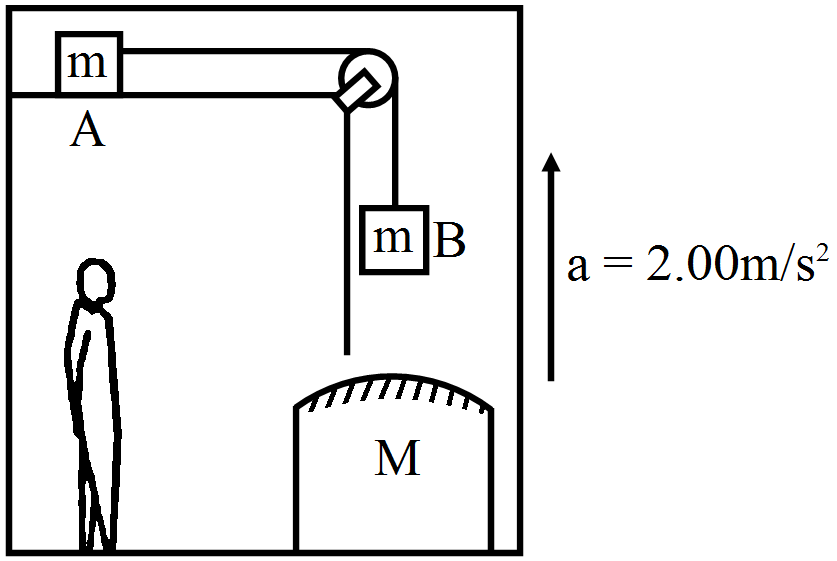
Consider the situation shown in figure. The elevator is going up with an acceleration of $2.00m/s^2$ and the focal length of the mirror is 12.0cm. All the surfaces are smooth and the pulley is light. The mass-pulley system is released from rest (with respect to the elevator) at t = 0 when the distance of B from the mirror is $42.0cm$. Find the distance between the image of the block B and the mirror at $t = 0.200s$. Take $g = 10m/s^2$.
Two identical pith balls, each carrying a charge q, are suspended from a common point by two strings of equal length l. Find the mass of each ball if the angle between the strings is $2\theta$ in equilibrium.
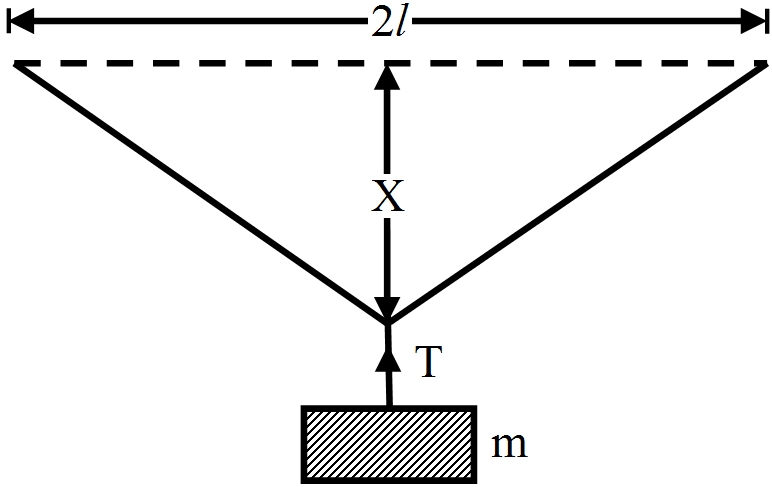
A steel wire of length 2l and cross-sectional area A is stretched within elastic limit as shown in figure. Calculate the strain and stress in the wire.
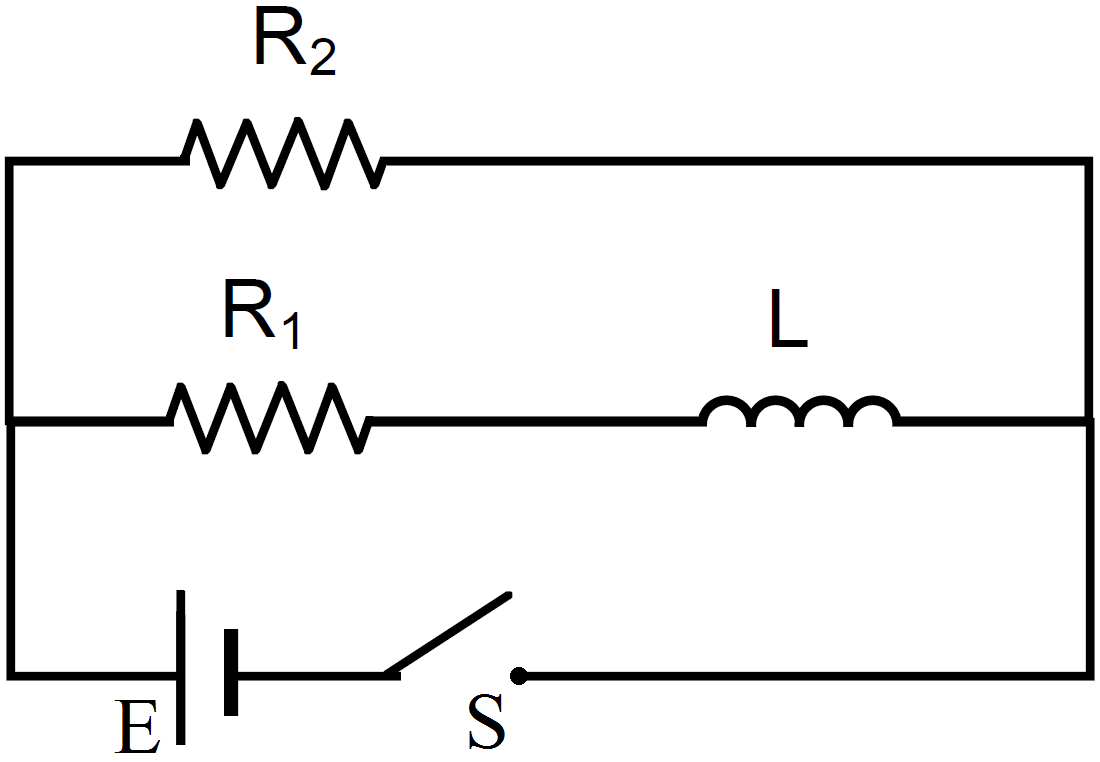
Consider the circuit shown in figure:
  1. Find the current through the battery a long time after the switch S is closed.
  2. Suppose the switch is again opened at $t = 0$. What is the time constant of the discharging circuit?
  3. Find the current through the inductor after one time constant.
Quite often, connecting wires carrying currents in opposite directions are twisted together in using electrical appliances. Explain how it avoids unwanted magnetic fields.
A particle starts from the origin at t = 0s with a velocity of $10.0\hat{\text{j}}\text{m/s}$ and moves in the x - y plane with a constant acceleration of $(8.0\hat{\text{i}}+2.0\hat{\text{j}})\text{ms}^{-2}.$ (a) At what time is the x- coordinate of the particle 16m? What is the y-coordinate of the particle at that time? (b) What is the speed of the particle at the time?
An ideal gas is kept in a long cylindrical vessel fitted with a frictionless piston of cross-sectional area $10cm^2$ and weight $1kg$. The length of the gas column in the vessel is $20cm$. The atmospheric pressure is $100kPa$. The vessel is now taken into a spaceship revolving round the earth as a satellite. The air pressure in the spaceship is maintained at $100kPa$. Find the length of the gas column in the cylinder.
A block is kept on a horizontal table. The table is undergoing S.H.M. of frequency 3Hz in a horizontal plane. The coefficient of static friction between block and the table surface is 0.72. Find the maximum amplitude of the table at which the block does not slip on the surface.
The coefficient of volume expansion of glycerine is $49 \times 10^{–5} K^{–1}$. What is the fractional change in its density for a $30°C$ rise in temperature?
Two discs of same mass and thickness are made of materials having different densities. Which one of them will have larger M.I.?