Question
Consider the circuit shown in figure:
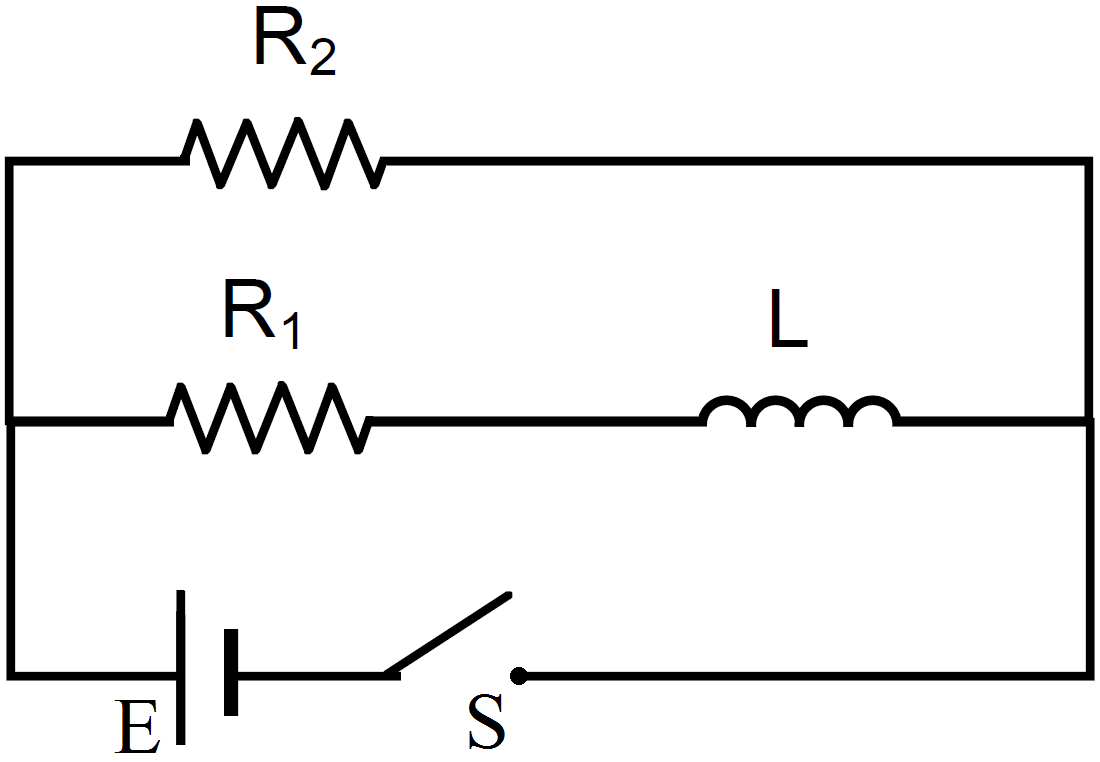
  1. Find the current through the battery a long time after the switch S is closed.
  2. Suppose the switch is again opened at $t = 0$. What is the time constant of the discharging circuit?
  3. Find the current through the inductor after one time constant.
Answer

  1. Because the switch is closed, the battery gets connected across the L‒R circuit. The current in the L‒R circuit after t seconds after connecting the battery is given by
$\text{i}=\text{i}_0\Big(\text{e}^{\frac{-\text{t}}{\tau}}\Big)$
$i_0$ = Steady state current
$\tau=$ Time constant $=\frac{\text{L}}{\text{R}}$
After a long time, $\text{t}\rightarrow\infty$
Now,
Current in the inductor, $i = i_0 (1 - e^0) = 0$
Thus, the effect of inductance vanishes.
$\text{i}=\frac{\text{E}}{\text{R}_{\text{net}}}$
$=\frac{\in}{\frac{\text{R}_1\times\text{R}_2}{\text{R}_1+\text{R}_2}}=\frac{\in\big(\text{R}_1+\text{R}_2\big)}{\text{R}_1\text{R}_2}$
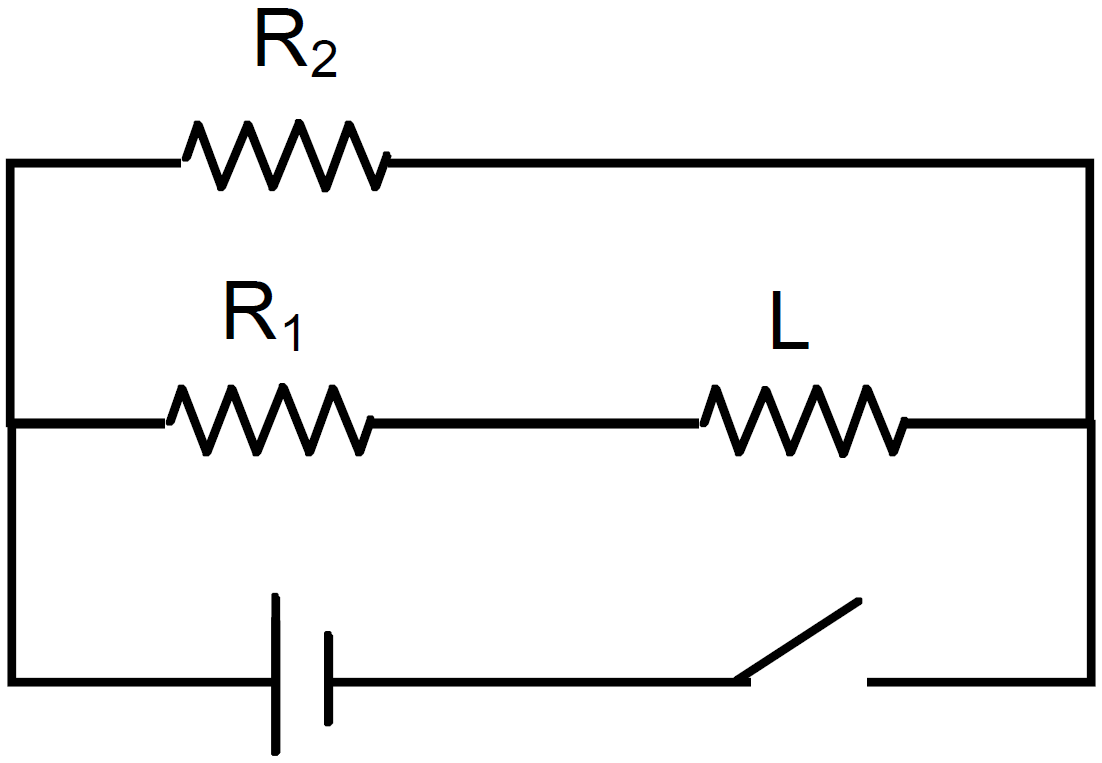
  1. When the switch is opened the resistors are in series.
The time constant is given by
$\tau=\frac{\text{L}}{\text{R}_\text{net}}=\frac{\text{L}}{\text{R}_1+\text{R}_2}.$
  1. The inductor will discharge through resistors $R_1$ and $R_2$.
The current through the inductor after one time constant is given by
$\text{t}=\tau$
$\therefore$ Current, $\text{i}=\text{i}_0\Big(\text{e}^{\frac{-\text{t}}{\tau}}\Big)$
Here,
$\text{i}_0=\frac{\in}{\text{R}_1+{\text{R}_2}}$
$\therefore \ \text{i}=\frac{\in}{\text{R}_1+{\text{R}_2}}\times\frac{1}{\text{e}}$

Need a full question paper?

Generate a complete, print-ready paper with questions like this in minutes — across 16+ boards, with answer keys.

Start Generating Free

Similar questions

Two identical masses, one at rest and the other moving, undergo elastic oblique collision. Prove that they will move at right angles to each other after collision.
The half-life of ${ }^{40} \mathrm{~K}$ is $1.30 \times 10^9 \mathrm{y}$. A sample of 1.00 g of pure KCl gives 160 counts/s. Calculate the relative abundance of ${ }^{40} \mathrm{~K}$ (fraction of ${ }^{40} \mathrm{~K}$ present) in natural potassium.
A wave propagates on a string in the positive x-direction at a velocity v. The shape of the string at t = to is given by $\text{g}(\text{x},\text{t}_0)=\text{A}\sin\big(\frac{\text{x}}{\text{a}}\big).$ Write the wave equation for a general time t.
A $5 ~ m$ long steel wire hanging from the ceiling of a room has a mass of 25 kg at a radius of 10 cm . The height of the ceiling is 5.21 m . When the body is made to oscillate, it passes through touching the floor. If $Y$ is $2 \times 10^{11} N / m ^2$ and the radius of the wire is 0.05 cm . If so, what will be the velocity of the body at its lowest point?
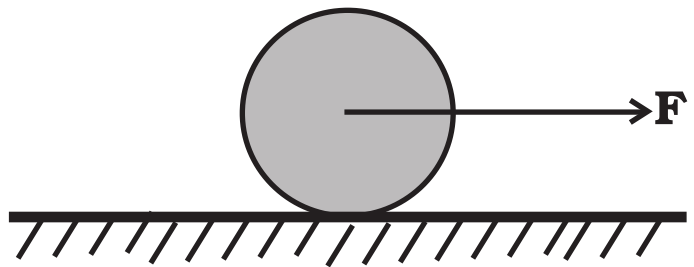
A uniform disc of radius R, is resting on a table on its rim.The coefficient of friction between disc and table is $\mu.$Now the disc is pulled with a force F as shown in the figure. What is the maximum value of F for which the disc rolls without slipping?
An object may be regarded to be at rest or in motion depending on the frame of reference chosen to view the object. Because of length contraction it would mean that the same rod may have two different lengths depending on the state of the observer. Is this true?
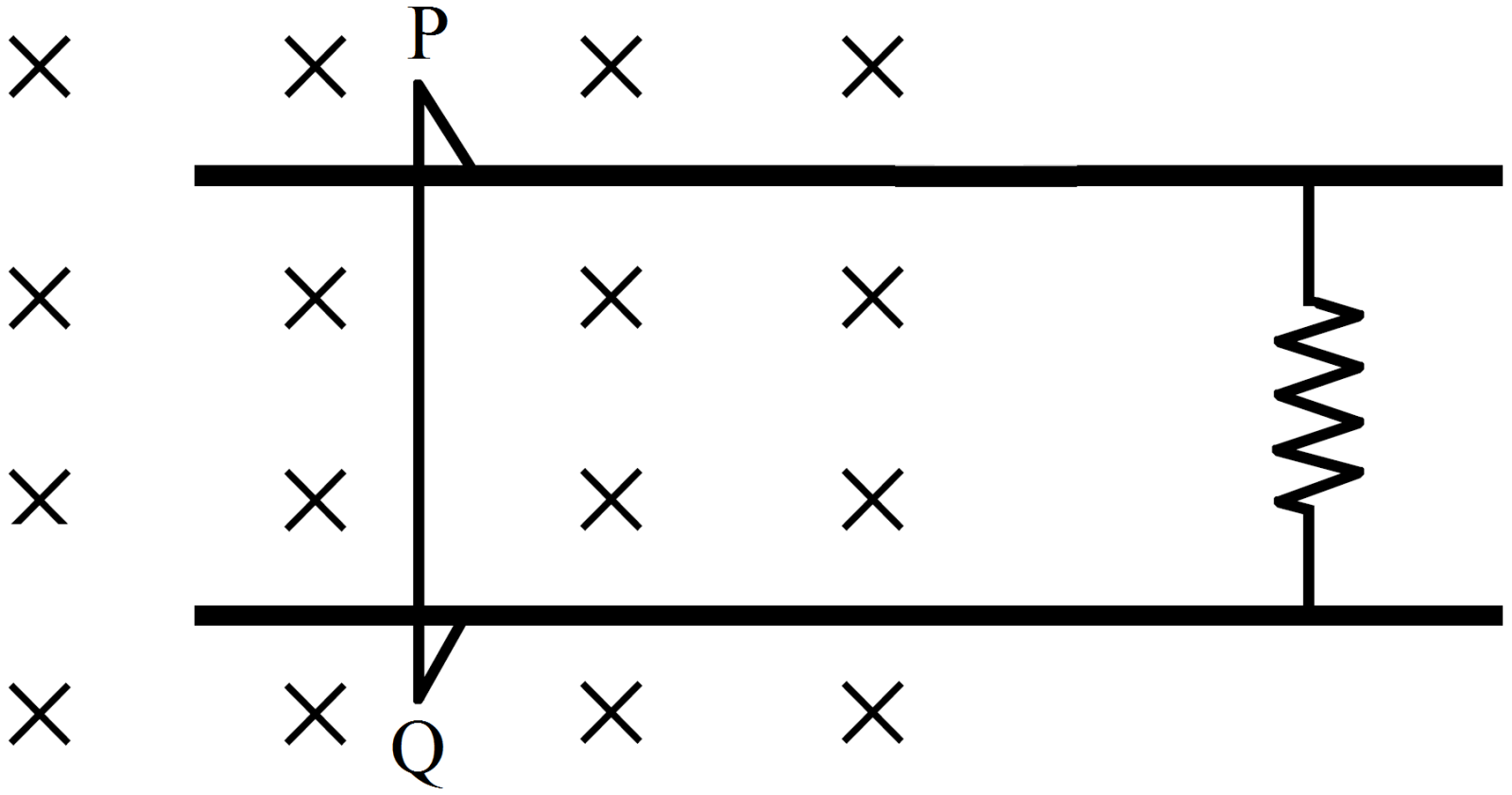
Consider the situation shown in figure. The wire PQ has mass m, resistance r and can slide on the smooth, horizontal parallel rails separated by a distance l. The resistance of the rails is negligible. A uniform magnetic field B exists in the rectangular region and a resistance R connects the rails outside the field region. At $t = 0$, the wire PQ is pushed towards right with a speed $v_0$. Find
  1. The current in the loop at an instant when the speed of the wire PQ is v.
  2. The acceleration of the wire at this instant.
  3. The velocity vas a functions of x.
  4. The maximum distance the wire will move.
An organ pipe of length L open at both ends is found to vibrate in its first harmonic when sounded with a tuning fork of 480Hz. What should be the length of a pipe closed at one end, so that it also vibrates in its first harmonic with the same tuning fork?
A constant force acting on a body of mass 3.0kg changes its speed from $2.0ms^{-1}$ to $3.5ms^{-1}$ in $25s$. The direction of the motion of the body remains unchanged. What is the magnitude and direction of the force?
A space ship is stationed on Mars. How much energy must be expended on the space ship to rocket it out of the solar system? Mass of the spaceship $=1000 \mathrm{~kg}$, mass of the $\mathrm{Sun}=2 \times 10^{30} \mathrm{~kg}$, radius of Mars $=3395 \mathrm{~km}$, Mass of the Mars $=6.4 \times 10^{23} \mathrm{~kg}$. Radius of the orbit of Mars $=2.28 \times 10^{11} \mathrm{~m} . \mathrm{G}=6.67 \times 10^{-11} \mathrm{Nm}^2 \mathrm{~kg}^{-2}$